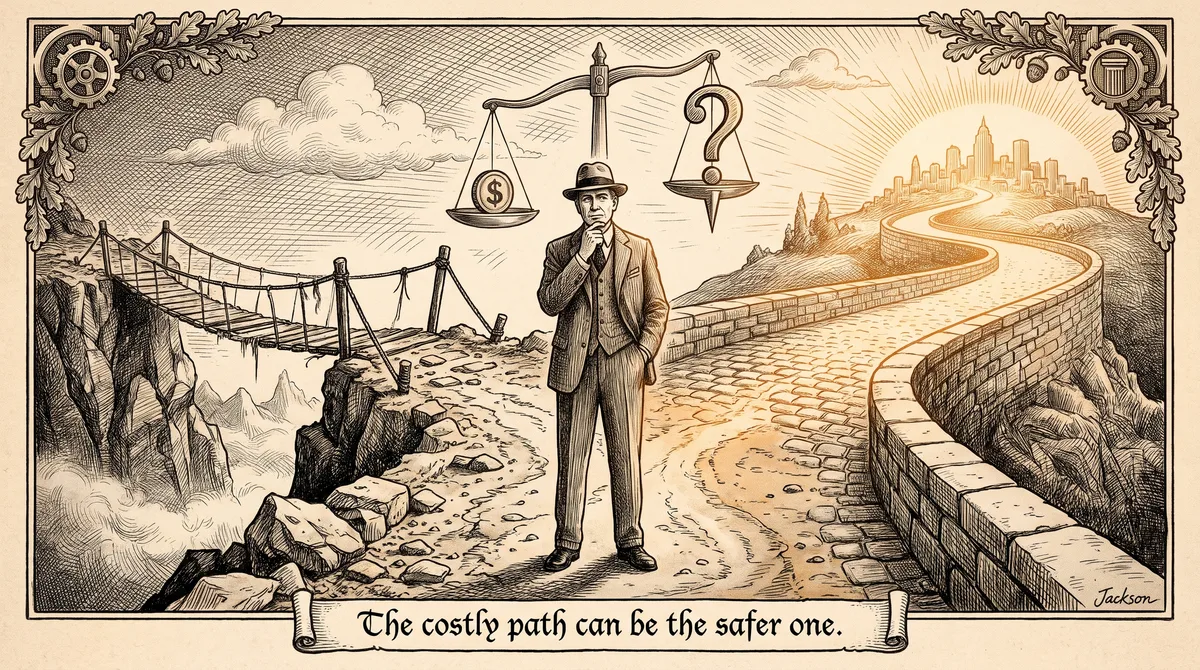
Here's something I've learned about price:
Expensive and risky aren't the same thing.
We often treat them like they are.
A $10,000 decision feels riskier than a $2,000 decision because there's more money involved.
But that's not necessarily true.
Imagine I offered you two choices.
One costs $2,000, and there's a pretty good chance it might work.
The other costs $10,000, and you're virtually certain it's going to produce a $100,000 outcome.
Which one feels riskier?
That's what I started to understand with our Money-Making Websites.
They were expensive compared to regular websites.
But I wasn't selling a website.
I was selling the outcome the website was designed to produce.
And because I knew the methodology worked, I could start removing the uncertainty around that outcome.
I could select the right people.
I could make sure they followed the process.
I could include everything necessary to give them the best chance of succeeding.
And I could put more of the risk on me.
Suddenly the higher-priced option could actually become the lower-risk decision.
That's an important distinction.
Your customers aren't necessarily trying to spend the least amount of money.
They're trying to avoid making a mistake.
Those are very different things.
Which means the opportunity isn't always to make your product cheaper.
It might be to make the decision safer.
More proof.
More clarity.
Better qualification.
A more complete solution.
A stronger guarantee.
Less uncertainty.
Claude Hopkins understood this more than a hundred years ago:
Ask someone to take a chance on you and you'll meet resistance.
Offer to take a chance on them and the way becomes much easier.
So maybe the question isn't:
“How do I make this less expensive?”
Maybe it's:
“How do I make this less risky?”