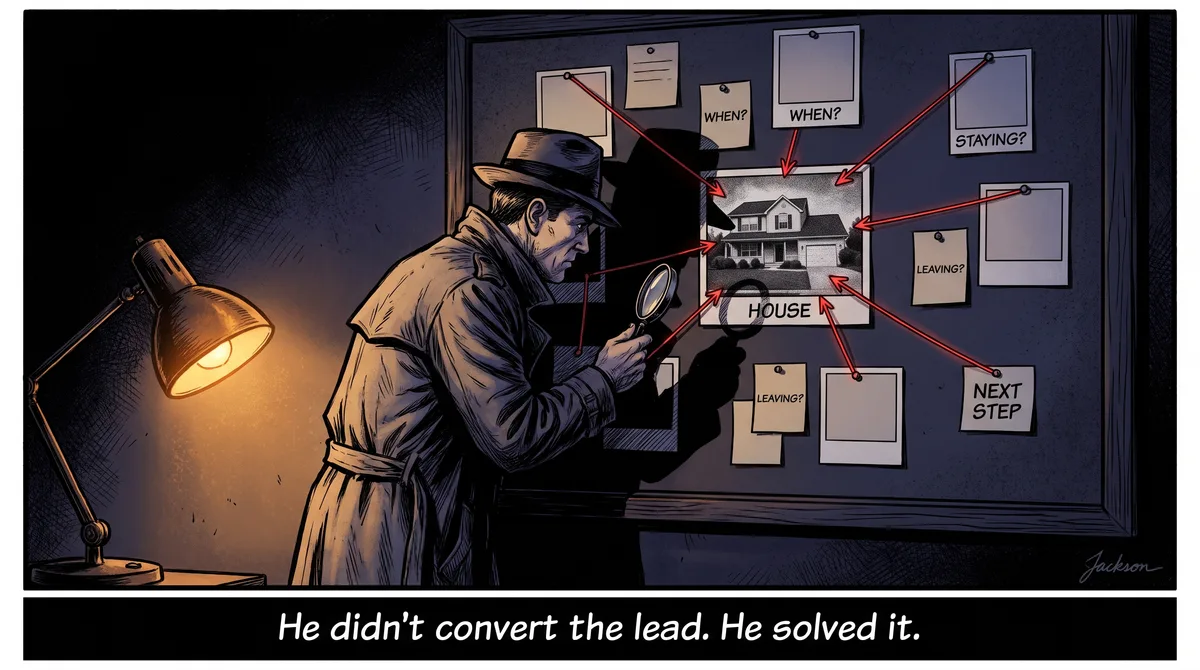
The best lead converters are detectives.
Not salespeople.
I was looking through Journal #6 from 1997 this morning, and I found pages where I was designing the follow-up system for people who responded to my book:
“How to Sell Your House for Top Dollar.”
The first thing I did was write down the facts.
Fact #1: They voluntarily asked for a guide about selling their house.
Nobody forced them.
They saw an ad, raised their hand, and gave me their information.
So we know something.
Then I started asking…what else can I know?
I have their name.
Their address.
Their phone number.
What can I discover from that?
Today, of course, the possibilities are almost unlimited.
You can look at the house.
See how long they’ve owned it.
Estimate what it’s worth.
Look at the sales history.
You can gather hundreds of data points before ever asking them a question.
The interesting question is:
What would I like to know that I can’t discover on my own?
Are they actually thinking about selling?
When?
Are they buying another house?
Are they staying locally?
Are they leaving the area?
Now we’re doing detective work.
Imagine one of those detective-show bulletin boards with the pictures and the red string connecting all the clues.
That’s pretty much how I think about every lead. :)
And once we understand what’s actually happening, we don’t have to “convert” them.
We can serve them.
Someone selling in the next six months needs a completely different conversation than someone who might sell three years from now.
That sounds obvious.
But most follow-up systems treat everybody exactly the same.
Same emails…same calls…same message.
Same urgency.
The breakthrough is realizing your job isn’t to convince every lead to buy.
It’s to discover who they are…
understand where they are…
and help them take the next natural step.
That’s what lead conversion really is.
Detective work.
Dean