The 1996 Marketing Idea That Changed My Life
Watch
Listen
If you help enough other people get what they want, you can get anything you want. That one idea took my marketing far beyond real estate.
Up until 1996 I was a practitioner. I used marketing to build my own real estate business, but I wasn't teaching it to anyone yet. Going through journal number one, I can see the moment that started to change.
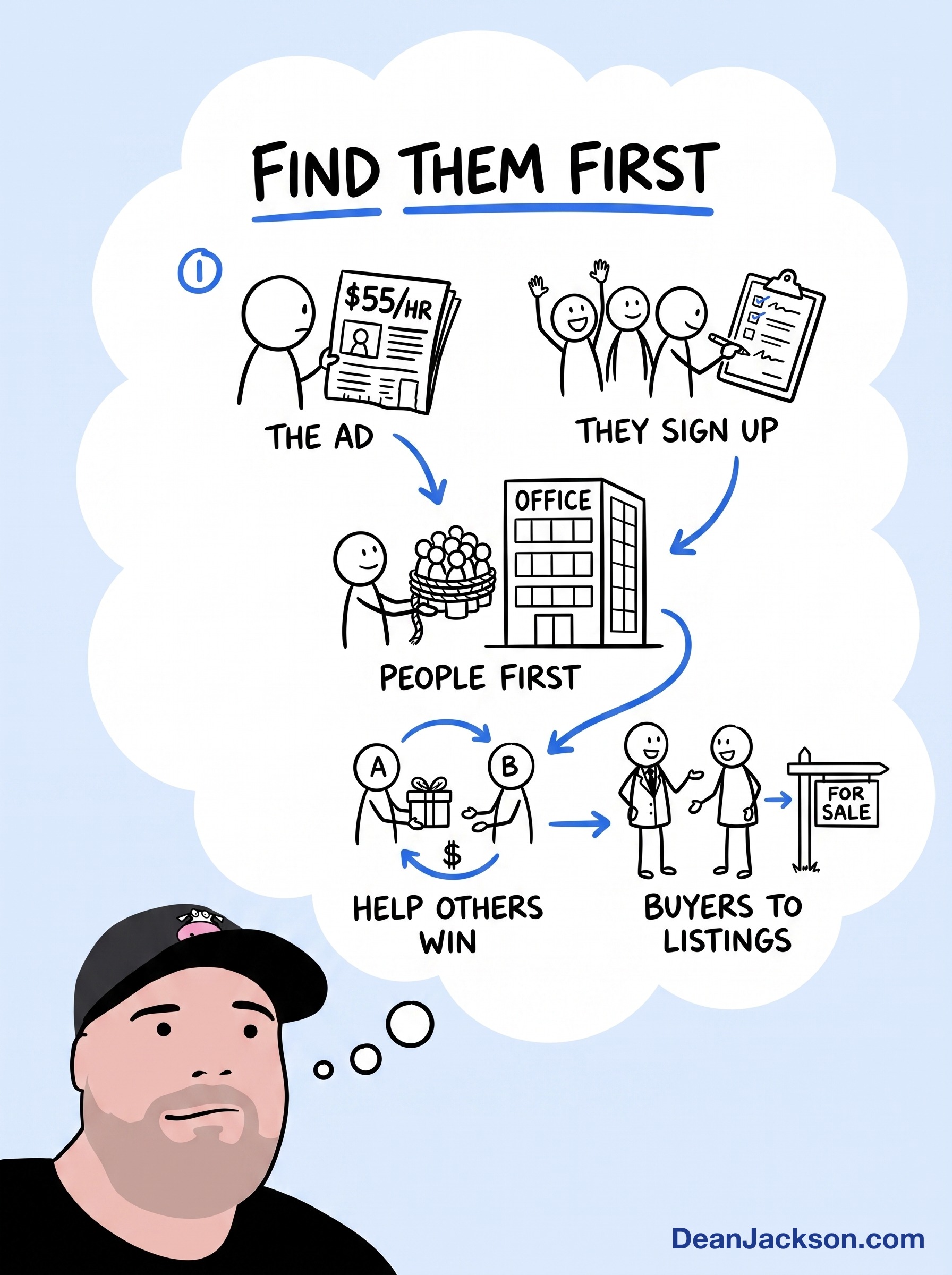
One of the first times I applied what I knew outside real estate was helping a friend in Ottawa who placed contract programmers. Instead of chasing companies for job openings, we ran an ad that gathered the programmers first, then walked into the telephony companies with the people already in hand.
That's the first principle I keep coming back to. If you help enough other people get what they want, you can get anything you want. It's why finding buyers first makes you valuable to any realtor who needs listings.
This same journal also holds the day I first walked into the Strategic Coach office and picked up Dan Sullivan's How the Best Get Better, before I'd ever met him. It's funny to see where these things start.
Join me live on the next free 50-Minute Profit Finder call, Friday, October 9 at 1:00pm ET. Save your spot →
Transcript
Auto-generated transcript, provided as supporting material. It may contain errors, and speaker labels are occasionally mis-attributed.
All right. Hey, welcome back. Dean Jackson. Episode 3 as I go through 30 years of journals.
It's been great to see all the comments and the reunions and everything that bringing people out of the woodwork here. Um so, I'm going to get in some of the insights that I've been recognizing as I'm going through these cuz a lot of these been a long time since I've looked at them and I can see the patterns that became um bigger things. You know, I I it's fun to look back at it realizing that I see now where everything went and it's fun to look and see the genesis of things. Like I was almost thinking about the very beginning of the before unit, the during unit, and the after unit as a thought.
That was something that I could see it forming in these journals because I'm really like a a big um first principles kind of thinker. I like to get a durable, always true, constant context for things. And what it really comes down to and it's been this way for as long as business has been around that it's been about getting leads, finding people who want to do what it is that you do, educating them about the process and why they should choose you, and then delivering an amazing result for people, and then keeping a relationship with them and growing it. So, the little graph that I showed uh last episode was kind of the foundation of that and it hasn't changed much, but I've added I added the words, you know, before, during, after, and then filled it all out with the eight profit activators, and I can't wait to see when that all that all came um along here.
But, the reality is that I up until 1996, I was doing all of this as a practitioner. I was doing I wasn't teaching this. I was using it to build my own real estate business, and I mentioned Michael Gerber's E-Myth being the foundation of that, that when I understood that I could approach my business as something that I was going to duplicate 5,000 times, that changed my whole mindset about it. It wasn't just me being a realtor and being constantly always doing the things.
I really started thinking, how could I completely remove myself? Now, I didn't mention it in this journal, but one of the books and the the people that I was really learning a lot from in that kind of 1994, 95, 96 phase is Tom Peters. And Tom Peters, you know, originally wrote an amazing book called In Search of Excellence, but in the mid-90s, he wrote a book called The Pursuit of Wow. And he was so right on with the things that he was thinking is approach and what he would advocate for people is to look at every element of your business, and what would it look like if you were trying to create that division of your business as a professional service firm.
That you're looking that how could you make the accounting division of your business or the lead generation, you know, the marketing part of your business so good that you could hire it out as a marketing as a professional service firm. And one of the exercises that he had on uh in the pursuit of wow was to make a list of every single thing that needs to be done in your business and then work on the idea of how can you get every one of those things done for you in a way that it can be done repeatedly and offer as part of a wow experience. I always loved that kind of uh that thought of the pursuit of wow. And that's why you know, I named everything.
On the real estate side, we would talk about creating a buyer wow process and a seller wow process. And uh that's what I did in my own business and that became the foundation for me to do this with Toronto and Beyond. It was essentially duplicating the system that I had created for my own business, creating it, duplicating it 40 towns, and that led to my relationship with Just Dump and I met Eben Pagan and we were able to, as I said, grow this uh from there. But up until this point, every single thing that I had done marketing-wise was really about real estate and the real estate business.
So, I'm looking and I'm reminded that on page 22 of this journal uh was the first time that I walked into the Strategic Coach offices in Toronto. I didn't know Dan Sullivan yet. I didn't even know about Strategic Coach. But I had a friend and who owned a talent search business in Ottawa, Canada.
And I realized you start to see when you start getting marketing skill, you start to see the world as 3D kind of you have these glasses that you see through a lens and I was starting to see immediately how things could fit towards other businesses. And one of the first things that I did was help Alan create some lead gen for for his business. And in Ottawa, this is still to this day one of my favorite um ads that we that we did. There the idea of the way that the the talent business worked was he was helping managed services for a for telephony businesses.
They would look for and hire um contracted programmers like Unix programmers and C++ programmers. And so the job was to find these people and hire them under contract and then essentially lease them to these big telephony companies. And one all the other all the telephony companies are looking to all the the job search companies are looking for companies to hire them get the listing sort of thing and have them go do a search and find the people. And it dawned on me that wouldn't be cool if we just found the people first, and then we'd have the people when we go in and talk to the the telephony things.
So, we created a little ad that looked like a newspaper article, and it was just a you know, two-column headline, two little columns of of text, and the headline was UNIX contractors commanding $55 per hour. And then we would just tell a little story about how because of the amazing growth of telephony that the UNIX contractors are in such demand that they are commanding $55 per hour. And then most of these programmers were in salaried positions in the early '90s making 30 or 40 thousand dollars a year. And so, for them to see $55 an hour, that's over a hundred thousand dollars a year.
It made it all of a sudden safe and attractive for them to consider the riskier thing of being a contractor. And so, we ran this we ran these ads and would get a list of people. com, and people would sign up, and then we could go to any of the telephony companies. Nortel was one of the big companies.
And already have a pool of exactly what they were looking for. So, it was such a competitive advantage to rather than saying, "Give us the opportunity, and then we'll go find the people." We already were able to say we found the people. Here they are.
Now, that same principle, you know, I talk about first principles, is it really comes down to if you help enough other people get what they want, you can get anything you want. So, how we use that same approach is that realtors want to get listings. And the way that they approach it is they look for people to give them a listing so they can run out and uh run ads and use it to find buyers. But if you think about a category, you know, we we look at like each of these suburbs in the Toronto and beyond system, if you find buyers who are looking for homes in any one of these suburbs, that's going to be a big advantage for any of these realtors looking to get listings because that is going to be 50% of the way to having the job done.
So, I think that's an amazing um outcome there. But I just amazed 1996 April 25th page 22 journal number one, my first opportunity to walk into the Strategic Coach office because I was meeting Alan Kearns for dinner. And I picked up a copy of Dan Sullivan's, it was brand new at the time, program called How the Best Get Better. And it was a little booklet and um cassette uh program that outlined his whole approach to the entrepreneurial time system and the strategy circle and all the kinds of things that um were the foundation of the Strategic Coach program.
So, it's amazing to see the genesis of of things. So, I've been looking through these and I've got all the I've got some insights that I'm going to do them in chunks like this one where the insights are going to be the the lead of this here to show you kind of what the what the principle is and how I've both developed it in 1996 and how we're still using it today. So, it's all very exciting. I'm excited that you're here.
By the way, we're on YouTube now. Going viral. We almost got 100 views on the second one. I laugh because we get thousands of views on on Facebook.
That's probably primarily where everybody is. So, if you're looking at it on Facebook, you want to watch it on the big screen, in color, in high definition, on your TV, go to YouTube at that Dean Jackson. You'll see these episodes and don't forget to subscribe and smash that like button, as they say. And I'll be here with more insights from over 30 years of journaling.
Get BreakthroughDNA Free
Discover the 8 Profit Activators that can transform your business. Get the complete framework, free.