The More Helpful You Become, The Less You Have to Sell
Watch
Listen
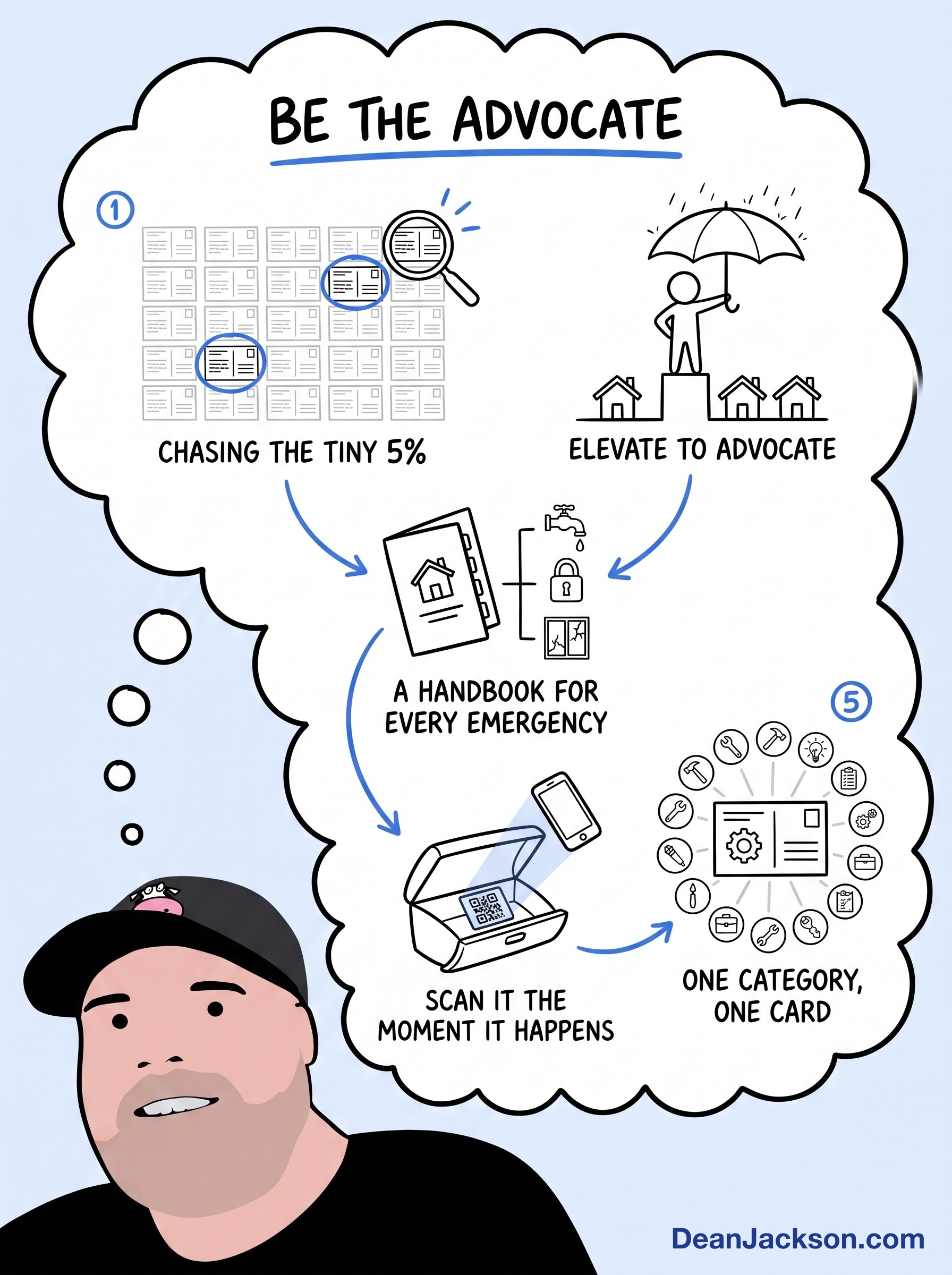
Page 170 of my 1996 journal, one idea I've never let go of: stop chasing the few people ready to buy, and appoint yourself advocate for your whole category.
Page 170 of journal number two. November of 1996.
I'd been deep in The One to One Future, and something clicked about the realtors.
They spend all their time and money hunting the tiny slice of people who'll actually buy or sell a house this year. Call it a 5% turnover. Mail a thousand postcards and only 50 of those people are even in the market over the next twelve months.
So 95% of the money is adding no value to the homeowner... and none to the realtor either.
But here's the thing. A homeowner does a hundred things that have nothing to do with buying or selling.
What if you elevated yourself, and became their advocate for all of it?
That was the first version. I called it Household Helpers. A little mailing that made you the person a homeowner knows and likes and trusts, long before they ever think about selling.
And the beautiful part is nobody appoints you to that job. It's self-appointment only. Nobody's standing in your way.
Nobody's going to stop you from being the advocate for homeowners... or lakefront owners... or drivers in your county.
So I made a household emergencies handbook. A little folded card with a directory of everything that can go wrong in a house. Broken window. Leaking roof. Clogged drain. Locked out. Bugs. A garage door that won't open.
Then an auto emergencies handbook for the glove box. Flat tire, dead battery, keys locked inside, who to call.
All the businesses that fix those things are mailing everybody too, just hoping to catch the one person who needs a garage door today. Just as wasteful.
Put yourself at the center of the category instead, and you're the one adding the value.
Do it today and it's even easier. A QR code in the glove box. The moment somebody's in an accident, they scan it and there you are, walking them through exactly what to do.
I've got a friend here who's a personal injury attorney. Most people spend their whole life hoping they never have to meet him.
So imagine building a coalition around lowering accidents, or distracted driving... a common cause everybody rallies to. Your name is on the good thing long before the bad thing ever happens.
You see these 9 by 12 postcards now, selling 16 spots willy-nilly to whoever wants one. The elegant version is a category card, where everything on it lines up around a single topic.
Because the moment you categorize something, it becomes more valuable.
This is one of those ideas that's stuck with me for 30 years and keeps evolving. And I've never had anyone really take it and run.
Maybe it's you.
Transcript
Auto-generated transcript, provided as supporting material. It may contain errors, and speaker labels are occasionally mis-attributed.
Do you ever have an idea that just won't leave you alone? I mean, I on page 170 of journal number two in November of 1996 was struck by this idea that was a culmination of all the thoughts that I'd been having about reading the onetoone future and learning what I learning about direct response marketing and having a focus 100% on real estate and realizing that realtors spent so much time and money and effort trying to find the super minority of the population that's going to buy or sell their house this year without really realizing the value in the relationship with a home owner over all of that time. There's so many things that a homeowner does that are not involving buying or selling a home that a realtor if they took a position of being an advocate for somebody could really build an amazing solid foundational business that would maybe be more profitable even than the real estate transactional business. So I was thinking about when you take contextually the things that rather than elevating or rather than just limiting your thinking to looking to help people buy and sell homes to get into this situation of helping people who are living their life as homeowners.
That's really what the the big thing is. When I started looking at the when I started looking at the um I mentioned the where the money goes, the seven things that everybody spends their money on. Those things aren't changing. We all spend money on our homes, our living, everything to do with home.
We spend money on food. We spend money on transportation, cars, insurance, gas, all of that stuff. We spend money on money. We spend money on our health.
We spend money on kids. And we spend money on ourselves. That's the seven veins that every budget in America goes. And you know, I coupling that with my love for looking at the models, right?
breaking down to the baseline model. Those things are universally true. They were true 30 years ago. They're true today when I was putting that lens of the onetoone future and elevating this opportunity of being an advocate for people.
How could you build that relationship? So my the first iteration of this was something I called household helpers and it was a little mailing. You know imagine one of the biggest expenses that realtors incur in trying to get listings is reaching out to them is sending mailings essentially looking for the super minority of the population that's actually going to sell their house. And let's say that it's a 5% turnover rate over overall.
That means if you mail a,000 postcards, there's only 50 people in the next 12 months that are even going to be there's a possibility for you to help them. If we break that down by quarter, there's less than 3% or 2% of the people who are in the market right now for that. And it seems like it's such a waste that 95% of the money that they're spending to reach these people is adding no value to the homeowner and it's not adding any value to the realtor. So, I started thinking, what would it look like if we could along with mailing information in case somebody's thinking about selling their house that we could at least be an advocate, elevate yourself to the position of being an advocate so that everything is going right with your home in your role as home owners and they get to know you and like you and trust you and have a good experience in their relationship with you so that when they do get to the point that they're going to sell their house, they're going to look favorably on that.
And all along the way, you could turn this mailing into a profit center. Now, I've used this playbook in many different ways. If you in whatever business you're in, if you just look at who else is trying to reach this person in this category and I you know I started looking um one of the things that we did with the realtors and it's going to come up here in a future journal is we started creating for realtor with their top 150 the people who know them, like them and trust them that we started sending what we calling giftgiver postcards. And I'll I'll explain that whole thing, but just the thought process is raising yourself to be an advocate for the category because nobody is ever going to appoint you to that position.
It's selfappointment only and nobody's standing in your way. Nobody is going to stop you from being an advocate for homeowners of oceanfront homes or oceanfront condos or lakefront homes or whatever it is, what is going to be valuable to them. And uh you know when you take that in the other categories, you think about the um you think about what the same type of thing for um the auto for cars. I had a conversation.
I have a friend here who's a a um personal injury and motor vehicle accident uh attorney. And you know, the thing that struck me about that business is that most people are going their whole life hoping they never have to meet him. If you're if you have to meet my friend as a personal injury attorney, there's something that went wrong in your life. And very few people actually ever have to need his services.
But when they need them, they need them right away. And I think if you take this category of being an advocate for drivers, automobile owners in Poke County, Florida, and elevate to get something where you're adding value. I presented this idea of creating a coalition of people with the express intention of lowering accidents or distracted driving or create a common uh enemy that everybody can uh rally around and then your name is associated with that good thing so that when the bad thing happens you already know you've already built up a bank of of adding value. So I started playing around with these, you know, you start thinking about what would people keep by their telephone or keep in their drawer.
Remember there was no internet. There's no like just Google it or say to Siri, "Hey, get me something." So, the idea, I created this household emergencies handbook that was a little folded postcard that just had a directory of all the things that could uh that could go wrong with your with your house that let's say you got a broken window or a leaking roof or a clogged drain or you're locked out or you've got appliance trouble or an electrical problem, your heat and air conditioning, your TV's is broken. You got bugs or pests.
Your garage door opener won't work. There's so many things that could be happening to a homeowner at any given time. And all these people who run businesses that help people in this situation, they're all thinking, how can we get people who need u a their garage door fixed? And it's just as inefficient for them to mail to everybody just on the thing of hoping that somebody needs a a garage door.
And the same thing we did a version called the auto emergencies handbook. And imagine if you could get in the glove box of everybody who owns a car in Pulk County and there's a directory of exactly what to do. Now, you could do it with QR codes. You know, imagine if the moment somebody is in an accident, they remember they've got this emergency handbook in their glove compartment.
They can turn it on, scan the QR code, and there you are giving them a consultation on what to do and what not to do in that situation. or who to call or what to do if you got a flat tire or you're locked out or your brakes are bad or your muffler or you need your car detailed or you're out of gas or the car won't start, you need an oil change, all of those things. Think about your category and start organizing all the other people around it, but appoint yourself to the position of the advocate for that category. And there's limitless opportunities here.
We've got the boredom emergencies. What would you give? There's nothing to do. Mom, you got all of these things you could advertise.
It would be great for a bowling alley or a comedy club or anything. You know, the let's do something different uh tonight handbook or let's eat out tonight uh handbook. you start thinking about when you categorize something, it becomes more valuable. I see this now.
There's a real trend towards people doing these 9 by12 postcards. I don't know whether you've seen these where they'll mail out a postcard and they'll just sell willy-nilly 16 spots to whoever wants to advertise them. I think an elevated elegant solution to that is doing these category cards where everything is around one specific topic. So, I got more to say about this because this is one of those ideas that's just stuck with me and continues to evolve and I've haven't had anybody really take this and run with it.
Maybe it's you.
Get BreakthroughDNA Free
Discover the 8 Profit Activators that can transform your business. Get the complete framework, free.