You Can't Want What You Want Until You Know What You Want
Watch
Listen
Yesterday, it's okay to want what you want. Today, how you work out what that is: Dan Sullivan's 25-year question, and a property improvement plan for life.
Good morning.
Yesterday I said it's okay to want what you want.
Today is the harder half. Actually knowing what that is.
Because after I made yesterday's video I sat down for a couple of hours and wrote the whole thing out. Every vision. Crystal clear.
And there's something almost magical about writing it down. Your mind gets to hear you say, I want this.
Dan Sullivan has a book called Wanting What You Want.
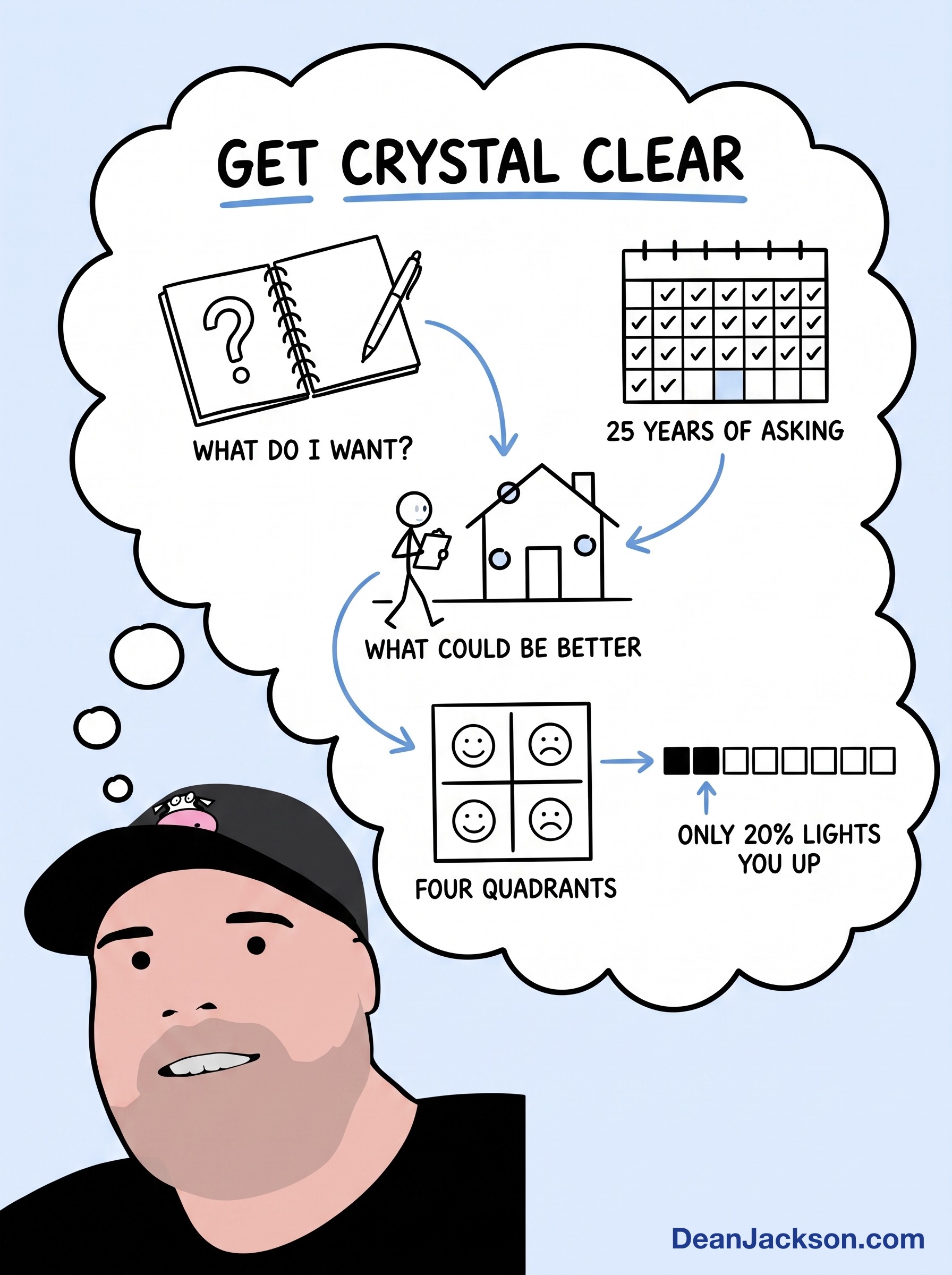
Every day for 25 years he opened his journal and wrote the same question. What do I want?
He missed about 12 days in the whole 25 years.
He started because he noticed the situations he'd landed in were the ones where he'd never been crystal clear on what he wanted in the first place.
So that's where I'd start you. Open the page and ask, what do I want?
And don't limit yourself.
Now, going back through my own journals, the same few flavors of that question keep showing up.
First one is my favorite. What do I want my days to look like?
I write them as vignettes. Painting the picture of the day. The environment, the pace, the way things flow.
And you really can't go wrong attaching your variety to the things that are stable.
Because the rhythm of existence is a constant. There's always going to be a morning. There's always going to be sleep.
That structure isn't going anywhere in the next 30 years, so hang everything you want on it.
Second one is your environment.
When somebody buys an apartment complex or a commercial property, they walk the whole thing with a clipboard and write a property improvement plan. Every single thing that could be better.
Do that with your life.
I keep a page in my journal called better ideas. Anything I notice that could be improved goes on it.
That's where the garbage can by the door of my car came from. Tiny thing. But now it's easy to grab it and empty it, and a problem I hadn't even named just stopped existing.
Walk around with that eye. What would make this better? What would solve this?
Third one is pure fun. The wish list.
The Christmas list. The supermarket spree where you fill the cart with anything you want.
You get a little dopamine hit just imagining having them. That's fine. Write them down anyway.
Then there's the quadrant. If you only do one of these, do this one.
Draw a cross on the page.
Personal satisfactions. The things that genuinely make you happy.
Personal dissatisfactions. The things you don't want in your life, and how to spot them while they're happening.
Professional satisfactions. The work you're happiest doing.
Professional dissatisfactions. The work you'd be glad to never do again.
That lines up almost exactly with Dan's idea of your unique ability.
I'm rereading a Tom Peters book right now, and he cites a survey where executives did a version of this.
They listed the activities that light them up. Then the ones they can take or leave. Then the ones that drive them crazy.
I call them the verbs. All the things you actually do with your time.
Here's what the survey found.
20% was high value work that made them feel great.
60% was mundane. Take it or leave it.
20% was driving them crazy.
That list becomes your working document. Now you know exactly what to drive out.
And this is the beautiful part of being an entrepreneur. You have the power to design whatever you want.
It's okay to want what you want. But you can't want what you want until you know what you want.
Which starts with a pen, some paper, some time, and some thoughtful directed thinking.
By the way, while I was sitting here reading this page back, a bird pooped on my journal. So that's how the morning is going.
One more thing.
Every idea I've ever had, and every dollar I've made in 30 years, went through my brain and my pen and onto a journal page before it ever went out into the real world.
So I'm running the 50-Minute Profit Finder for the first time. Free, live on Zoom, and I'll take you through the exercise myself.
Bring a pen and something to write on. We'll go looking for the lowest hanging fruit in your business, and probably some fruit you didn't know was there.
And here's your nudge for today.
Open a page and write, what do I want?
Then keep going until you can see it.
Transcript
Auto-generated transcript, provided as supporting material. It may contain errors, and speaker labels are occasionally mis-attributed.
Good morning. Okay, yesterday I talked about that it's okay to want what you want. And I realized in going through these journals that I spend a lot of time figuring out what I want. And I'm going to share some of the ideas of how to go about that.
After I did uh yesterday's video, I spent a couple hours just writing all this what I want everything crystal clear on what the the visions of of what I want to do. And uh I realized the importance of it. There's something magical about writing down and having your mind to say, "I want this." Dan Sullivan has a great book called Wanting What You Want.
And it's a uh you know, an amazing thing so important that Dan would uh did for 25 years, every day in his journal, he wrote, "What do I want?" and he, you know, got himself to do it uh every day because he realized that some of the situations that he had gotten in were because he didn't, he wasn't crystal clear on what he wanted. So, he decided, I'm going to for every day for 25 years and I think he said he missed like 12 days over the whole 25 years of of doing it. And I would encourage you, that's a good place to start is just start in your journal and say, "What do I want?"
Now, um there's some categories of this as I'm looking through the journals of repetitive things that I would do. I always I love this idea of what do I want for my days? What do I want my days to look like? And I've mentioned using creating these vignettes of like just painting a picture of your uh of your day of the environment of how you want things to flow.
And I was amazed you know there's no you can't go wrong by attaching your variety to the things that are stable. like I you know I don't know it just seems so simple and maybe I don't know whether it's just me the way I look at it but this fact that the rhythm of existence the rhythm of life is always going to be a constant. So we're always going to have the we're always going to sleep. We're always going to have the mornings.
We're always going to have all of those things. So being able to attach to those the things that you uh that you want, I think that's an amazing um exercise. So I would just constantly start with that. What do I want?
And not limit yourself. Then another great way of looking at things is looking in your environment. I love this idea of um I've found out, you know, when people buy investment properties or they'll buy an apartment complex or commercial property, they'll go around with a clipboard and they'll make a list, a property improvement plan where they get all the possible things. And for me, I think today I'm going to do this is I would go through and look at my environment and say, what do I want?
And I'm all you're always looking for things that what would make this better or what would solve this problem. I think I mentioned, you know, uh I was looking one of the questions that I always ask uh that I would have a page called better ideas that would just [cough] get my [clears throat] thinking of things that I've noticed would be an improvement. And out of that came things like my um garbage um can right by the door of my car so that it's super easy to just grab this and put it in the the garbage. Solving the problems that not having those solutions creates and looking at your environment with that eye for what could be better here.
I think that is a really valuable exercise for you. A really valuable exercise of um you know just constant awareness of your environment and the ways that you could improve. I think I would make a list of things. Make like a my Christmas wish list or the things that I want if I just could go on a you know supermarket spree and get just fill my cart with anything that I wanted is that's one of the flavors of what do I want?
And it's fun to do these kind of uh exercises because in your mind you sort of get a little bit of dopamine hits by just imagining the moment of getting those things or how you would feel if you had those uh those things. And so I'm going to encourage you that you know in your journal looking for those opportunities. I saw I came across a quadrant. I'm just sitting here and a a bird pooped on my uh page on my journal there.
But uh I was looking and I would create these quadrants and on one side in the quadrants I would have personal satisfactions, things that you're happy with personally, things that uh that really make you happy on a personal basis. And then in the lower quadrant, what makes you unhappy? What are the things that you don't want in your personal life? Just getting like how to recognize when they're happening.
And then on the other side, the professional satisfactions. What are the things in business or in work that you're super happy with? And what are the things that you are completely unsatisfied with? And I found that that completely jives with uh Dan Sullivan's idea of your unique ability, right?
Of the things that those are the things that are probably going to bring you the most joy that you feel most fulfilled in. And um one a book I'm reading a a Tom Peters book I'm rereading and he referenced a survey of executives and they just asked them to list the activities that they do that light them up. The things that they do that are the most exciting, most rewarding, the things where they feel the best about what they're doing. and then list the things that are they're just okay like they're I'm I could take it or leave it.
I don't mind it. I can tolerate it kind of thing. And then what are the activities that are that drive you crazy that you don't care whether you'd ever do them again. And that's a really good way if you just make a list of all of the activities, all the I call them verbs, all the things that you do in your time and in your day.
What are the things that that light you up? What are the things that that really drive you crazy? And then that becomes your working list to drive out the things that you don't like or don't like to do. And by the way, the executives, there was only 20% of the things they were doing that were actually high value and made them feel good.
60% of the things were just, you know, mundane or could take it or leave it. And 20% of the things were uh were d driving them crazy. And that's a um as an entrepreneur, the great thing is that we have the power to design whatever you want. It's okay to want what you want, but in order to want what you want, you need to know what you want.
And that starts with taking your pen, taking some paper, taking some time, and going through some thoughtful directed thinking to process it all. and then work towards improving or adding all of those things for you. I got a funny email the other day from Rick. It says, "Dean, question.
Are you saying you can teach me to make fat stacks by hanging out at a pub drinking coffee like you?" And I laughed to myself because I was thinking, you know, yes, I I can do that. That's what I do. is the funny thing.
What I really realized is that every idea that I've had, every dollar that I've made over the last 30 years has gone through my brain, through my pen onto a piece of paper in my journal before it went out into the real world. And if I can turn people on to that activity as a driver for what to do, what to think about, what to ask yourself to draw out, what the next most valuable action is for you, and how to find the most profitable things that you can install in your business. I'm all for it. m.
I'm going to do for the first time a 50inute profitfinder workshop and you're going to join me live on Zoom and we're going to go through a 50inute exercise. Bring your pen. Bring a notebook or piece of paper. And I'm going to guide you through a thinking process that will help you identify where the lowest hanging fruit is in your business and maybe some fruit that you didn't even know was there.
But I'm going to show you where to look for it. So, it's free. It's for you. m.
this Friday. Just watch. Go to What did we call the website, Josh? >> 50inut profitfinder.
m.
Get BreakthroughDNA Free
Discover the 8 Profit Activators that can transform your business. Get the complete framework, free.