Creativity Isn't a Gift. It's a Formula.
Watch
Listen
Still on journal four, 1997: why Max Martin's hit-song chassis and the 8 Profit Activators are the same trick, and the formula sitting underneath both.
Good morning.
I can't stop thinking about yesterday's page.
We found the genesis of the 8 Profit Activators, sketched around a pool in 1997... and I've been sitting with it ever since.
Because what I actually walked away with that afternoon wasn't a marketing framework.
It was a lens.
Everything I do with a business, thirty years later, still gets run through it. I can look at somebody's business, spot where the big opportunity is, and immediately have thirty years of ideas ready to combine with it.
That's been my magic. My winning formula.
And having your own frame of reference is the whole thing. Not borrowing somebody else's. Having one of your own that everything passes through.
Now here's where my head went next.
Max Martin.
He lives in Sweden. The list of people who've written the most number one songs on the Billboard charts goes Paul McCartney, then Max Martin, then John Lennon.
His first top ten was 1997. Same year as this journal page.
Backstreet Boys. Britney. NSYNC. Pink. Katy Perry.
And if you listen closely, they're all the same song.
Not the melody. The chassis.
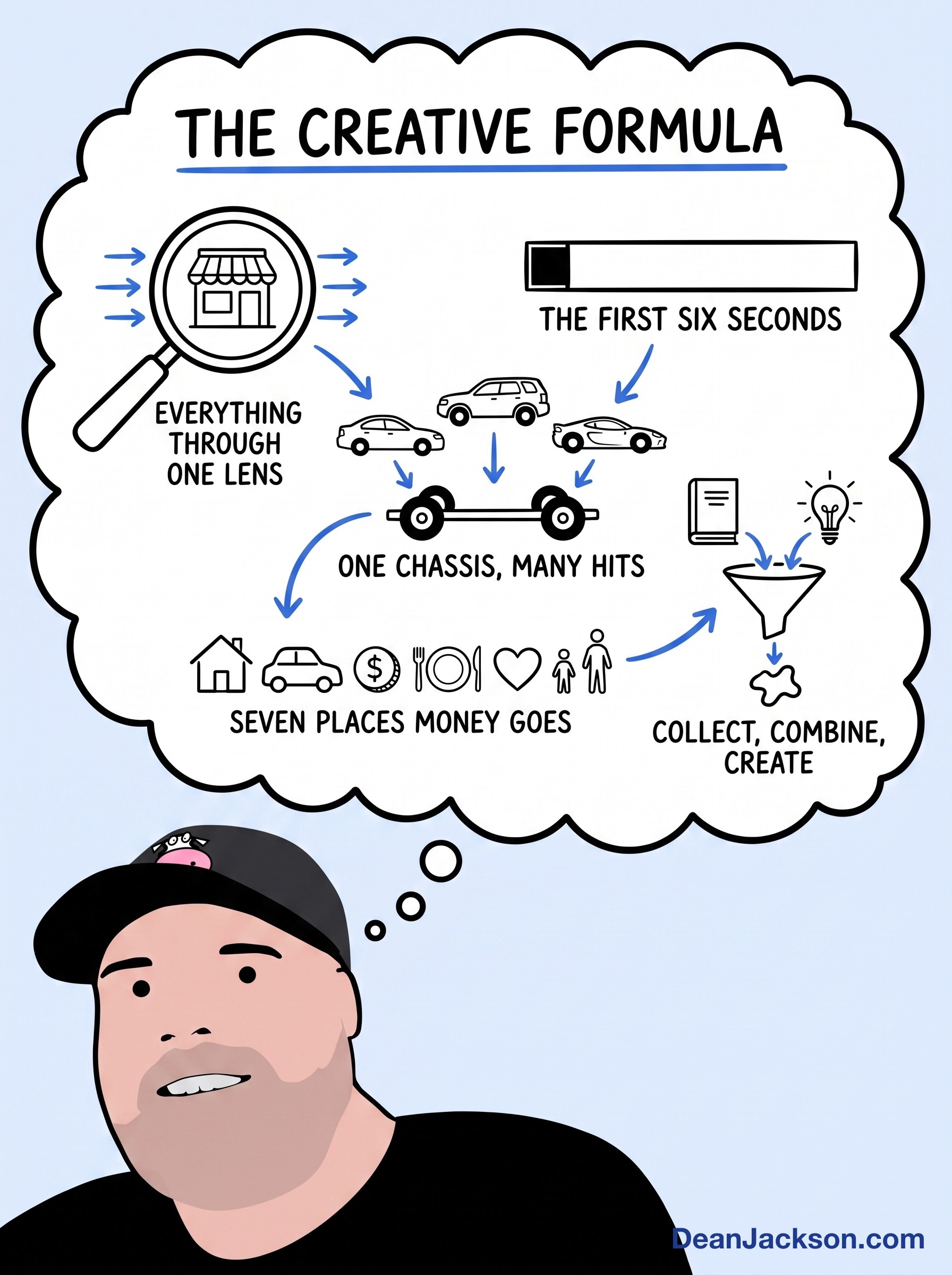
The first six seconds is a distinct sound. I call it the ooh, turn it up moment... the thing that makes a teenager lunge for the dial the second it comes on.
Then the first verse. Singsongy, one octave, so easy you're singing along before you know the words.
And inside 35 seconds you're into the chest voice, anthemic chorus.
Every single time.
He didn't write hit after hit because he's a creative person who gets visited by the muse. He worked out a chassis, and then he built on it.
Which is exactly what I'd done with a business.
Take the seven categories where people actually spend money. Their home, their auto, their money, their food, their health, their kids, and them.
That's durable. That's not changing.
Wayfair figured out a chassis too. One hyper-focused ecom brand per thing. All bar stools. Grandfather clocks. Ottomans. Speaker racks.
Same chassis. Different body on top of it.
So... is there a formula for having ideas?
I think there is, and my friend Chad Jenkins has the cleanest version of it. He calls it IC3. Three C's.
Collect. Go read, watch, pay attention, expose yourself to things. Take input in on purpose.
Combine. Run what you collected through the framework you already have. Your lens.
Create. That's the part everybody thinks is the whole thing.
But it's the third step. It's never the first one.
There's no mystery to being creative. It isn't that some people are creative and you're not.
Collect, combine, create. Do the steps and the ideas turn up.
And honestly, that's all I'm doing here. I've got 160 of these journals and we're only on number four. Everything that came after is thirty years of running things through the same filter.
I got a funny email from Rick the other day. Dean, question. Are you saying you can teach me to make fat stacks by hanging out at a pub drinking coffee like you?
And I laughed to myself, because... yes. That's exactly what I do.
Every idea I've ever had, and every dollar I've made in thirty years, went through my brain and my pen and onto a journal page before it ever went out into the real world.
So I'm running the 50-Minute Profit Finder. Free, live on Zoom, and I'll walk you through the exercise myself.
Bring a pen and something to write on. We'll go looking for the lowest hanging fruit in your business, and probably some fruit you didn't know was there.
And here's your nudge for today.
Open a page and write down your chassis. The handful of things you run every new idea through.
If you can't name it yet... that's the most valuable thing you could work out this week.
Transcript
Auto-generated transcript, provided as supporting material. It may contain errors, and speaker labels are occasionally mis-attributed.
Good morning. I can't stop thinking. I just can't stop it. Since yesterday when we discovered the beginnings of what became the eight profit activators, I've really been recognizing the impact and the value of having your own frame of reference, your own model for thinking about it.
I think in a very early video I mentioned that idea of taking in information and forming your models and combining them with all the things that you are or using it as a filter to put all of the ideas that you have. And I was reminded how literally everything that I do to this day businesswise is filtered through this lens of what's now the eight profit activator. So, I'm quickly able to look at a business, diagnose what the big opportunity is, and then immediately have this bank of experience and ideas that I can apply to combine with that business model. And it's been my magic, my winning formula.
And I started realizing that anything like these amazing um similarities in some different uh things that we've seen over the last 30 years. Like when when you really think about where we are here in 1997, uh you know, there's a lot of things that haven't happened yet. The internet is literally just getting started. And I'm I'm fascinated by once you figure out a chassis and execute on it, what's possible in an amazing amount of time.
Uh I think in the very first video that I did, I talked about Max Martin. And Max Martin is a gentleman who lives in Sweden. And on the list of people who've written the most number one songs on the Billboard charts, that list goes Paul McCartney, Max Martin, John Lennon, and Max had his first top 10 Billboard hit in 1997. If you remember that whole thing, it's amazing.
You know what can happen? [laughter] If you think about what Max figured out in that time frame was he figured out a chassis for making hit songs. And it's amazing to hear him describe it because all of the songs that Max Martin creates follow this framework or formula that he has and he's applied it to all the different artists that he's worked with and had the most prolific songwriting and production catalog ever. All the way from uh Backstreet Boys was the one of the first uh number ones that he had.
Britney Spears, In Sync, Pink, Katy Perry, all of those. And if you listen closely to Max Martin's songs, they follow a very simple formula. first six seconds is really all about the um there's a unique distinct sound that you can I call it the ooh ooh turn it up uh moment that you can imagine these teenage girls waiting for their favorite song to come on the radio and the first six seconds comes and they're oh oh turn it up and then the first verse is all a singongy very easy to follow along with in one octave verse that sounds like you're singing, very easy to sing along with. And then within 35 seconds, it gets to this chest voice anthemic chorus.
And that chassis is so reliable that he's played that or or applied that to so many songs. And if you go down that rabbit hole, it's amazing to see. And so I look at this same thing is, you know, if I'm applying the same chassis to any business, it's uh we're I've created a chassis to create hit songs or to create hit business uh ideas. If I take this same thing, I've been talking a lot about the uh seven categories where people spend money.
if their home, their auto, their money, their food, their health, their kids and them. That's really a durable kind of idea of this is where all the all the money happens. com where what Wayfair had was they figured out a formula and a chassis to make individual super uh super focused ecom brands that sold a very specific thing. All bar stools or grandfather clocks or ottomans or speaker racks.
com. And so I think that what I've discovered as going through these journals is the formula for creating your own ideas as as close as it comes. There's there's a couple of different um approaches to this. My friend Chad Jenkins talks he's got a formula he calls IC3 which is three C's where you're a whole idea is to collect information collect input go read books watch things pay attention watch what's happening in culture watch in expose yourself to new ideas that's the first collect then combine them with the things that you already know or run them through your framework.
That's the most durable. If you've got a reliable set of heruristics that you can run your ideas through, you run them through that filter. And then the third C is create. So you're collecting, you're combining, and you're creating.
There's no mystery to how to be creative. It's not that you are a creative person. There's a creative formula and if you do the steps, if you focus your thinking in a way of running it through even that is a mental model, collect, combine, create and I'm just seeing in retroactively all of the things from the genesis of this and we're going to see as I go through the rest of these journals. We're only in journal number four.
It's early 1997 here. I got 160 of these journals and I know some of the things that are coming cuz I was there. I I know what we've been able to do. But it's the the most uh the funniest thing is trying to take today's perspective and interpret it through what I was uh going through here.
But I'm having some insights for myself in going through this process and I hope that you are too. I got a funny email the other day from Rick. It says, "Dean, question. Are you saying you can teach me to make fat stacks by hanging out at a pub drinking coffee like you?"
And I laughed to myself because I was thinking, you know, yes, I I can do that. That's what I do. is the funny thing. What I really realized is that every idea that I've had, every dollar that I've made over the last 30 years has gone through my brain, through my pen onto a piece of paper in my journal before it went out into the real world.
And if I can turn people on to that activity as a driver for what to do, what to think about, what to ask yourself to draw out, what the next most valuable action is for you, and how to find the most profitable things that you can install in your business. I'm all for it. m. I'm going to do for the first time a 50inute profitfinder workshop and you're going to join me live on Zoom and we're going to go through a 50inute exercise.
Bring your pen. Bring a notebook or piece of paper. And I'm going to guide you through a thinking process that will help you identify where the lowest hanging fruit is in your business and maybe some fruit that you didn't even know was there. But I'm going to show you where to look for it.
So, it's free. It's for you. m. this Friday.
Just watch. Go to What did we call the website, Josh? >> 50inut profitfinder. m.
Get BreakthroughDNA Free
Discover the 8 Profit Activators that can transform your business. Get the complete framework, free.