How To Stop Your Best Ideas From Dying in Your Notebooks
Watch
Listen
Woody Allen's drawer of yellow pads, Dan Sullivan's book a quarter, and why no idea in your journal comes to life until it gets out into the real world.
Good morning.
Quick question before anything else.
How many of the things running your business today started as an idea you had years ago?
I bet it's more than you think.
Now the other side of it.
How many ideas are still rolling around in your head that never made it out into the world?
That one's probably more than you think too.
This is my 50th daily video. Journal number four, 1997.
Going back through these has taught me a few things. I want to give you four of them today.
First one. Focus.
What made that stretch of my life so prolific is that I was specializing in one thing.
Real estate agents. Every waking thought pointed at that one market.
I started by applying everything I was learning to my own business... then packaging it so other people could use it too.
I've been genuinely shocked at how much of what I still use today had its genesis thirty years ago.
Second. Compounding.
It started with a guide to Halton Hills for my own business.
That turned into licensing the system to 40 agents in 40 different areas around Toronto.
That led to Joe Stumpf, and the two of us taking the whole thing to North America.
None of that was luck. It compounded because I was building it with the end in mind.
That's Michael Gerber's idea from the E-Myth. Think about your business as a machine you're going to duplicate 5,000 times.
Build it that way from the start and everything you make stacks on top of everything you already made.
Third. Time moves at the speed of reality.
Your mind can see the whole finished thing in an instant. There are no rails on it.
But the building of it still happens in real time, one day at a time.
That gap is where most ideas quietly die.
Fourth, and this is the one I'd underline.
Nothing is happening in your journal.
No idea comes to life sitting on the page. It has to make it out into the real world.
Woody Allen made a movie a year for 45 years.
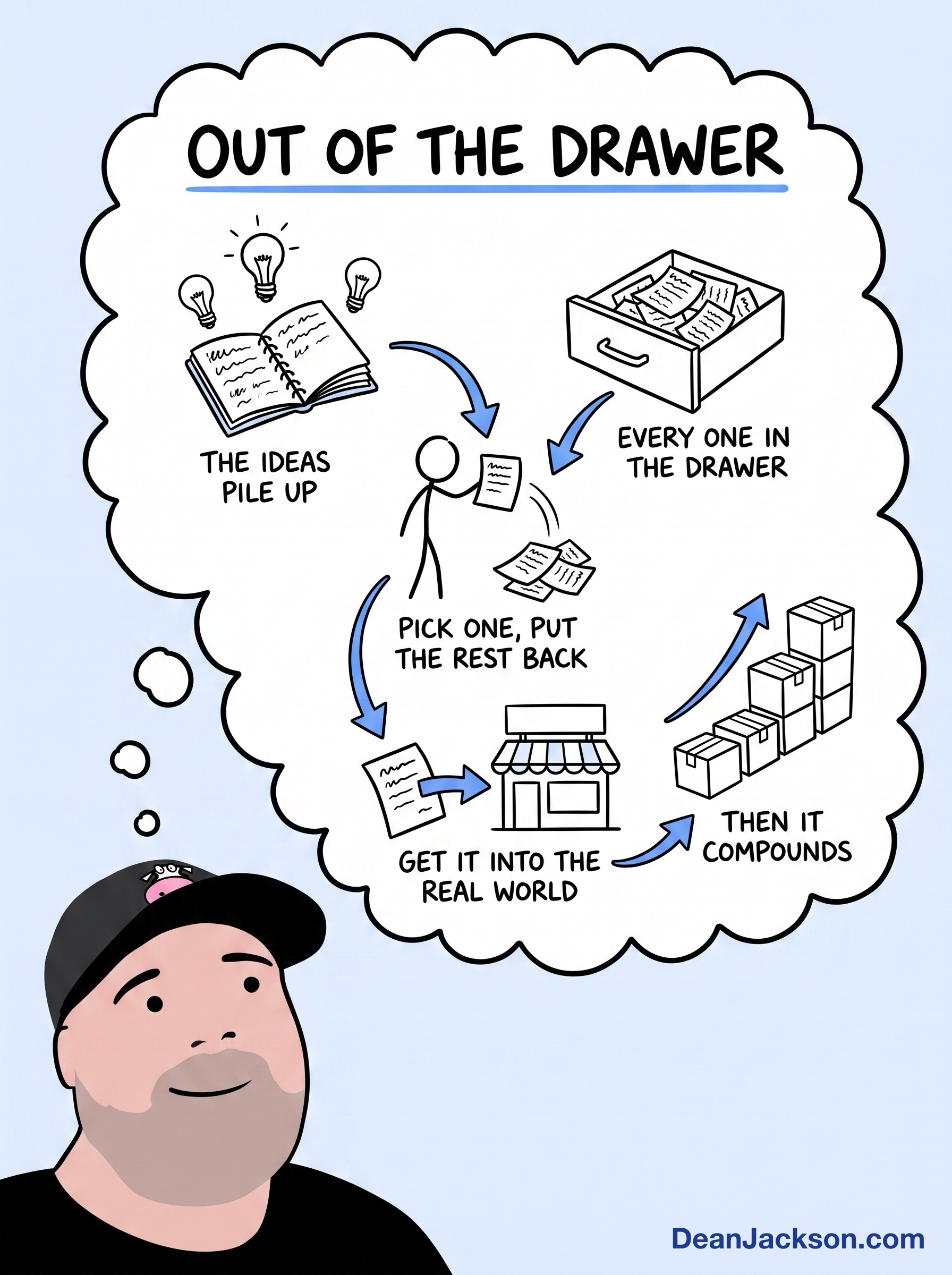
He writes his ideas on a yellow pad and puts them in a drawer. An actual drawer.
When it's time to make one, he opens it up, spreads them all out, picks one, and puts the rest away.
Tarantino set out to make 10 movies. He's made nine. He's 100% immersed in one until it's finished.
And Dan Sullivan. When he was 70 we were walking around London, talking about writing a short book in a short space of time.
We shook hands on it. Two weeks later we both turned up at Strategic Coach with a finished book.
I built the whole 90-Minute Book process around that.
Dan's written one book a quarter ever since. Twelve years of it. He's somewhere around book 48 now.
One idea. Write it. On to the next.
That's the law of compounding with a face on it.
I got a funny email from Rick the other day. Dean, question. Are you saying you can teach me to make fat stacks by hanging out at a pub drinking coffee like you?
And I laughed to myself, because... yes. That's exactly what I do.
Every idea I've ever had, and every dollar I've made in thirty years, went through my brain and my pen and onto a journal page before it ever went out into the real world.
So I'm running the 50-Minute Profit Finder this Friday at 1pm. Free, live on Zoom, and I'll walk you through the exercise myself.
Bring a pen and something to write on. We'll go looking for the lowest hanging fruit in your business, and probably some fruit you didn't know was there.
And here's your nudge for today.
Open your journal and find one idea that's been sitting there waiting. Just one.
Pick the smallest piece of it you could put into the real world this week... and go do that piece.
Transcript
Auto-generated transcript, provided as supporting material. It may contain errors, and speaker labels are occasionally mis-attributed.
Good morning. Listen, if you're an entrepreneur, how many of the things that you use in your business every day, the things that drive your business are ideas that you had years ago, but are still valuable and being used today in your business? I bet there's a lot of them. And how many ideas do you have that you have not created into something that is going to have an impact on your business?
I think you'll be surprised at how many things how many ideas you have that are active and how many ideas that are still rolling around that never got out into the world. So, welcome if you're new here. I'm Dean Jackson. I've been journaling almost every day for over 30 years.
And every day I post a little insight from my journals. Today we're in 1997 journal number four and this is my 50th daily video. And I've learned a lot of things in reflection here going through this. I'm going to share four of those with you today.
We can talk about them. But what I learned in reflection here is looking back that I think that what made this period of my life so very prolific is that I was focused and specializing in one area and I was devoting all my thoughts and waking attention to that one market every day and that was real estate agents. You know, I started out applying all the marketing things that I was learning to my own business and then this is the transition into creating and packaging those ideas so that other people could use them. I've actually been shocked at how many of the things that I still use today are had their genesis in uh you know 30 years ago or more.
And I think that part of that is having this mindset of duplicating your business, thinking about your business as a machine and thinking about it as something that you're going to duplicate 5,000 times. That was a big idea from Michael Gerber from the E-Myth. That was a really uh, you know, fundamental thing for me. But as I'm looking and reflecting through these first four journals, the thing that struck out to me is how deeply I was thinking about each element of the real estate business in terms of getting leads.
and not just leads but specifically granularly all the different types of leads that you could get in real estate and then how to convert those leads into appointments. So realizing that not everybody's ready to buy right now. I was having that realization uh as I come here and having this followup way and that's where we did the home buyer college realizing that if we could find a buyer and then continue to educate them until they were ready that that was going to be a big thing and those tools that I created were are still being used today. So I think that the lesson here, what I see in contrast for my life right now is that there's so many different things that I am uh that I'm able to work on, but I had this realization over the last 60 days that I'm really streamlining stuff to what the number one most valuable thing that I do is help entrepreneurs create what I call prospect vending machines and using all of these things that I've learned across all different industries to be able to create that structure um for people.
So that's I think about that as the compounding effect. That's the second thing that I had uh noticed here is that all of the things that I've been doing have compounded on each other. When you kind of like have this wake that you're bringing along behind you, it's uh you know, it creates this amazing impact that things are still working. It started out with the very first guide to Halton Hills in my own business.
That led me to think I could show other people how to do this and licensing my system to the 40 uh agents in 40 different areas around Toronto. And that led to my relationship with Joe Stumpf and we were able to create this and take this to all of North America. And that all compounded because I was thinking with the end in mind that I'm creating this so that thousands of people can use it. But on a macro or micro level, I was focused on applying this first in my own business, but then in Julie Matthews business right here in Winterhaven, the prototype, all of the things that I was developing were uh were creating there.
And that's kind of a I I think that when I look at it, the discipline and your personal productivity system are really a big opportunity. I realize and as we get further into these journals, we're going to see a lot of ideas that I had that have not made it out into the real world. Like I think about these I mentioned the seven ways that people spend money on their home, on their auto, on their uh kids, on their money, on their health, and on themselves. And that whole I was spending a lot of time thinking about all the possible categories and trying to think about it as the whole in the grand completion.
But what I've realized is that time moves at the speed of reality. We can come up with the ideas. You can see something completely finished, but the actual execution of it has to happen in real time. I was telling Josh over breakfast like a couple of things that remind me of this is I saw a documentary about Woody Allen and uh Woody Allen for at the time 45 years had made a movie every year and his process for it he's constantly coming up with ideas for movies and he writes the ideas on a yellow pad.
He writes the ideas and explains what the movie is about or certain scenes for um movies and then he puts them all in a big drawer, literally in a drawer and then when it's time for him to uh make a new movie, pick a movie for this year, he goes to the drawer, he opens it up, he spreads all of these things out and he looks through and then he picks one of the ideas and he puts it to the side, puts all the others away. And that's the movie that he's making this year. And that consistency has allowed him to make a movie every single year. Quinton Tarantino does the same thing.
His whole arc, he set out with an intention of I'm going to make 10 movies and now he's made nine movies and he's got one more. But he's all 100% immersed in that movie until it's done and only then he has a period of time where he'll get the idea for the next one and then he has to drop everything and and do that. So I think where the things that have worked for me in doing this have been the things that I've actually taken out of the theoretical world and put them into the real world. And nothing is happening in your journal.
Nothing, no ideas are coming to life if they're just sitting in your journal. They've got to make it out into the real world. com approach to all of these ideas because they all fit under the same model. com.
And I think that because our minds are so expansive that we can uh we can see and have grand uh plans that there's nobody stopping us. There's no rails on that. So I think that that would be an amazing thing. My friend Dan Sullivan is 82 years old now and when he was 70, I remember we were in London, England, and we were walking around and then we went to a um for dinner and we were talking about this idea of writing short books in a uh you know in a short period of time.
and we made a little uh you know wager with each other that we were meeting at Strategic Coach in 2 weeks and the goal was we were going to come to Strategic Coach with a with a full book and so we shook hands and we did that and then I built a whole company around the uh 90-minute book process that we created. But what Dan did is every quarter for the last 12 years, Dan has created four books. One book per quarter. He picked one idea, he wrote that book and then on to the next.
And when you look at it now, he's on, you know, book number 48 or whatever, uh, whatever it is now. And that's an amazing evidence of the law of compounding. So I think those are some uh those are some big reflections that I've had so far in my first 50 daily reflection episodes here. So tune in and we'll keep going.
I'll go through all of these uh journals and milk out all these ideas for us. I got a funny email the other day from Rick. It says, "Dean, question. Are you saying you can teach me to make fat stacks by hanging out at a pub drinking coffee like you?"
And I laughed to myself because I was thinking, you know, yes, I I can do that. That's what I do. is the funny thing. What I really realized is that every idea that I've had, every dollar that I've made over the last 30 years has gone through my brain, through my pen onto a piece of paper in my journal before it went out into the real world.
And if I can turn people on to that activity as a driver for what to do, what to think about, what to ask yourself to draw out, what the next most valuable action is for you, and how to find the most profitable things that you can install in your business. I'm all for it. m. I'm going to do for the first time a 50inute profitfinder workshop and you're going to join me live on Zoom and we're going to go through a 50inute exercise.
Bring your pen. Bring a notebook or piece of paper. And I'm going to guide you through a thinking process that will help you identify where the lowest hanging fruit is in your business and maybe some fruit that you didn't even know was there. But I'm going to show you where to look for it.
So, it's free. It's for you. m. this Friday.
Just watch. Go to What did we call the website, Josh? >> 50inut profitfinder. m.
Get BreakthroughDNA Free
Discover the 8 Profit Activators that can transform your business. Get the complete framework, free.