How to Figure Out Why People Actually Buy Your Stuff
Watch
Listen
A 1997 journal page, a book about arguing like an attorney, and the six questions that get you inside your prospect's head before you write a word.
Good morning.
What if you prepared your marketing the way an attorney prepares a case?
Not sat down to write an ad. Prepared a case.
That's where my head was in March of 1997. Journal number five.
I was reading How to Argue and Win Every Time, and it put me into a completely different way of thinking about the people I was trying to reach.
Page ten of that journal, there's one question written at the top.
What is the secret for getting listings?
Every waking thought I had was pointed at real estate agents back then. But the question works for anything.
What's the secret for getting new deck builds. New lawn customers. New clients.
Underneath it, six questions I worked through with my pen. Here they are.
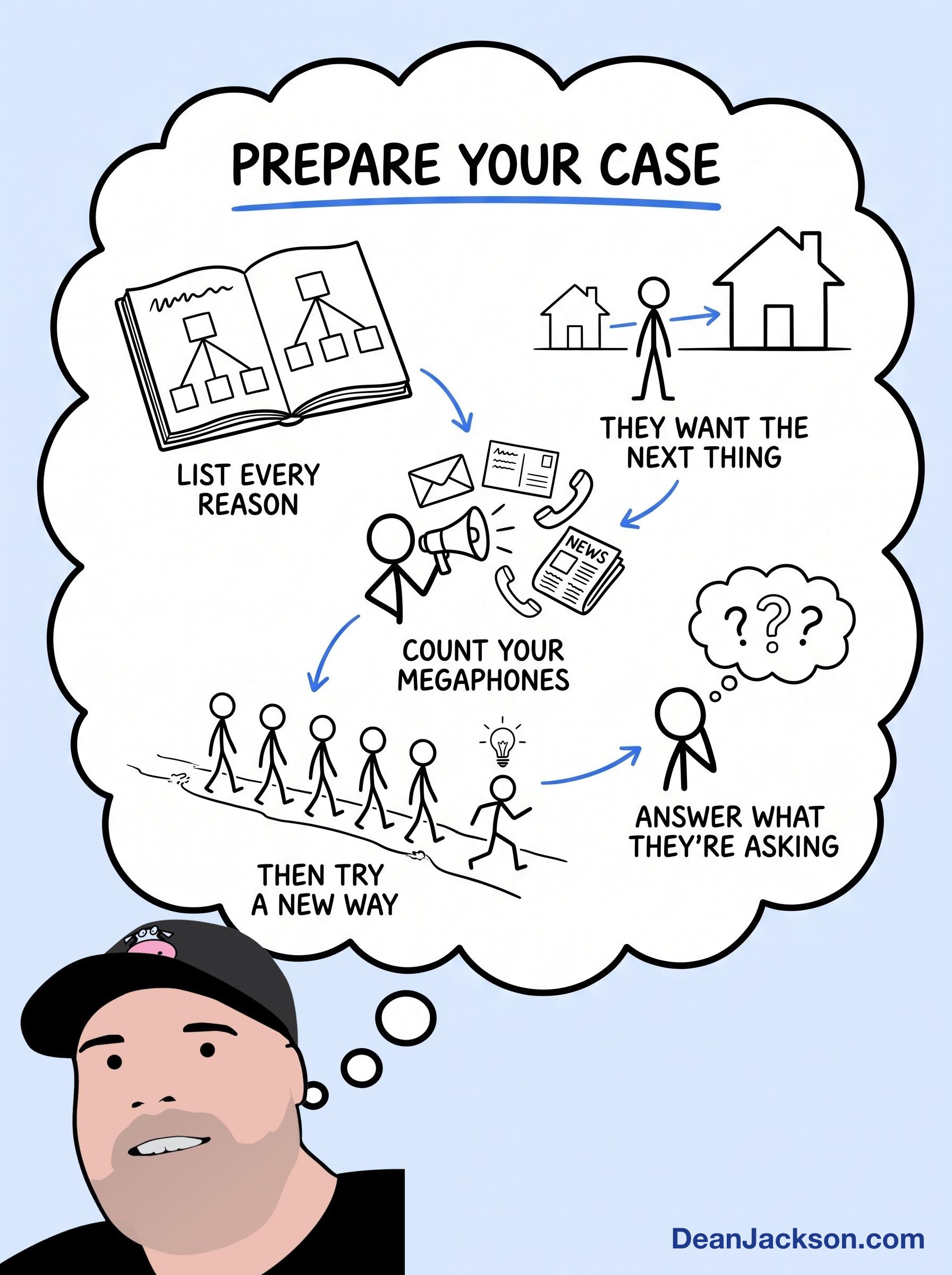
First one. What reasons would somebody have to do this at all?
For me that was, what reasons would people have to sell their homes?
Moving up to a bigger house. Building a better one. Finally buying in the neighborhood they've always wanted. The lakefront house.
Or the other direction. Downsizing. Retiring into assisted living.
Then the ones nobody puts on a brochure. Money problems. Divorce. A job transfer. Somebody dies. Health changes.
I listed all of them.
Because every one of those is a different conversation.
You don't talk to somebody chasing their dream house the same way you talk to somebody who has to sell one.
Those aren't one market. They're different target markets wearing the same label.
Second. What are they going to consider first?
I thought about it and realized nobody wakes up motivated to sell a house.
They're moving toward the new one. The lakefront place, the house in the country.
Selling the one they've got is only the mechanism that gets them there.
Worth knowing which end of that you're talking to.
Third. What methods could I use to reach these people?
Direct mail. Postcards. Telephone. Newspaper ads. The real estate publications.
That's 1997, so look at what's not on the list. No Instagram, no Facebook, no YouTube, no Google. No email. Not even the internet.
Those were the megaphones. Every one we had.
Whatever your version of that list is today, write it out... because the message and the megaphone get built together.
Fourth. What are the best methods being used right now?
The collected wisdom of your industry. What everybody already does.
Realtors chased expired listings. Called for sale by owners. Cold calls, farming an area, door knocking, evaluation certificates.
Financial advisors run the dinner seminar. Invitations go out, everybody comes down to the steakhouse, there's a presentation, a few of them book a meeting.
That's the baseline. You have to know it before you can step off it.
Fifth, and this is the fun one. What new ideas could work here?
I wrote down: what about the houses right around a home that just sold?
That became a whole program called The Listing Next Door. The twenty homes surrounding a sold sign.
Another one. Geographically complementary areas. Not asking a neighborhood if they want to sell... but marketing it to the people already dreaming about moving into it. Townhomes to detached. Condos and apartments to starter homes.
And the one that actually started my career. A telephone research survey.
Not calling to get listings. Calling to status people.
Mr. McQuade, it's Dean Jackson calling from Royal LePage. We're conducting an area market survey, I wonder if you'd have just a minute to be included.
They'd usually say no.
And I'd say, it's only five questions, one minute, I promise.
Then they'd say yes.
That's rejection and retreat, straight out of Cialdini. They turn down the bigger thing, so you retreat to the smaller one.
Five questions. Have you lived in Georgetown more than five years. How many years in your current home. Where did you live before. How did you happen to choose Georgetown. And if you were to move, would you stay in Georgetown or leave... and when would that be.
That was the whole call.
Every hundred people I called gave me the ones looking to sell right now.
But it also gave me a record of everybody friendly who'd told me roughly when they were going to move. Two years out. Three years out.
That's the long game, and hardly anybody plays it.
Sixth. What's already rolling around in their head?
Somebody thinking about selling wants to know what their house is worth. That's the number that tells them whether the move is even possible.
What do buyers look for now. How do I get the house ready. What's it really going to cost me to move up.
Somebody thinking about a deck wants to know what decks cost. What the options are. Wood, or the fiber stuff they've been hearing about.
Answer the questions already going on in their mind and you've cleared the path for them to do business with you.
That's it. Six questions, a pen, and a page.
You come out the other side with the raw material to write anything.
I got a funny email from Rick the other day. Dean, question. Are you saying you can teach me to make fat stacks by hanging out at a pub drinking coffee like you?
And I laughed to myself, because... yes. That's exactly what I do.
Every idea I've ever had, and every dollar I've made in thirty years, went through my brain and my pen and onto a journal page before it ever went out into the real world.
So I'm running the 50-Minute Profit Finder this Friday at 1pm. Free, live on Zoom, and I'll walk you through the exercise myself.
Bring a pen and something to write on. We'll go looking for the lowest hanging fruit in your business, and probably some fruit you didn't know was there.
And here's your nudge for today.
Write question one at the top of a page. What reasons would somebody have to want what I sell at all?
Don't stop at three. Get to ten...
Then look at how many different people you've been talking to as if they were one.
Transcript
Auto-generated transcript, provided as supporting material. It may contain errors, and speaker labels are occasionally mis-attributed.
Good morning. What if you took the time and approach to prepare your messaging for who you're going to communicate with, the people that you're trying to help, the people that you're trying to get to buy your stuff or collaborate with you? What what if you took the approach of preparing this like you are an attorney preparing your case, preparing your argument. And I was uh it's 1997 right now.
We've moved into journal number five. It's March of 1997. And one of the books that I was really kind of studying was How to Argue and Win Every Time. And I really got me into this thinking of preparing your case.
And as I'm looking through these uh journals and some you'll see some as we come into future journals, but I really started this process of deeply thinking with my pen in my journal about the person that I'm trying to communicate to. So I, you know, here on page 10, journal number five, I wrote the question, what is the secret for getting listings? Cuz remember, I was talking about focusing on a single thing. So my days were deeply invested in trying to figure out how to apply what I'm learning to the real estate market.
But this would apply to anything. What is the secret for getting new deck builds or new uh you know lawn customers or whatever it is that your business is if you just think that what's the secret for getting this and I would go through kind of a sixpart process and the first is I would write the question what reasons would people have to sell their homes like I start thinking about what's going to trigger this for people and this could be for anything that you're doing there. But for on this situation, what reasons would people have to sell their homes? Well, maybe they're going to uh buy a bigger home or they're going to build a better one or they're going to buy in a prestigious area.
They've always wanted to live in a particular neighborhood or buy a luxury home or a lakefront home or they're moving out of town. they're going to move to another town or relocate. Maybe they're downsizing and they're going to buy a smaller home. Or they're going to retire and go into assisted living.
Or maybe they're having money problems or divorce and they need to sell the house or their job transfer or somebody dies or their health changes. And I just started listing all of the possible reasons because from that every uh every branch from there is going to have a different approach. You're going to talk to somebody differently who's motivated by buying a bigger home than someone who is getting divorced and needs to sell their home or they're in financial problems. And so understanding the granular distinctions between where people are in your situation, what would be the triggers that would get it?
And I think you'll find that those are different target markets. So I started listing the thing. I said, "What do you think people are going to consider first?" And so I think about that.
if you look at your situation, what are people going to consider first? And so for me, I thought they're going to consider buying the house they want before they even think of getting rid of the one they have. It's not going to be a motivation to just sell this house. I think the primary driver for it is going to be that it's moving towards the new house that they want.
They want that lakefront house or they want the house in the country and selling the house that they currently have is only going to be the mechanism that gets them into what they're really looking for. So then I start thinking number three, what methods could I use to contact these people? So I'm really I'm circling the wagons around your market here. So around the market here and again this is 1997.
So I'm listing all the ways that we can get to them. Direct mail letters, postcards, telephone, we could run newspaper ads. And then I'm listing the real estate publications that we can get in them. These are all of the megaphones that we have to get to people.
So, you notice that I didn't say Instagram or Facebook or YouTube or Google or the internet itself or email or any of that. This was only this was the the collection of ways, pathways to get to these people. So you're trying to develop the message and we're trying to build it in the context of what's the messenger that we're going to be able to use to get to those people. Now I start looking at what are the best methods used right now.
So look in your industry and look in your things and say what are the best ways that other people in my business are using to get people. So if I think about what were other realtors doing to get listings like the common things is expired. They might chase expired listings or call for sale by owners or make cold calls or do farming. They might farm an area or do door knocking or offer evaluation certificates.
Those were kind of the big ways of how people might approach the collected wisdom kind of thing of this is how realtors get listings. And if we're thinking about this with financial advisors, they might be, you know, one of the most common things that people do as financial advisors is they run dinner seminars where they'll send out a bunch of invitations. They'll bring people down to the uh steakhouse for a dinner and then they'll present their uh opportunity to them and some of them will go in and meet with people. But that's kind of like the best way that that people might do that.
Now then that opens up to ask yourself innovatively, what are some new ideas that we could use here? And so I started listing things like I started thinking outside of the box here and I thought what if we processed around other listings around homes that have just sold and you'll see as we come forward I actually created a whole program called the listing next door which was designed around approaching the 20 homes right around a house that just sold. Um or another one I listed was geographic complimentary areas. So imagine that if there are if you have a listing in a a area that somebody would be um super happy to uh live in or aspire to move up to is not just hey you want to sell your house but start marketing those homes to geographically complimentary areas.
Where are people moving from town houses to a particular detached home neighborhood or from condos or apartments into starter homes or town homes? Um, telephone research survey. That was a way something that was how I started my career actually was doing a telephone research survey. not calling to get listings, but calling to status people in my neighborhood.
I would call them up. I would just ask five questions. I would say, "Mr. McQuade, it's Dean Jackson calling from Royal La Page.
We're conducting an area market survey. I wonder if you'd have just a minute to be included." And usually they'd say, "No." And I'd say, "It's just five questions, one minute.
I promise." And then they would say yes. And that of course was using rejection and retreat from Robert Chaldini's weapons of influence. They said no.
I just retreated to a softer thing. It's only one minute, five questions, I promise. And then I would just go through and ask them, have you lived in your home for more in Georgetown for more than 5 years? How many years in your current home?
And how did you happen where did you live before you moved to Georgetown? And how did you happen to choose Georgetown? And if you were to move, would you stay in Georgetown or would you move out of the area? And when would that be?
That was it. That was the questions. And I would go through and I would record people's answers so that every time I called a 100 people, I not only would have people who were looking to sell their house right now, but I also have a record of the people who were friendly and who said at some point that they had an idea of where they were going to move. even if it was 2 or 3 years from now.
So that was taking the long game there. Um so thinking through what are some new ideas that you have that could approach uh that could approach your market. Then I started making lists of what kind of things could they possibly want to know? What is the conversations going on in their head right now?
Somebody who's thinking about selling their house probably wants to know, well, how much is my house worth? Cuz that's going to help them solve the equation of how much is it going to cost me to move into this new house? Or they might be thinking, what do buyers look for in a new home now? Or they might be thinking, how can I prepare my house for sale?
How much is it going to cost me to move up? Doing the calculations. If you can get the uh help them answer the questions that are rolling around in their mind that's going to prepare the way for them to now do business with you. If they're thinking about getting a deck, they're probably thinking, Well, how much do decks cost?
How much is it going to cost? What are my options? Is it better to get wood or is it better to get these fiber decks that I've been hearing about? Or you know, all of that stuff.
When you start thinking through from the mind of your prospect, that kind of thinking process is going to give you the raw material to be able to really speak to those things and create the best ads that you can that will attract all the prospects that you need. I got a funny email the other day from Rick. It says, Dean, question. are you saying you can teach me to make fat stacks by hanging out at a pub drinking coffee like you?
And I laughed to myself because I was thinking, you know, yes, I I can do that. That's what I do. is the funny thing. What I really realized is that every idea that I've had, every dollar that I've made over the last 30 years has gone through my brain, through my pen onto a piece of paper in my journal before it went out into the real world.
And if I can turn people on to that activity as a driver for what to do, what to think about, what to ask yourself to draw out, what the next most valuable action is for you, and how to find the most profitable things that you can install in your business. I'm all for it. m. I'm going to do for the first time a 50inute profitfinder workshop and you're going to join me live on Zoom and we're going to go through a 50inute exercise.
Bring your pen. Bring a notebook or piece of paper. And I'm going to guide you through a thinking process that will help you identify where the lowest hanging fruit is in your business and maybe some fruit that you didn't even know was there. But I'm going to show you where to look for it.
So, it's free. It's for you. m. this Friday.
Just watch. Go to What did we call the website, Josh? >> 50inut profitfinder. m.
Get BreakthroughDNA Free
Discover the 8 Profit Activators that can transform your business. Get the complete framework, free.