How to Find Clarity on What Matters When EVERYTHING Feels Urgent (In 5 Minutes)
Watch
Listen
When everything feels urgent, ask what's real in the next 100 hours... then the next 100 minutes. A five-minute journal exercise from 1997.
Good morning.
Here we are at the end of journal number five. Still 1997.
And going back through these pages, I realized something about what my journals are actually for.
They're a focusing tool.
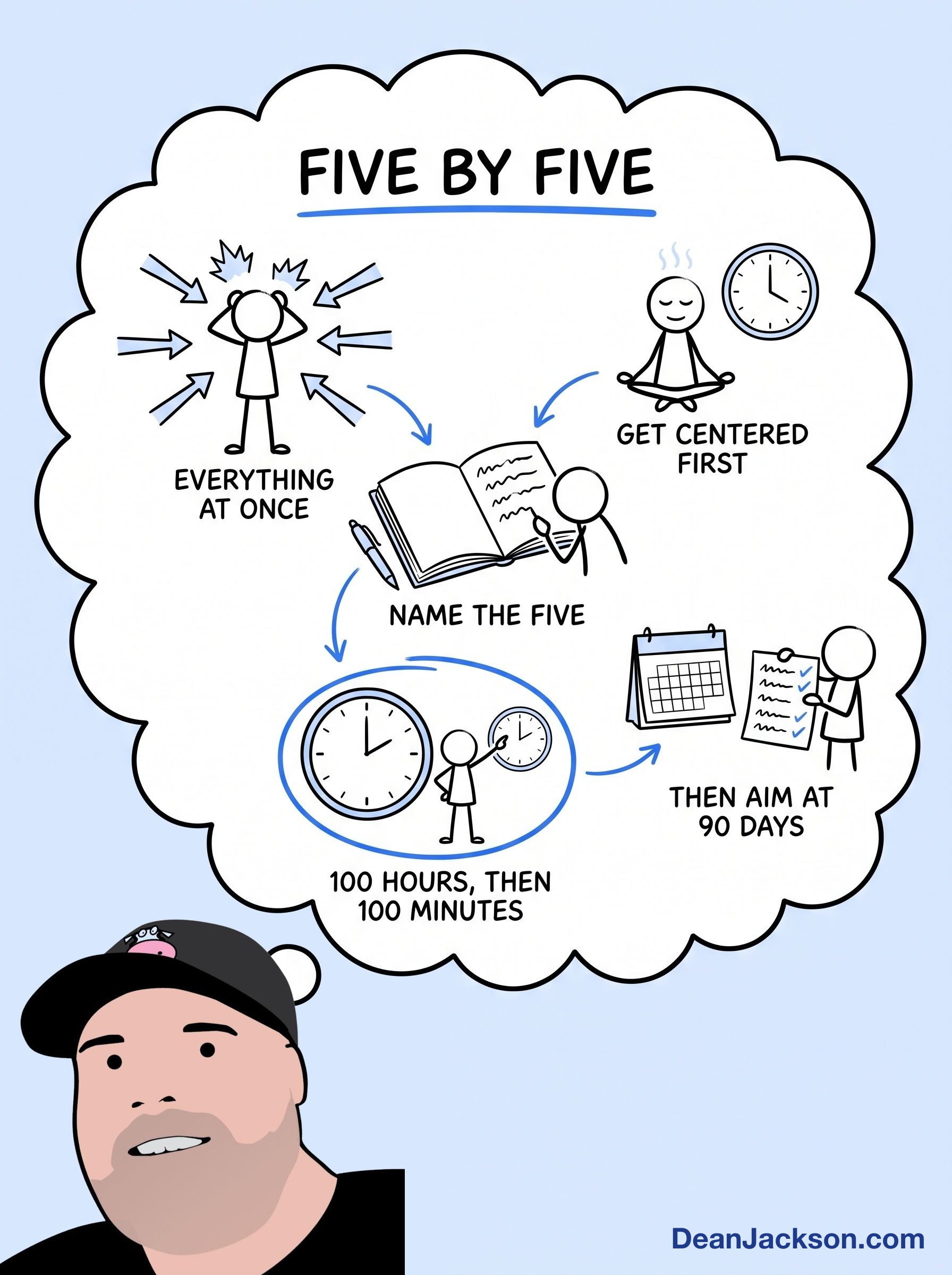
I used to run what I called five by five sessions. Five questions. Five minutes. Five things listed underneath each one.
You can point it at the long term or the short term. But where it really earns its keep is in the middle of an overwhelming week.
Too much going on. Everything competing for the front of the line.
Because here's what our minds do in that state. We time travel.
We project forward and get anxious about something that hasn't happened yet. Or we go back and ruminate on something that already did, and drag the meaning of it into today.
And the most comforting thing I know is this.
In the moment, time moves at the speed of reality.
You've heard me say it. Time moves at the pace of sixty minutes per hour.
You would be amazed how long one minute is if you sit quietly and watch the second hand sweep all the way round to the top. Just breathe and watch it.
I saw Rick Rubin being interviewed by Anderson Cooper on 60 Minutes recently.
Before they started, Rick suggested they take two minutes to get centered. Just to arrive in the moment.
That's exactly how I come into one of these sessions.
So set your environment up. Take the distractions away. And then, before you write a single thing, be still for a minute.
Then start listing.
What are the five most pressing things I'm putting off, or worried about, or feeling the pressure of?
Just naming them does something. Getting them out of your head and onto the page makes them feel more manageable straight away.
And then I get granular about when they actually land.
Look down the list and ask what's really happening in the next 100 hours. Sometimes the thing taking up all the room in your head has no consequence at all in the next 100 hours.
Then go further in. The next 100 minutes.
That's the immediate present. That's the part you genuinely control.
So what's the most important thing you could do in the next 100 minutes?
Even when something is due by the end of the day, taking five minutes... or fifty... to get your thinking right first is an advantage, not a delay.
Lincoln said if he had four hours to cut down a tree, he'd spend the first three sharpening the axe.
Same thing here.
Now, once the fog has lifted, I use the same tool to plan.
These were the questions I was asking myself at the end of that journal. All of them pointed at the next 90 days. The far actionable future.
What five habits would improve my performance most dramatically in the next 90 days?
What five things have I been putting off that would clear my mind if I just got them done?
What tools or technology would improve my production capability?
I laughed at my own answers to that one. In 1997 I wanted a laser printer that would run 11 by 17 pages, so I could fold my own magazine sized booklets and lay out full page tabloid ads exactly the way they should look. A color scanner was on there too.
What are the five most important projects I could be working on?
What five things would I like to do just for fun?
And what would I like to learn in depth?
You can make a serious dent in something in 90 days if you take it on as a priority and go full immersion on it. That might be ChatGPT or Claude today. Or how to run Meta ads. Whatever the thing is that would have the biggest impact on you.
Answer those and you can't help but come away with clarity.
Because having it on paper, and confirming it, is a completely different thing to carrying it around in your head.
It's amazing how much insight our minds already have... and how much of it comes out the moment you give it somewhere to go.
I got a funny email from Rick the other day. Dean, question. Are you saying you can teach me to make fat stacks by hanging out at a pub drinking coffee like you?
And I laughed to myself, because... yes. That's exactly what I do.
Every idea I've ever had, and every dollar I've made in thirty years, went through my brain and my pen and onto a journal page before it ever went out into the real world.
So I'm running the 50-Minute Profit Finder this Friday at 1pm. Free, live on Zoom, and I'll walk you through the exercise myself.
Bring a pen and something to write on. We'll go looking for the lowest hanging fruit in your business, and probably some fruit you didn't know was there.
And here's your nudge for today.
Set a timer for five minutes and list the five things pressing on you hardest right now.
Then mark the ones with a real consequence in the next 100 hours... and decide what you're doing with the next 100 minutes.
Join me live on the next free 50-Minute Profit Finder call, Friday, October 9 at 1:00pm ET. Save your spot →
Transcript
Auto-generated transcript, provided as supporting material. It may contain errors, and speaker labels are occasionally mis-attributed.
Good morning. Here we are ending. We're coming up to the end. Journal number five, still in 1997.
And one of the things that I realized in coming across this little collection of pages here is one of the most valuable things that I do in my journals is use it as a focusing tool. And this exercise that I went through, I would do these, I'd call them five by five sessions where I would have five questions and I would give myself five minutes to make a list of five things underneath that question. And where it comes in very handy, you can do it both in long-term things, you can do it for short-term things, but the thing that I find it really helpful with is in the midst of an overwhelming situation where you're you've got a lot going on and you've got a lot of competing priorities. One of the things that our minds can do is we can time travel.
We can project. We can, you know, have anxiety about things that are coming in the future or feeling like the pressure of of deadline things. We can have, you know, rumination about the the past of something and transfer that meaning to what we're doing. But in the moment, this is the most comforting thing is that the in the moment time moves at the speed of reality.
You hear me say that a lot that time moves is at the pace of 60 minutes per hour. And you would be amazed at how long one minute is if you just sit quietly and you look at your watch and you just sit quietly and watch the second hand sweep its way through to the top of the minute and just breathe. Just get presented like that. I saw an interview just recently with Rick Rubin who was on 60 Minutes with Anderson Cooper.
And one of the interesting things that he suggested to Anderson before they got started with the interview was that they just take 2 minutes to get centered to get into the uh come into that that moment. And I always take that approach when I'm coming into uh this kind of a clarity session. And so I would love for you to experience that like you know take a page in your journal and just in the beginning you've of course set up your environment. You've removed all the distractions.
You've done all of that stuff and here you are. How to get the most out of it is just to get centered. be still in that thing and then list, you know, if you start listing what are the five most pressing things that I'm either procrastinating or I'm concerned about or I'm feeling the pressure on. And usually just by doing that, by naming them, by listing them, you're going to see that automatically it feels a little bit more manageable.
And you'll realize that one of the things that I do is I think I I go in granular things. When we're thinking about something being overwhelming, it's all in the moment and it feels like these competing priorities all need to be done right now. But when I look at it and I look down the list and I say I start with the the next 100 hours, I start to say like when what which what'll happen in the next 100 hours that is pressing cuz sometimes it's something that is coming and it's on your mind but it's not there's no consequence or nothing in the next 100 hours. And if you go all the way down to the next 100 minutes, that's your real controllable um time frame, right?
That's what I would call the immediate present that you are in that you can pretty much even if you just think about it now that if you just look and you kind of put that through that filter and say like what would be the most important thing that I could do in the next 100 minutes and just acknowledging the things and where they fit on that scale of where the real consequence is. Even if you have to do something by the end of the day, taking you know, five minutes or 50 minutes to, you know, get your thinking right is a u is a real advantage. I think it was Abraham Lincoln that said if he had, you know, 4 hours to cut down a tree, he'd spend the first three hours sharpening his axe and then do the the work. And I think that that's the the same thing here.
But once you're out of those uh clarity things, I use this as a a planning thing as well. So I would some of the questions that I have, I was doing this at the end of my journals. I usually will kind of presence what was talked about and then kind of look forward into the the future there. But I one of the questions I asked was what five habits would allow me to improve my performance most dramatically in the next 90 days?
And if you just start looking at those uh if you start looking at those things and make that list for yourself, it would be a really uh I think you're going to see that you get some great ideas from there. The second question I had was, "What are five things I've been putting off that would clear my mind if I got them done in the next 90 days?" And I like this like 90 days, the far actionable feature, like get your quarter kind of um organized that way. Three is what tools or technology would improve my production capability in the next 90 days.
So at this point I everything that I was doing I was creating and deploying direct response marketing systems. I was creating systems out of these experiments and these things that I was doing. And I'm kind of laughing because I look at the things. For me, one of the things I wanted on that list was a a laser printer that prints 11 by7 pages cuz I was printing.
That way I could make folding booklets that were the size of magazines or I could do big full page tabloid newspaper ads laid out exactly the way that they should be. A color scanner was on my list. Uh those kind of things are really helpful for you to kind of just get your your thinking together that way. What are the five most important projects I can be working on in the next 90 days?
And if you allow yourself to go through these questions and answer them, you can't help but leave with clarity because having things on paper and confirming them, that makes a uh that makes a big thing. This one was fun. What are five things I would like to do for fun in the next 90 days? What are things that have been on your list?
I love the idea of, you know, planning out the things that that you want to uh that you want to do. Number seven is what areas would I like to learn in depth in the next 90 days? you can make a big dent in something if you take it on as a a priority as a um you know an in-depth kind of I'm going to go full immersion on this for 90 days and imagine now it might be learning chat GPT or claude or any of the the AI tools or maybe learning how to run meta ads or how to whatever ever the thing is that would have a big impact on you over the next 90 days. Having this menu of things to draw from really helps you get clarity and that's what this is that's what this is really all about.
It's amazing how much insight our minds actually have and uh and how clarifying spending time in your journal on a regular basis can be to get you focused. I got a funny email the other day from Rick. It says, "Dean, question. Are you saying you can teach me to make fat stacks by hanging out at a pub drinking coffee like you?"
And I laughed to myself because I was thinking, you know, yes, I I can do that. That's what I do. Is the funny thing, what I really realized is that every idea that I've had, every dollar that I've made over the last 30 years has gone through my brain, through my pen onto a piece of paper in my journal before it went out into the real world. And if I can turn people on to that activity as a driver for what to do, what to think about, what to ask yourself to draw out, what the next most valuable action is for you, and how to find the most profitable things that you can install in your business.
I'm all for it. m. I'm going to do for the first time a 50inute profitfinder workshop and you're going to join me live on Zoom and we're going to go through a 50inute exercise. Bring your pen.
Bring a notebook or piece of paper. And I'm going to guide you through a thinking process that will help you identify where the lowest hanging fruit is in your business and maybe some fruit that you didn't even know was there. But I'm going to show you where to look for it. So, it's free.
It's for you. m. this Friday. Just watch.
Go to What did we call the website, Josh? >> 50inut profitfinder. m.
Get BreakthroughDNA Free
Discover the 8 Profit Activators that can transform your business. Get the complete framework, free.