News Flash: People Are Lazy. Here’s How to Build Your Business Around It.
Watch
Listen
In 1997 Jerry Ballinger told me people don't do what they could do. The fix isn't better instructions... it's building for what they will actually do.
Good morning.
I'm live at Honeycomb this morning, for their fifth anniversary. Cortado. Eggs and bacon. Journal open on the table.
That's the whole pattern, by the way. I come here, I pick up the journal, I look through it, and I find the insight.
Still 1997. Coming up on the end of my first year of journaling.
Yesterday I showed you the Today's Homeowner kit. The whole elaborate system, laid out step by step so anybody could run it.
And going back through it, something Jerry Ballinger said to me landed differently than it did at the time.
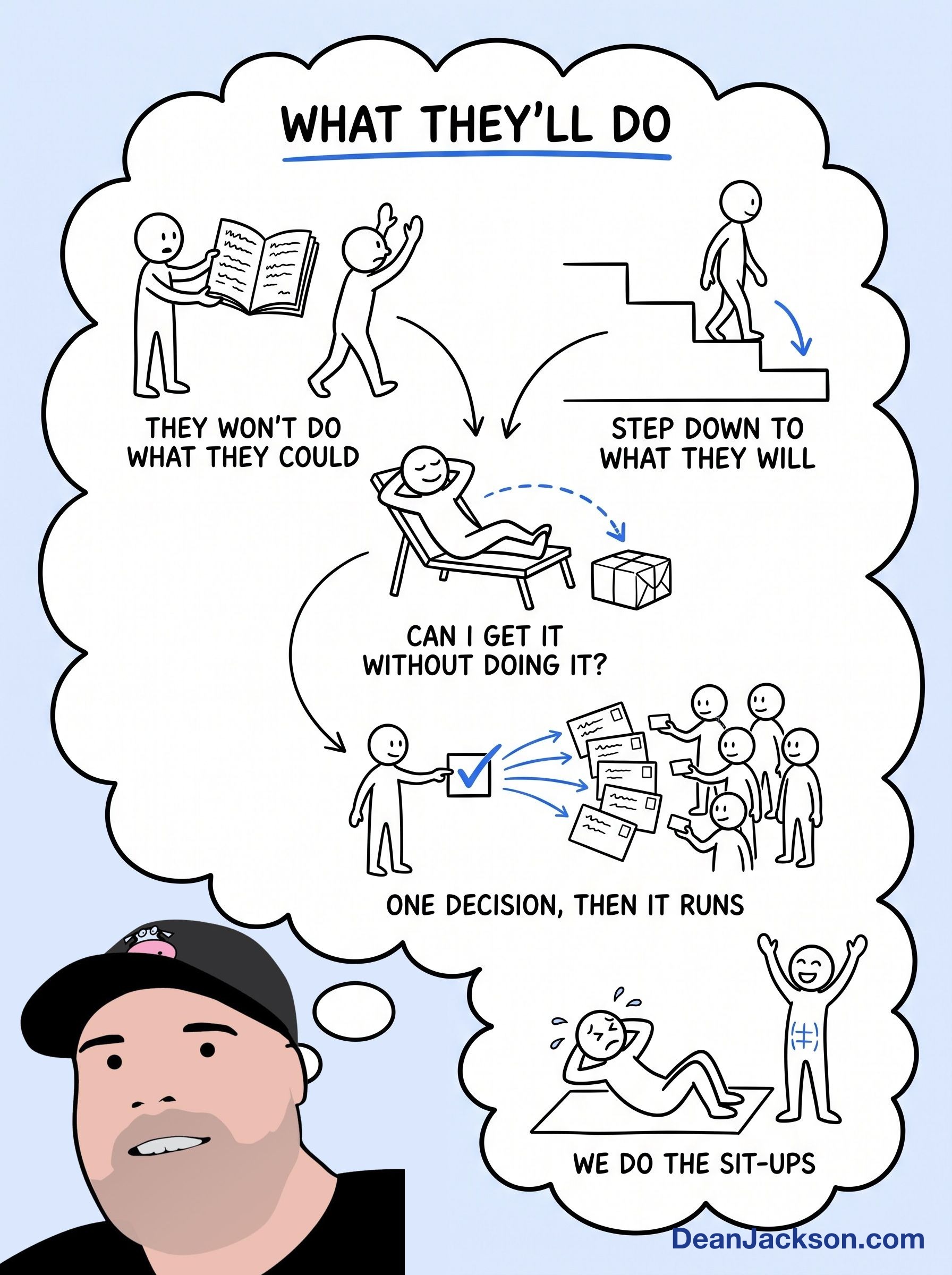
People don't do what they could do.
I didn't have enough experience yet to hear that as a pattern. I do now.
Think about what I was handing people. They could photograph every house style in their neighborhood. They could assemble the guide. They could run the ad. They could send out the information.
They could do all of it. I did it, and it worked.
But they don't.
And thirty years of getting results for people, and through people, later... that's still my quietest disappointment.
Jerry didn't leave it there, though. He gave me the ladder.
If you're in the coaching or information business, he said, you can't build around what people could do. You have to step down to what they're likely to do.
And if you really want to lock it in, you step down one more. What will they do?
That last one is the interesting one.
Dan Sullivan and I do a podcast every Sunday, Welcome to Cloudlandia, and Dan has a three question test for anything he wants to get done.
First question. Is there any way I can get this result without doing anything?
That's his first choice. And look how neatly that lines up with what people will do... because if there's a way to get the result without doing anything, that's the thing they'd pick.
If the answer is no, second question. What's the least I could do to get this outcome?
And then the third. Is there a who who can do my least?
Which puts him right back at getting the thing without having to do it himself.
That's all of us. We want the result. We don't want the work.
Here's the part that surprises people.
Everybody's guarded about their ideas. Frightened somebody's going to steal them.
Nobody's stealing your idea.
And if they take a run at it, they'll only ever execute the surface of it. I know this because I spend my days trying to get people who are paying me for my ideas to actually execute my ideas.
So take the postcard.
What somebody could do is build the whole coalition. Treat their clients as advocates. Take the entire home under management, the entire life under management, everything that comes with living in Winter Haven rather than just buying a house here.
That takes a rare person. I've dealt with tens of thousands of people, so I can tell you how rare.
But what will they do?
They'll identify the 150 people already in their world. The people who know them, like them, trust them.
And then they'll make one decision.
Send the world's most interesting postcard to those 150 people every month. We write it. Interesting facts on the front, and on the back a note built specifically to orchestrate referrals.
One decision. These are my 150 people, and yes, send it every month. We prepare the whole thing once, and it goes out.
No thinking required.
And the outcome we're actually after is their return on relationship. That the people who already know them do more business with them and introduce them to others.
The bare minimum way to get that... the least you could do... is send the postcard automatically. So nobody in your world is ever more than thirty days from having your contact information physically in their hand.
That's the shift I can see happening across these journal pages.
It starts as look at this cool thing I did, and here's exactly how to do it yourself.
And it becomes here's the toned down version, and we'll help you with most of it.
And the things that work best of all are the ones where it's just... get out of the way, let me do it for you.
The way we articulate it now is the winner.
It's like working with a personal trainer, except we do the sit-ups and you get the six-pack.
That's what everybody dreams of. We do the hard work. You get the benefit.
So if you're starting down the path of getting your ideas executed through other people, that's the thirty years of lessons compressed.
People will do what people are willing to do. Which is nothing, ideally, with the result arriving anyway.
Accommodate that, and it's a great journey.
And here's your nudge for today.
Take the thing you're asking people to do... and ask yourself honestly whether that's what they could do, or what they will do.
Then build the second one.
Join me live on the next free 50-Minute Profit Finder call, Friday, October 9 at 1:00pm ET. Save your spot →
Transcript
Auto-generated transcript, provided as supporting material. It may contain errors, and speaker labels are occasionally mis-attributed.
Good morning. Okay, live at Honeycomb 5th anniversary for the place I come to uh breakfast every day. Have my little cortado and some eggs and bacon and then think about a video for you. This is the whole pattern.
I pick up my journal. I look through and I find the insight. So this right now is ending the first year of journaling and we're in towards the middle of 1997 right now. And yesterday I shared the idea of the home uh today's homeowner magazine this elaborate whole complete system for people to do and it's fantastic.
And one of the things that I realize on reflection because I w hasn't had enough experience yet to recognize it as a pattern. But one of the things that that Jerry Ballinger said to me and uh became very evident is that people don't do what they could do. And I thought those words are really interesting, right? like these things.
When I describe the things that I did, people could take pictures of all the different house styles in their neighborhood. They could put it all together in a guide. They could run an ad. They could send people all the info.
They could do all of that, but they don't. I did and it worked. And my goal was to show them, hey, if you do this, and put together like really explicit step one, do this, step two, do this, things that people would follow and do what I did and get the result that I got. And so now after 30 years of getting results for other people and through other people, one of the biggest I'll say like low-key frustrations in my life or disappointments is that people don't do what they could do.
And Ballinger went on to explain that when you're in this information uh when you're in the the coaching or information uh business and he had a very successful business coaching financial advisors and he said you because people don't do what they could do you have to frame things around what are they likely to do. That's one step down is what are they likely to do? And then if you really want to lock it in, you have to go to the level of what will they do? What will they do is the thing that's very interesting.
And now 30 years later, you know, Dan uh Sullivan and I talk every uh Sunday. We do a podcast called Welcome to Cloudlandia. And one of the things that Dan talks about is his three question test for uh for anything that he wants to get done. His first question is, is there any way I can get this result without doing anything?
That's his first choice. And that aligns with this what will people do? If there's a way to get the result that they want without doing anything, they would do it. Then his next question is, if the answer is no, that there's no way for him to get it without doing anything, his next question is, well, what's the least that I could do to get this outcome?
And then the question is, is there a who can do my least? So, he's full circle back to getting the thing that he wants without having to do anything. And I thought, that's what we all want. We all just want the result, but we don't want to do the work.
And so if I take this, what people could do is put together this whole coalition, treat their uh existing clients like advocates, like being an advocate for them. taking that whole life under management or home under management and realizing that there's a lot of other things that are going to go into now living in Winter Haven, not just buying a house in Winter Haven. But it requires a a special person, you know, that that is willing to do things. And my experience is after dealing with thousands probably tens of thousands of people is that those people are very rare.
So I can say to you with assurance that a lot of times people are very guarded about their ideas and their things for fear that people will steal their idea. And the reality is nobody's stealing your idea and they're going to only execute the surface of it. And I come to that realization because I struggle with getting the people who are paying money to get my ideas to execute my ideas. So you're never worried about somebody going to take it and do it.
But in the spirit of moving things down to what people will do is I know that if I can just get them to identify the 150 people that are in their world, the people that know them, like them, trust them, the same people that I was advocating that they send the today's homeowner to. If I can just get them to identify those 150 people and then with one decision they can send the world's most interesting postcard to them that we put this together where we do the entire thing for them. So we write every month a uh world's most interesting postcard with you know interesting facts and uh interesting information on the front and then on the back we have a note that is specifically designed to orchestrate referrals. So when we look at that and send that every month to people without with them only having to make one decision they these are the 150 people and I want to send this every month and we can do the whole thing for them so they don't have to do any thinking we prepare it all one time and then every month this postcard goes out to to people and we use this process of programming people for referrals.
And if you look at what the outcome that we're looking for is to improve somebody's return on relationship that people that they know will do more business with them and introduce them to other people. The bare minimum of being able to do that is this is what we would say is the least that you could do is send this uh this postcard automatically. And everybody that you know is going to never be more than 30 days away from having your contact information physically right there in their hand. And that, you know, that shift for me, I've realized as we're going is like, hey, look at this cool thing that I did.
Here's exactly how to do it to, okay, here's this kind of toned down version of it, and we can help you with a lot of it. The things that have the most success are the things that are just like, okay, just get out of the way. Let me do it for you. And the articulation that we've come to that's the winner is saying to people it's like working with a personal trainer except we're going to do the sit-ups and you're going to get the six-pack.
That's what everybody would dream of, right? We're going to do all the hard work and you're going to get the benefit. So, if you're starting down that path of wanting to take your ideas and execute them through other people, that's a 30-year journey of lessons that I've learned to get to that point that people will do what people are willing to do. That's all that's what they want to just do nothing and get the results.
So, if you can accommodate that, fantastic. It's a great journey. I got a funny email the other day from Rick. It says, "Dean, question.
Are you saying you can teach me to make fat stacks by hanging out at a pub drinking coffee like you?" And I laughed to myself because I was thinking, you know, yes, I I can do that. That's what I do. is the funny thing.
What I really realized is that every idea that I've had, every dollar that I've made over the last 30 years has gone through my brain, through my pen onto a piece of paper in my journal before it went out into the real world. And if I can turn people on to that activity as a driver for what to do, what to think about, what to ask yourself to draw out, what the next most valuable action is for you, and how to find the most profitable things that you can install in your business. I'm all for it. m.
I'm going to do for the first time a 50inute profitfinder workshop and you're going to join me live on Zoom and we're going to go through a 50inute exercise. Bring your pen. Bring a notebook or piece of paper. And I'm going to guide you through a thinking process that will help you identify where the lowest hanging fruit is in your business and maybe some fruit that you didn't even know was there.
But I'm going to show you where to look for it. So, it's free. It's for you. m.
this Friday. Just watch. Go to What did we call the website, Josh? >> 50inut profitfinder.
m.
Get BreakthroughDNA Free
Discover the 8 Profit Activators that can transform your business. Get the complete framework, free.