How To Know Which Leads Are Actually Going To Buy
Watch
Listen
Profit Activator 3, part two. You can't tell who'll buy from a name and an email, so the first hundred hours has one job: find the five-star prospects.
Good morning.
Day five of Profit Activator week.
Yesterday we worked out what a bundle of a hundred leads is quietly worth over the next hundred weeks.
Today is about the first hundred hours.
Because here's the problem with that bundle. You can't tell, by looking at it, which of those hundred people are going to buy.
All you've got is a name, an email and a phone number. There's no information in that.
Wouldn't it be lovely if we could run them all past a sensor and the ones who are going to buy glowed bright green.
That's what the first hundred hours is for.
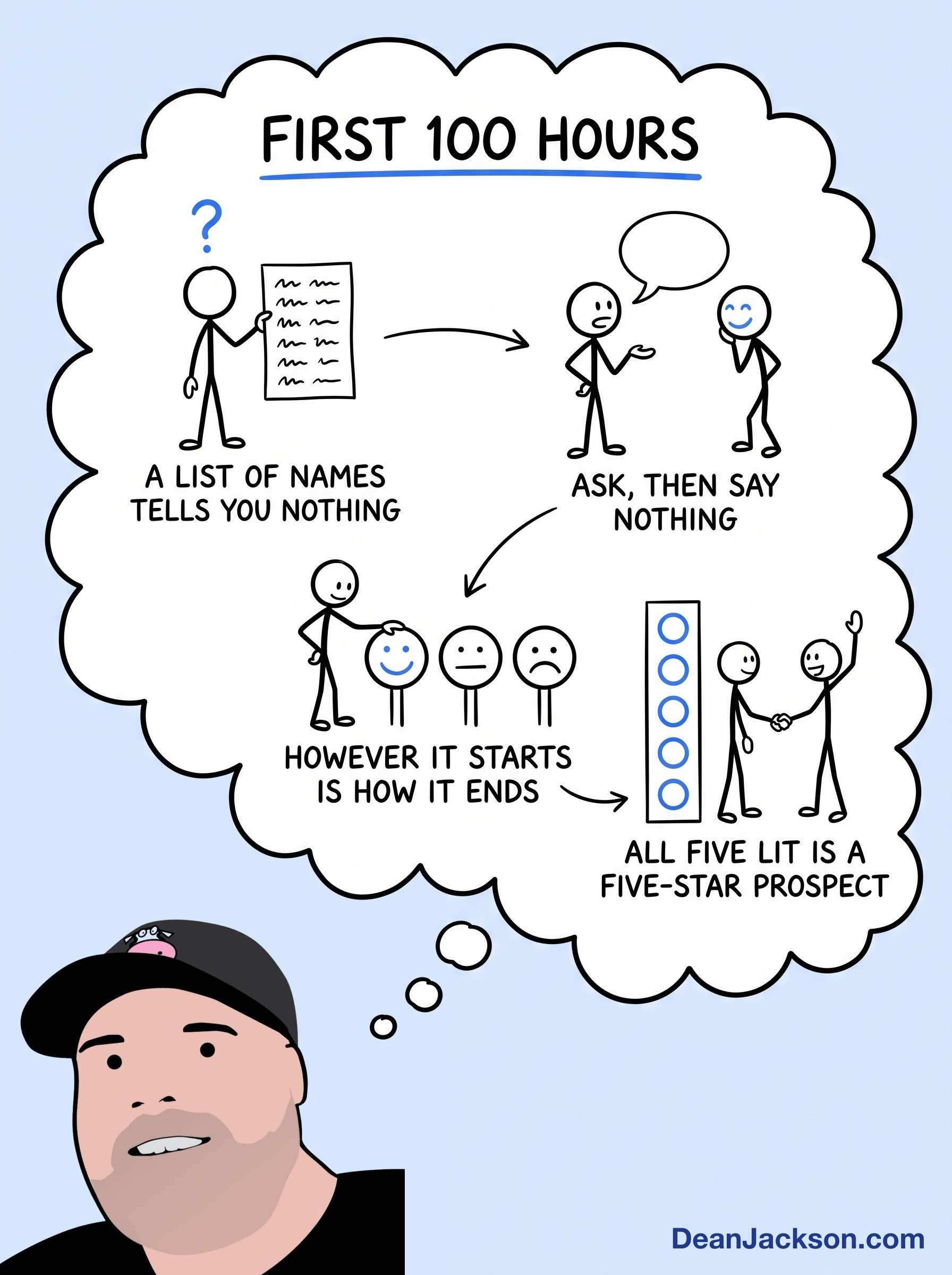
Not to sell anybody anything. To find out who's a five-star prospect.
Five things have to be true.
- They're willing to engage in a dialogue.
- They're friendly and cooperative.
- They know what they want.
- They know when they want it.
- And they'd like us to help them.
That's a five-star prospect. All five, or it isn't one.
Now, most people run at this backwards.
They start at number five. Here's what you should buy, here's the price, and the price goes away at midnight.
They're making the prescription before they've done any diagnosis. They don't know yet whether this is even somebody they can help.
I think about it like the staged lighting at the drag races. First light comes on, then the second, then the third. You go through them in order.
So start at the top. Are they willing to engage?
I build everything as though my phone only accepts incoming calls. So mostly I'm not chasing anybody... I'm making it easy for them to start talking to me.
And when you do reach out, do it with the true intention of connecting rather than closing. You can tell in the first thirty seconds.
When we were running the beach condo price report, the whole call was this.
Hi, it's Dean Jackson. I sent you the beach condo price report. Just wanted to make sure you got it.
That's it. Everything true, nothing pushy.
Then, once they're actually talking to you, ask the most neutral thing you can think of.
What are you thinking of doing?
And then shut up.
Because what happens in the next ten seconds is the whole thing. Is what comes out of their mouth coming through a smiling face... or is it hands-off and a bit resistant?
We've literally got smiley, neutral and frowny icons in the CRM for it.
I'm a big believer that however it starts is how it ends. It doesn't get better.
Somebody who's dismissive on the first call is not going to warm up into friendly and cooperative.
But when it goes the other way, listen to what you get.
Well, we've been vacationing in Longboat Key for years. Prices look like they're starting to come down. We're getting closer to retirement... might be time for us to buy something.
Now you're into whether they know what they want. Is this permanent? Are they snowbirds? Are they going to put it on Airbnb, because that rules out a lot of buildings.
Same thing with a fence. Do you need a fence right now, or have you got some time to plan?
A tree came down on ours, it's still lying there.
Or, we're building, the house is ready in about six months.
They'll tell you. People are much happier telling you their situation than being asked to confirm yours.
And what somebody volunteers is worth more than anything you had to extract.
Only when you understand what they want, and when they want it, are you ready to say here's how I can help you get it.
That's element five. And by then you're making the offer from a relationship, not from a standing start.
Stephen Covey had it right. Seek first to understand, then to be understood.
What you've got isn't interesting to anybody until you understand what they want.
So the job in the first hundred hours is to be responsive. Start the conversation, start the clock.
Don't send the download link and disappear. Don't let the leads pile up in a list somewhere while you decide what to do about them.
If half of these people are going to do something over the next hundred weeks, the only sensible thing is to find out which of them might do it now.
Tomorrow we'll talk about sorting them, and what to do with people at each stage.
Here's your nudge for today.
Take the next person who raises their hand and ask them what they're thinking of doing... then say nothing at all and see what comes back.
Join me live on the next free 50-Minute Profit Finder call, Friday, October 30 at 1:00pm ET. Save your spot →
Transcript
Auto-generated transcript, provided as supporting material. It may contain errors, and speaker labels are occasionally mis-attributed.
Good morning. Another beautiful day in Winter Haven, Florida. If you're playing along at home, this is Profit Activator week. And so far, we've talked about selecting your ideal dream clients, selecting a single target market, Profit Activator one.
We talked about compelling your best prospects to raise their hand. Talked about generating people in advance of what they're going to do. in profit activator 3. Yesterday we talked about the value of a hundred leads over a hundred weeks.
So it's a very very valuable proposition here. But let's talk about what do we do to educate and motivate these 100 prospects starting from the minute that they come in and what do we do in the first 100 hours of them being uh in our world. So if we say if somebody's downloaded a catalog for something for whatever it is a a fencing gate catalog or a deck catalog or a kitchen cabinet catalog whatever it is is a pretty good higher than uh good u expectation that if we take those people and check in with them a 100red weeks from now that many of them are going to have bought a fence or redid their kitchen or sold their home or whatever it was that we compelled them to indicate that they're doing. So our first job is to imagine these 100 people as a cohort rather than one and understand that you can't tell which individual people are the ones who are going to buy.
You can't tell it just by looking at a name and an email and a phone number. There's no uh information there for us. So, we have to treat everybody the same. And so much of this is your mindset.
So much of this is if you knew that the person if if we could like shine a light or put them through a sensor and they the ones who are going to buy would glow bright green that would be a real advantage. And that's what we're trying to create in these first 100 hours of somebody coming in. We need to find who are what we call fivestar prospects. In order for you to work with somebody, they need to meet these five criteria.
They need to be number one willing to engage in a dialogue. They need to not everybody is going to be willing to talk to you. Not everybody's going to be responsive to your emails or your texts or whatever it is. So, we're looking for the people that are willing to engage, people that are friendly and cooperative, that they know what they want and they're willing to share it.
They know what they want. They know when they want it. And they'd like us to help them. That's a five-star prospect.
That should be our objective in the first 100 hours. Not to sell them, but to inquire, to serve, to engage with them and figure out if they're a five-star prospect. Now, many times when people are taking an expense-based approach to this, they start at the bottom. Here's what you should buy and you need to buy it right now.
And this price is going away. If you don't buy midnight, this price is going to be you'll never get a lower price. And they're trying to they're saying to people, this is what you need and this is what you should buy and you should do it now. They're working backwards without even knowing whether somebody is a five-star prospect or whether they're this is what they need.
So I look at it that if all five have to be true, then we may as well start at the top and just see if they're willing to engage. And I look at this as like the staged lighting at the drag races where the first light comes on and then the second light and the third light and you have to go through that that process. So often we say to people like listen you can tell if you're making outbound followup to people which often I don't even do that. Most of the time, everything I'm looking at is built with a proposition of what would I do if my phone only accepted incoming calls.
So, I'm trying to get people to engage in a dialogue uh that way. Often, like pouncing on people is not the best thing uh that you can do, especially if you have that mindset that you're trying to get somebody to buy right now. Um, if you're reaching out with true intention of seeing, introducing, connecting with them, seeing if they're willing to engage and if they're friendly and cooperative, you can find that out in the first 30 seconds of talking with someone. You know, when we were doing the uh beach condo uh price report, we call people up and the whole conversation, you can tell from you just say what you're saying and always say the truth.
Hi, it's Dean Jackson. I sent you the beach uh the beach condo price report. Just wanted to make sure you got it. And then when they are engaged, when you're you know that they're on the phone and just asking them either a simple sorting question, do you need a condo right away or have you got some time to plan is a great way to give people the, you know, the sense that you're not just trying to get them in a beach condo today.
That it's okay, whatever the thing is. But I found that often just asking a neutral question that lets them take the the lead on this is we'd often ask them, "What are you thinking of doing?" "What are you thinking of doing?" is such a neutral.
We're not leading the witness in any way. We're not accusing them of of anything or we're not trying to pigeon hole them in a thing. And if you just say those words and shut up, what's going to happen next is every in that first next 10 seconds, you're going to see is what comes out of their mouth coming through a smiling face or is it coming from a handsoffish or a uh resistant tone? And we actually in the CRM have little icons for smiley face, neutral face, or frowny face.
And when you're talking with somebody, how I'm a big believer that however it starts is how it ends. It doesn't get better. Somebody who's like mean and dismissive and resistant, that's not somebody who's friendly and cooperative. But if you just start out offering valuable service to people, finding out what are you thinking of doing and they say, "Well, we've been vacationing in Longboat Key for a long time, lots of years.
We see that prices are starting to come down now. We're getting closer to retirement. Probably thinking it might be time for us to uh to buy something." And then that opens up a conversation now about do they know what they want?
And so the whole thing in knowing what they want is what now are the use cases? Is this going to be a permanent thing? Are they going to be snowbirds? Are they going to use it as a vacation property and rent it out?
Are they hoping that they're going to put it on Airbnb? Are they going to put it on Verbbo or whatever? Uh because different condo associations have different rules. So, if they're thinking that they're going to put it on Airbnb, then that limits the number of things.
But all of this is exploring what their desires are and spending a lot of time getting to know do they know what they want and helping them evaluate what they want and in that getting a sense of when the timing is. Now, the same thing is true if it is a fence or a gate. Is this Do you need a fence right now or have you got some time to plan? As a matter of fact, we just had a tree fall on the fence.
It's uh still down. We need to get that replaced. Or, oh, you know, we're building a house. It's going to be ready in about 6 months.
We're going to need to fence in this much. So people are telling you, give people a chance to tell you what their situation is. It's always better when people are voluntarily revealing information to you. And only when you understand what they want.
And the goal now is to educate and motivate them that you have the way to help them get what they want. And when you understand the timeline of this, only after that investigation and that conversation are you fully ready now to make your prescription in profit or in uh five-star prospect element number five to see would they like us to help them. And then when you make those offers, you're doing it from a foundation of a relationship, an engagement, a communication that you've established with them. So you can do this by email, you can do this by text, you can do it by phone, you could do it by carrier pigeon.
Whatever it is, you're sending a message that it's more important, like Stephen Covey said, to seek first to understand and then to be understood. It's not important what you want and what you've got until you understand that what you have is something that's going to help them get what they want. So, in that first 100 hours, that's our whole goal is to be responsive to people. We have a whole we take like a sevenstep connection process to try and uh engage with those people and start the clock.
Try and do it. Don't just let the leads pile up and and don't do anything or just send them the info and uh or send them a download link to download your book and then never reach out or have a conversation with them. We're trying to get a head start. If we know that 50% of these people are going to do something in the next 100 weeks, it only makes sense that we try if we can to sort them into a group of people who are ready to do something now.
So that's the that's the foundation here is job number one is to find the fivestar prospects. And then tomorrow we'll talk about how to after you've gone through that process to see how to sort people and what to do with people at the different stages. I got a funny email the other day from Rick. It says, "Dean, question.
Are you saying you can teach me to make fat stacks by hanging out at a pub drinking coffee like you?" And I laughed to myself because I was thinking, you know, yes, I I can do that. That's what I do. Is the funny thing, what I really realized is that every idea that I've had, every dollar that I've made over the last 30 years has gone through my brain, through my pen onto a piece of paper in my journal before it went out into the real world.
And if I can turn people on to that activity as a driver for what to do, what to think about, what to ask yourself to draw out, what the next most valuable action is for you, and how to find the most profitable things that you can install in your business. I'm all for it. m. I'm going to do for the first time a 50inute profitfinder workshop and you're going to join me live on Zoom and we're going to go through a 50inute exercise.
Bring your pen. Bring a notebook or piece of paper. And I'm going to guide you through a thinking process that will help you identify where the lowest hanging fruit is in your business and maybe some fruit that you didn't even know was there. But I'm going to show you where to look for it.
So, it's free. It's for you. m. this Friday.
Just watch. Go to What did we call the website, Josh? >> 50inut profitfinder. m.
Get BreakthroughDNA Free
Discover the 8 Profit Activators that can transform your business. Get the complete framework, free.