Getting Referrals: The Secret Psychology of Why People Refer
Watch
Listen
Profit Activator 8, and the finale. Nobody refers as a favor. They refer to be the hero of their own tribe. So stop asking people to talk about you.
Good morning.
Day twelve of Profit Activator week, and the last one. Profit Activator 8.
Thirty years ago, in journal number six, there were only seven steps. I've been working on this eighth one ever since, so let's finish the picture properly.
Nurturing lifetime relationships was never only about repeat business.
It was about referrals.
And there's a psychology to why people refer that most of us have completely backwards.
Here's the backwards version.
That referrals have to be earned. That somebody sending you a name is doing you a favor.
Which leads straight to compensating them for it. Incentivizing them. A finder's fee.
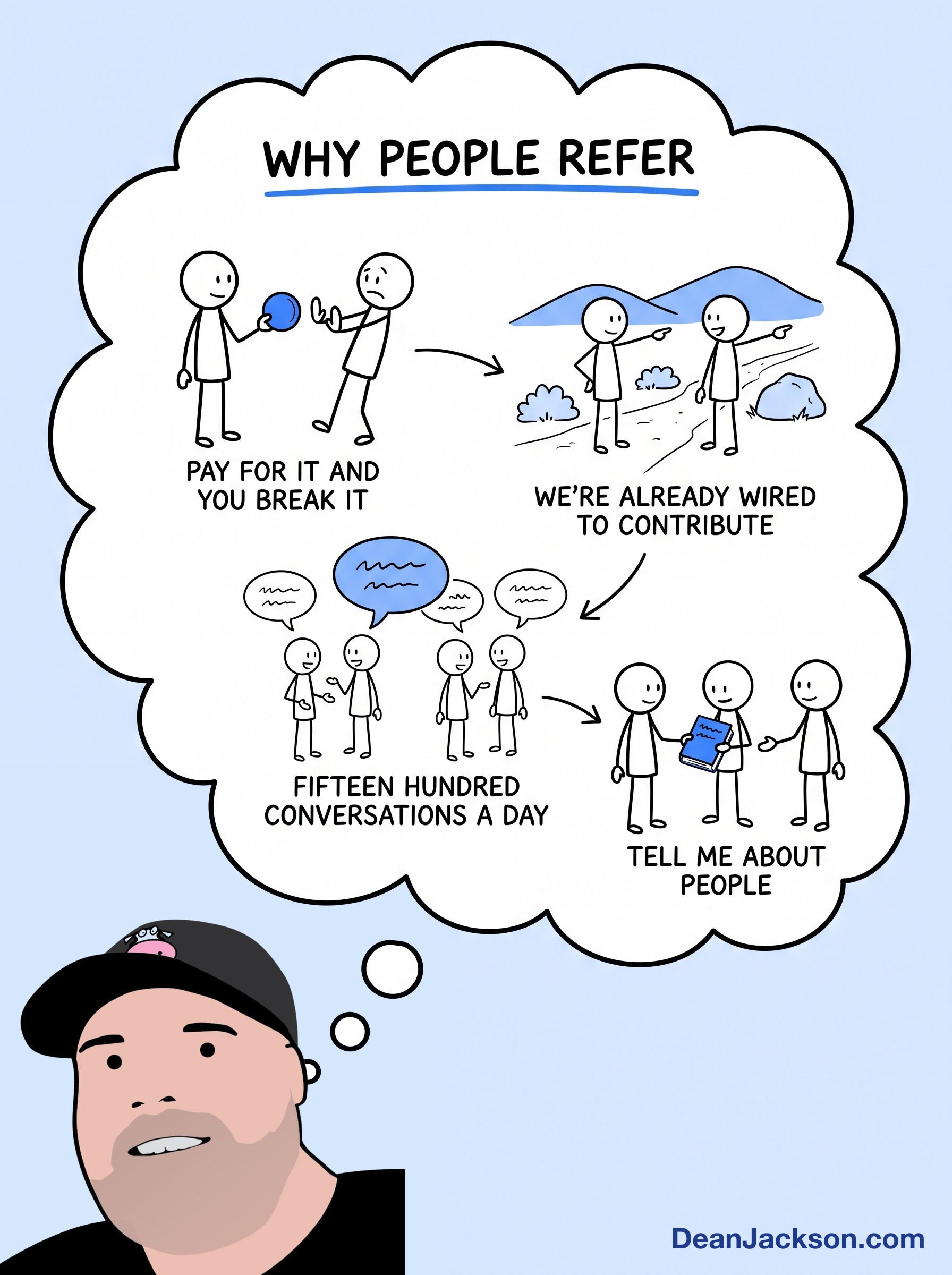
And the moment you do that, you break the thing that was already working.
Because we are already wired to add value to the people around us. It's not something you have to install.
Go back far enough and we're in tribes of about a hundred and fifty.
Robin Dunbar at Oxford put the number on it, and it's still the number. You can hold about a hundred and fifty relationships. You've got a hundred and fifty right now.
In a tribe that size you had to know everybody. And you had to be a contributor.
The worst thing that could happen to you was to be shunned.
So we contribute. Constantly. It's how we keep our status in the herd.
Let me put you out on the savannah.
I find a big patch of blueberries, gather some up, and on the way back to camp I run into Josh.
Hey. There's a blueberry patch over those hills. Go and get some... maybe Nancy makes her muffins tonight.
In that moment I am higher status than Josh. He's riding on my coattails.
So he immediately tells me to watch out behind those rocks, because he saw a lion on the way over.
Now we're both better off. And we're square.
That is still running. Every day. In every city.
It's why reciprocity works the way it does.
Dan Ariely has a lovely illustration of what happens when you put money into it. It's in Predictably Irrational.
Say I need to move a piano, and I call Josh and offer him twenty bucks to help.
Now he can do the math. Twenty dollars, that piano, those stairs... not worth it.
But if I just ask him, Josh, I need to move a piano, he's drawn to say yes. Because we're friends and I need help.
I think every piano ever moved by a friend was moved because a certificate came with it. Good for one reciprocal piano move, whenever you need it.
Bring the economic exchange in and you remove the social contract. So don't reach for it.
Now the mechanics.
Every referral you have ever received happened inside a conversation.
And in that conversation, three things had to happen.
They had to notice the conversation was about what you do.
They had to think of you.
And they had to introduce you.
Three things. Every time. Miss one and there is no referral.
We used to run big real estate seminars, and for three years running I'd have ten people stand up and tell me the story of their last referral.
Eighty percent of the time it was a stranger calling them. Hi, I got your name from Bob.
That's a passive referral. It's already done by the time you hear about it.
The other twenty percent was the client calling to say I was talking to my friend Nancy, you should call her.
That's a reactive referral. You react to it.
And then there's a third kind that I've never heard anybody talk about.
An orchestrated referral.
Here's the size of it.
You've got your hundred and fifty. Say each of them has ten meaningful conversations a day. It's far more than ten, but say ten.
That's fifteen hundred conversations a day. Nearly fifty thousand a month.
Your job is to program those hundred and fifty so that when the right conversation happens, they know exactly what to do.
Something happened to me that made this obvious.
Somebody in our real estate forum posted asking where they could get a carpet replaced that day. Closing tomorrow, and the painters had spilled paint all over it.
And my brain immediately started singing a carpet company's toll-free jingle.
Planted years earlier. Without my permission. Sitting there waiting for the words same day carpet.
Flip of a switch.
So here's the question I like to ask.
What if you could plant a chip in the ear of everybody who knows, likes and trusts you, and listen in on their conversations?
What would you program it to listen for?
What are the trigger words?
Bob's got a job transfer, we're moving to Poughkeepsie. We're thinking about a place in the country. The kids are graduating so we're downsizing. There's another baby coming and we need more room.
All real. All happening today.
Now here's the flip that makes it work.
Most of us tell our clients don't keep us a secret, tell your friends about us.
And they do it. They say you should call Josh, he's great, he sold our house.
Which quietly puts all three things back on them.
Instead, get them to tell you about people.
Just a quick note. If you hear anybody talking about selling their house this fall, and right after Labor Day is when they list, text me and I'll get you a copy of our book to give them.
Now it's easy. They're not selling anybody on you. They're handing a friend something genuinely useful.
And they get to be the hero inside their own tribe... which is the only thing they ever wanted.
Here's your nudge for today.
Write down the three trigger words that would tell you a referral conversation is happening.
Then write the one sentence that asks your hundred and fifty to tell you about people, instead of telling people about you.
Join me live on the next free 50-Minute Profit Finder call, Friday, October 30 at 1:00pm ET. Save your spot →
Transcript
Auto-generated transcript, provided as supporting material. It may contain errors, and speaker labels are occasionally mis-attributed.
Good morning. Welcome back to the exciting conclusion of Profit Activator Week. Even though 30 years ago in journal number six I wasn't referring to these as the eight profit activators — there was a seven-step process — I'm going to give you the eighth, because for 30 years now I've been working on and developing this, and it makes sense to give you the full picture right now.
The big thing I was including in nurturing lifetime relationships is getting not only repeat business, but doing additional things with people, and most importantly, getting them to refer people. So that's what we're talking about today: there's a secret psychology to why people refer, and in most cases, people get it wrong.
Fundamentally, people come from a position of thinking you have to earn referrals, or that people are doing you a favor by referring. So sometimes that leads people to think maybe we need to compensate people for referrals, incentivize them to refer. But the reality is, as a species, we're already inherently incentivized to add value to the people in our world.
Going all the way back to when we as humans started playing the cooperation game, we realized combined, we could have a better outcome than being rugged individual hunters on our own. The evolution of how we developed as a species involved banding together in tribes of 150 people — this is a known evolutionary psychology thing. Robin Dunbar at Oxford identified what's now called Dunbar's number: we're capable of holding about 150 relationships. Every one of you knows 150 people, and it's happening all the time.
When we were banding together like that, tribes stayed around 150, or split into two tribes beyond that, because you had to know everybody in the tribe — otherwise it was a potential threat. Part of our inherent wiring is to continue adding value to the herd. You had to be a contributor. You see it weaving through all our societal norms now — we want to keep proving our value to the herd, to raise and maintain our status. The worst thing that could happen is to be shunned. So we're constantly looking to contribute, to keep our tribes safe and bring good things to them.
In our modern world — cities — you don't know everybody, but we're all these intermingled tribes of 150 people, playing from the same playbook. That's why reciprocity works the way it does: if I do a favor for you, you owe me a favor, and we want to keep those things balanced.
Imagine we're out on the savannah, hunting and gathering, and I find a big patch of blueberries. I gather some up, run into Josh on the way back to camp, and tell him, "hey, there's a big blueberry patch over those hills — go get some, maybe Nancy will make her muffins tonight." In that moment I'm higher status than Josh, because he's riding on my coattails. So he immediately feels the need to tell me, "oh, watch out behind those rocks, I saw a lion on my way over here." Now we're both better off.
That dynamic plays out in modern society every day. We want to contribute information, share good news, be helpful. So instead of framing referrals as something you earn, or a favor someone's doing for you — tap into the idea that people want to maintain and improve their status in the herd. How can you make them look like a hero, earn status points within their herd? That's a completely different game than trying to incentivize people.
I've mentioned Robert Cialdini's book on influence, and there's another one on social psychology — "Predictably Irrational" by Dan Ariely. Ariely introduces the idea that bringing an economic exchange into something removes the inherent power of the social contract. For instance, if I need to move a piano and call Josh saying, "can you come help, I'll give you 20 bucks" — now I've put an economic value on it, and Josh can evaluate: "not worth it for $20." But because we have a relationship, if I just ask him to help move the piano, he feels socially drawn to do it, because we're friends and I need help.
Underneath it all, I believe every piano moved by a friend is only moved because they know that along with the piano move comes a "certificate" for a reciprocal piano move in the future. Maybe two years from now Josh needs to move a piano, and he knows he can call me, because I owe him one. This psychology, once you understand it, is fascinating — it's like getting in the jet stream of things that are already happening. We're a sharing species — constantly telling people about movies, Netflix shows, books, restaurants, vacations. And how we do that is in conversation. That's the important part.
Once you understand the psychology of why people refer, you can get into the mechanics of how referrals actually happen, and insert a way of tapping into that. All referrals happen as a result of conversation. In those conversations, three things have to take place: first, they have to notice the conversation is about whatever it is you do, or something that could turn into a referral for you. They have to think of you. And they have to introduce you to the person they've had that conversation with.
When we did the big real estate seminars, for the last three years, I'd have 10 people stand up and tell me the story of their last referral. 80% of the time, it was somebody calling them up saying, "I got a call from Nancy, who's a friend of Bob, and Bob told her I could help sell her house." The other 20% was the client calling: "hey, I was talking to my friend Nancy, she's going to sell her house, you should call her." Those are two types: passive referrals — they just call, it's already done — and reactive referrals — you react to somebody telling you their friend needs help.
The third type, which I never heard anybody talk about, is an orchestrated referral. This is where mastering the psychology of referrals really helps. If we know everyone's having conversations all day — I'm here at Honeycomb, and every one of these people behind me is having conversations. Say we have 10 meaningful conversations a day — it's way more, but let's say 10. Take your 150 people: that's 1,500 conversations a day happening, almost 50,000 a month. Your big opportunity is to program your clients so that when they hear the right conversation, they know what to do.
An example that made this crystal clear: we have a real estate group, and in the forum somebody posted, "does anybody know where I can get carpets replaced today? We have a closing tomorrow and the painters spilled paint all over the carpet, it's ruined." When I read that, my brain immediately started singing a well-known carpet company's toll-free number jingle. I knew that had been planted in my brain years earlier, without my permission, waiting to be triggered by "same day carpet." Immediate flip of the switch.
That's how you can tap into what's going on with your top 150 — the people who know you. So I ask people: what would it be like if you could plant a chip in the ears of all your potential referral partners — everyone who knows, likes, and trusts you — and listen in on all their conversations? What would you program the chip to listen for? What are the trigger words? If a trigger word happened and you got an alert — "referral conversation in sector 9" — what would you do?
Start thinking about what comes up in conversations: "Bob got a job transfer, we're moving to Poughkeepsie." "We're thinking about moving to the country." "The kids are graduating, we're going to downsize." "We're having another baby, need a bigger place." "We're looking for an investment property, thinking of doing a flip." All real conversations happening. If you can skillfully plant an opportunity for them to be a hero in that situation, that's amazing.
Say someone mentions selling their house, and you have a book called "How to Sell Your House for Top Dollar Fast," and one of your clients is a friend of that person. Imagine saying to your clients: "just a quick note — in case you hear someone talking about selling their house this fall (right after Labor Day is when people list, hoping to sell before year end) — if you hear that, give me a call or text me, and I'll get you a copy of our book to give to them."
Now it's so much easier for your client, who already knows, likes, and trusts you, to call you — and you're offering something valuable, a book, for them to give to their friend, to be a thoughtful contributor to their own tribe. It's much more likely for them to call you than to tell their friend to call you, because all three things still have to happen: notice the conversation, think of you, and introduce you.
Sometimes clients tell people about you — "you should call Josh, he's great, he helped us sell our house" — thinking they're doing the right thing, because you've told them "don't keep us a secret, tell your friends about us." They're doing what they think you'd love. But instead of saying "tell people about me," you want them to tell you about people. You want them listening for and recognizing conversations of people who are about to do something, and you offering them an opportunity — like a list of the 10 best flip opportunities in Winter Haven, or the 10 best horse farms, whatever applies.
Programming it like that is super valuable. Even offering something you could give them — a gift card, a free mosquito treatment — even better, because you're empowering people to fully introduce you to the people they're having these conversations with. Do that right, and you'll watch your referrals take off. Don't sleep on the referral opportunity.
I got a funny email the other day from Rick. It says, "Dean, question. Are you saying you can teach me to make fat stacks by hanging out at a pub drinking coffee like you?" And I laughed to myself, because I was thinking — you know, yes, I can do that. That's what I do. The funny thing I really realized is that every idea I've had, every dollar I've made over the last 30 years, has gone through my brain, through my pen, onto a piece of paper in my journal before it went out into the real world.
And if I can turn people on to that activity as a driver for what to do, what to think about, what to ask yourself to draw out what the next most valuable action is for you, and how to find the most profitable things you can install in your business — I'm all for it. So this Friday at 1 p.m., I'm going to do, for the first time, a 50 Minute Profit Finder workshop. And you're going to join me live on Zoom. We're going to go through a 50-minute exercise. Bring your pen, bring a notebook or piece of paper, and I'm going to guide you through a thinking process that will help you identify where the lowest-hanging fruit is in your business — and maybe some fruit you didn't even know was there, but I'm going to show you where to look for it. So it's free. It's for you. It's Friday at 1 p.m. This Friday. Just go to 50minuteprofitfinder.com and I'll get you all the details. And hopefully you can join us then, Friday at 1 p.m.
Get BreakthroughDNA Free
Discover the 8 Profit Activators that can transform your business. Get the complete framework, free.