Old Marketing Tools Still Work Just Fine
Watch
Listen
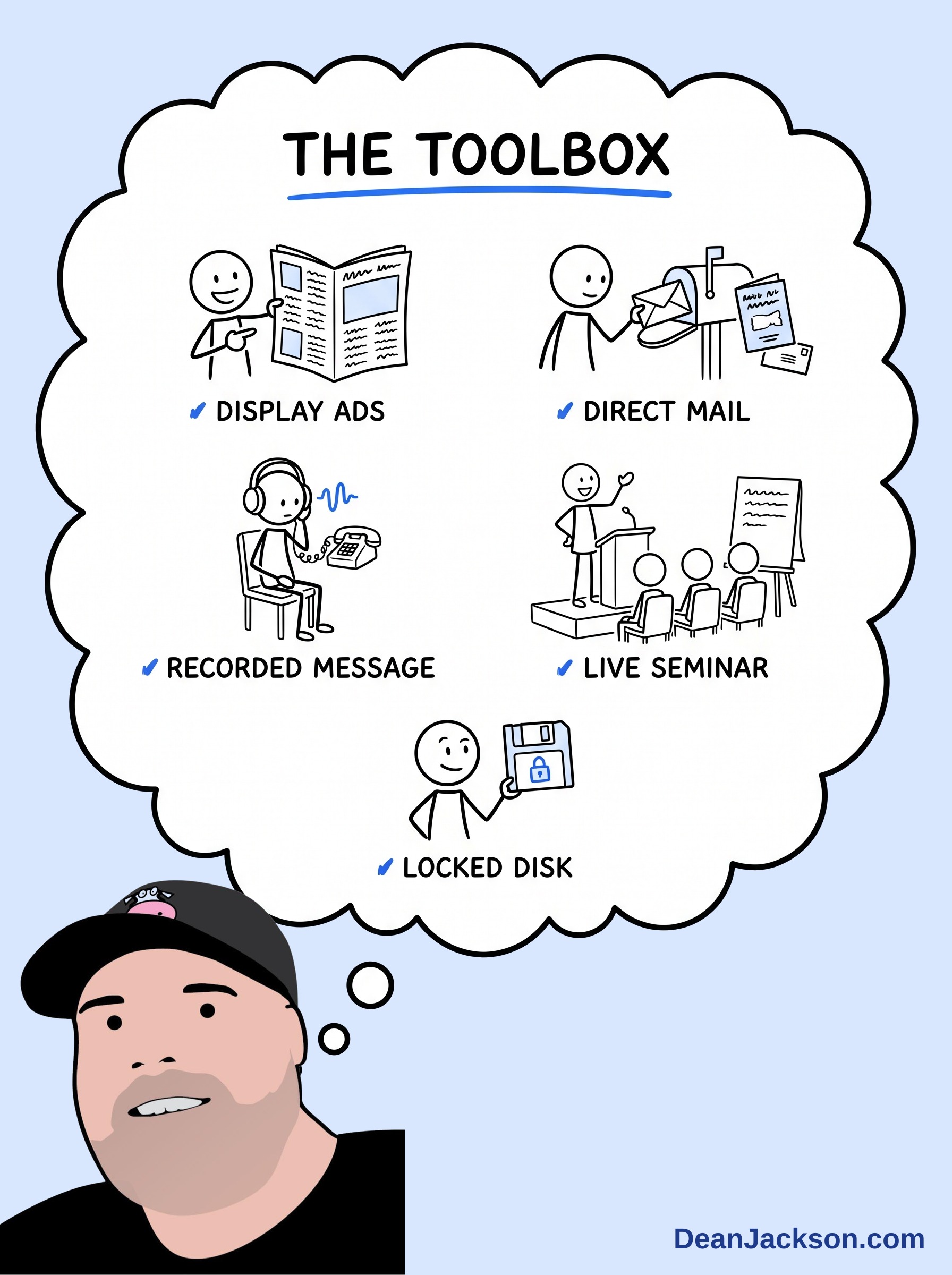
Journal seven, 1997. I made a list of every tool I knew how to use... and thirty years later almost every one of them still works just fine.
Good morning. We're heating up, working our way through the journals.
Journal 7. Summer of 1997.
And what jumped out at me today was a heading I'd written to myself.
What are the tools I know, or could know, how to use?
Because here's the thing about a tool.
Once you know how to do something, it ratchets in.
It goes in the toolbox. And it stays there. Ready to draw on whenever you need it.
So I made an inventory.
And what struck me reading it back... how many of these still work today.
First on the list. Direct response display ads.
The fastest way to get in front of the right audience.
Want to reach the whole town? Georgetown had two weekly papers, Wednesday and Friday. Run an ad, everybody sees it.
Want to reach specifically interested people? A page in a targeted magazine.
And now we take all of this for granted with Meta.
Meta is the new general display advertising. Same as putting out flyers to the whole population... except now you can target exactly who you want.
Here's the beauty of a display ad. When you find one that works, you run it again and again and again.
We had the book, How to Sell Your House for Top Dollar Fast.
In 1998 we contracted the newspaper to run the same half page ad every single week for a year. Paid it all up front. $10,000.
No changes. Same ad, fifty-two weeks.
We did $80,000 in commissions that year from people who responded.
And then another $80,000 the second year, from people who responded in the first year and sold later.
That's a display ad.
Next. Direct mail letters.
One of my favorites. You can mail a letter to an audience of one.
If you know exactly who you're trying to reach, you go directly to them.
People call direct mail old school. Postcards, letters, self-mailing booklets.
You could make a twenty page booklet, tabbed, mail it for one ounce. Eben Pagan and I would sit around dreaming up titles for those.
Classified ads. Little ads pointing to a free recorded message.
People call, leave their info, we mail the booklet, then follow up.
And the recorded message. 800 numbers.
Why did those work so well?
Immersive attention. In the moment they're listening, there's no distraction. Nothing to click. No way to skim or fast forward.
They hear it in the order you chose, at the pace you chose.
The modern equivalent is the VSL. The video sales letter. Get their attention, get them watching, let them take action right underneath.
Free books. Still my favorite thing to this day.
Using a book to say exactly what your audience would love to see.
Seminars. Getting people in a room live was the most efficient way to deliver a message on mass.
I started my homebuyer workshops as a realtor back in 1992. Ads, get people to the library, walk them through the process.
That became my six steps to home ownership show on public television.
And the model. Direct mail to a free seminar, to a paid seminar, to a coaching program.
That model built several businesses. Joe Stump, Eben, Terry Hunnefeld and me. Joe Polish did it with carpet cleaners. Dan Kennedy was action central for the whole thing.
That was information marketing. New at the time. From the early 90s to the late 90s, it was the thing.
Business reply mail. Another tool I knew how to use.
My very first postcards went to apartment complexes offering a book on how to buy your first home. A little coupon, drop it back in the mailbox.
And I'd get these stacks of cards. Because there was no website to send them to.
And here... on this page... is the first time I even mention the Internet.
In 1997, about 17% of homes had online access. That's why it isn't the whole story yet.
The one viable thing on the Internet in 1997 was email.
Websites were painful. Every pixel loaded slow, an image could take minutes.
But you could collect an email and send to a list. Autoresponders were becoming a thing.
And a sneaky one. Password protected disks.
Almost everybody had a computer. Almost nobody had the Internet.
So you'd mail a disk with the whole thing on it. A book, a course, templates. All locked.
They call in, leave the credit card, get the password. Now they unlock it.
And credit card processing itself was brand new. Figuring out how to take cards was a big deal.
That was state of the art, 1997.
And here's what hit me.
If I was limited to just those tools... I could build an empire on them alone.
They're still viable today.
So make your own inventory.
What are the tools you already know how to use? What can you deploy right now?
And then... what's the message you'll put through them?
Grab a pen and write your list today.
Transcript
Auto-generated transcript, provided as supporting material. It may contain errors, and speaker labels are occasionally mis-attributed.
Good morning. We are heating up. We're advancing through our journals. 1997, November. I saw.
No, it's actually sometime in the summer here. And what I was, what jumped out at me today was looking at the inventory of a heading called what are the tools I know or could know how to use? And this is fun, is thinking about. I would go through the things and think about how I could apply these things. Like, once you know how to do something, it ratchets in.
And now it's a useful tool in your toolbox that you can draw on to do something. So I look at, you know, the first thing on my list was direct response display ads. Now that was the easiest thing that you could do. If I think about it, I did. Before I turn on the camera here today, I was wondering, because I was thinking to myself, like, this is 1997 and I haven't even mentioned the Internet yet, but here's the page where I enter it.
And in 1997, at this stage they, the estimate is about 17% of homes had online access. So that's why it wasn't the, the predominant thing that we see now. So I'll be looking forward to kind of updating this, this tool list. But as I'm looking through it, I start to see how many of things that are still usable today. So direct response display ads was the fastest thing that you could get in front of the right audience.
Like, if you wanted to reach a local audience, the local newspaper was still a real thing. Even in Georgetown, outside of Toronto, it was a smaller town, 40 or 50,000 people. We had two weekly newspapers that would come out on Wednesday and Friday for the weekend edition. And if you wanted to reach everybody in town, you could run a newspaper ad and get your, your message in front of people. Magazines were the way to reach specifically interested people that you could run a page, you know, a display ad in magazines that were targeted to your specific group.
And, you know, all of these things now we take for granted with Meta. Like, I think meta is the new kind of general display advertising. We've talked about it like, as the equivalent of putting out flyers or, you know, doing things just to the general population, except that you could target now exactly who you're wanting. The good thing about display ads was that when you got one that worked, you could run it again and again and again and so much so, you know, we did some experimenting where I mentioned we had the book of how to sell your house for top dollar fast. And, and I had a great ad for that.
And we contracted, I think this was in 1998, we contracted with the newspaper to run this half page ad every single week for a year and pay them up front for the whole thing. So it was $10,000 to run the same ad every week with no changes. And that was about a $200 discount off of the rack rate of, you know, running a different ad every week. So yeah, we ran that, spent $10,000 over the course of the year, did $80,000 or $84,000 in commissions from people who sold their house because they responded for the, the booklet. And then in the second year did another $80,000 from the people who responded in the first year and sold their house in the second year.
So display ads are a, an amazing thing. We still use them in many cases like if you can be in a trade publication. Even a few years ago I was running full page ads in Success Magaz and you know, they're still a real viable thing to run direct response ads in publications. The other thing that I knew how to use were direct mail letters. That was one of my favorite things that you could mail a letter to an audience of one person.
If you know exactly who you're trying to reach, you can go directly to them. And that still the super advantage of direct mail. And it's funny that people use, you know, think about direct mail as old school and I'm talking about, you know, postcards and, and direct mail letters. And even I was, you know, starting to experiment with self mailing booklets. Like you could one ounce, you could create a 20 page, you know, eight and a half by five and a half, half of an eight and a half by 11 self tabbed booklet that would mail for one ounce.
And that was a really useful amount of space that you could do it. So Eben Pagan and I would constantly be coming up with these self mailing book titles that we could, that we could send. So we might run little classified ads. That's the next thing on here is classified ads to a free recorded message where people leave their contact information and we could send them this self mailing booklet as the response mechanism and then continue to follow up with them. So I, you know, I still love those small booklets on the things 800 numbers or recorded messages.
That was a wonderful thing how, you know, I'm sharing about recorded messages as a tool and I think that the reason that they were so effective is because you had immersive attention in the moment they were listening to your recorded message. There was no distractions, there was no Nothing else to click. No way to fast forward or to skim through something. You had to listen and present it. It was presented in the order and the at the pace that you wanted it to be.
And we could get people to listen to several minutes of a recorded message. Now the modern equivalent of that would be to send people to what's known as a VSL a video sales letter where you can get somebody's attention and get them to watch something and immediately take action right under, right underneath it. Free books is on my list of there and that's still to this day my favorite. My favorite thing is using a book to convey exactly what your audience would love to see. You're going to see coming up here.
Evan and I would spend so much time just coming up with book titles and there's some bangers in here. We may have to revive some of these seminars. You know at that point getting people in a room live was the most efficient way to deliver a message on Mass. I started doing my homebuyer workshops as a realtor in 1992. I would run ads, get people to come to the library and go through a process and that's what I turned into my six steps to home ownership TV show that I got on public television.
And I think about the business. I mean Joe Stump and Eben and I and Terry Hunnefeld built a very large coaching company based on inviting people to a three and a half hour workshop. A three and a half hour seminar in a ballroom in a hotel room to invite them to come to a thrift three day event in a bigger ballroom and then and offer them the coaching program and that model of direct mail to come to a seminar to learn about a paid seminar and the paid seminar to learn about the coaching. That model that built several businesses. Joe Polish did the same thing with carpet cleaners running display ads in super targeted trade publications.
In fact Dan Kennedy that's how we met was that Dan Kennedy was kind of action central for that emerging business. The most popular and maturing business model was information marketing. It was kind of a new thing and for that period from the early 90s to the late 90s it was the thing and then that started shifting into the online world of that magalogs. That was a fun one and I think we're now in catalogs. I would add on to that thing business reply mail.
That was a really good tool that I knew how to use and I used it in a lot of different things. The very first postcards that I sent used a business reply card and I mailed them to apartment complexes offering a book on how to buy their first home. And people would fill out the coupon and put it back in the mailbox. And I would get these stacks of cards of people replying because there was no way to send them to a website to fill it in or no on, on lead ads. A way for people just click a button and get it.
But business reply mail was an amazing thing. And I put an asterisk here because this right now, this is the first mention of the Internet. This is the first mention. And what I was thinking about from there was the, the autoresponders were becoming a thing. The viable thing about the Internet in 1997 was email.
That was the thing that you could keep count on the most. It was painful to load a website on the 1997 Internet because each pixel had to load and the pictures were painful. Might take, you know, minutes to download an image. So websites weren't really viable. But you could get somebody's email and create a list server that you could send out people there.
One of the like super stealth things that you could do was password protected disks. Computer usage was very high in 1997. Most people had a computer, but Internet was not a thing. So being able to mail somebody a letter and have a disk that had all of the information, like you could have a book or you could have a course, or you could have templates or whatever you wanted to sell, you could have those files on the disk, but they were password protected. So when somebody called to order or to buy, they called inbound order taking thing.
They would call and leave their credit card, pay for the thing, and then they would get the password to unlock the disk so that they could access what they wanted. That was a very clever thing that was just starting to happen. And then credit card processing was just figuring out credit card processing at that point. It was a big deal of how to get and take credit cards online. So that state of the art 1997, those tools, if I could, if I was just limited to these things, we could build an empire just on those things alone.
They're still viable today. So I think making your inventory of what are the tools that you know how to use, what are the things that you can deploy in your business and then what's the messaging that you're going to use to deploy these things to grow your business. Every idea that I've had, every dollar that I've made over the last 30 years has gone through my brain, through my pen, onto a piece of paper in my journal before it went out into the real world. And if I can turn people onto the that activity as a driver for what to do, what to think about, what to ask yourself to draw out, what the next most valuable action is for you and how to find the most profitable things that you can install in your business. I'm all for it.
So this Friday at 1pm I'm going to do for the first time a 50 minute profit finder workshop and you're going to join me live on Zoom and we're going to go through a 50 minute exercise. Bring your pen, bring a notebook or piece of paper and I'm going to guide you through a thinking process that will help you identify where the lowest hanging fruit is in your business. And maybe some fruit that you didn't even know was there, but I'm going to show you where to look for it. So it's free. It's for you.
It's Friday at 1:00pm this Friday, just watch. Go to what did we call the website?
Just go to 50 minute profit finder.com and I'll get you all the details and hopefully you can join us then. Friday 1:00pm.
Get BreakthroughDNA Free
Discover the 8 Profit Activators that can transform your business. Get the complete framework, free.