Before You Spend Thousands on Marketing, Run This $100 Test
Watch
Listen
A book from 1927 taught me to never spend big until a $100 test tells me I've got a winner. Here's the four-stage clinical trial I still run today.
Good morning. And I'm excited, because this kicks off a little series I've been promising.
All those books I was reading in 1996, 97, even earlier in my journey.
Because by 1997 I'd only been turned on to direct response advertising for five or six years. My true marketing education starts around 1991, 92.
And 30 years later there's one book I still read at least once a year.
My Life in Advertising, by Claude Hopkins.
If you follow any modern marketer worth following, there's a through line that runs all the way back to Claude.
I learned about him from Jay Abraham. And Jay is kind of the modern day Claude Hopkins. One of the greatest to ever live. I owe him a lot.
So we'll call this little series My Life Applying My Life in Advertising.
And right there in chapter one, on the very first page, is one of the things that has guided everything I do.
A conservative approach to advertising.
Here's the great thing about direct response. It's predictable. It's formulaic. Once you find an appeal that works, it's durable. You've seen the ads I made 30 years ago that still run today.
But they only work because I tested them.
And Claude has this line. All advertising disasters are due to rashness, needless and inexcusable.
Not failures. He's careful about that. We all attempt things that can't be done, because we're dealing with human nature. Wants, prejudices, idiosyncrasies.
But disasters? Those come from incaution.
And I've seen it again and again.
People come to me and say, we spent $70,000 on Meta ads. Or YouTube. Or direct mail. And it didn't work.
And honestly, it makes me cringe.
Because I can't imagine it. Direct response works right away if you've got a winner.
So here's how this evolved for me.
I think of new marketing almost like a pharmaceutical model. You're testing new drugs, so you run clinical trials.
And thanks to Meta, you can find out immediately whether you've got a winner or a dud.
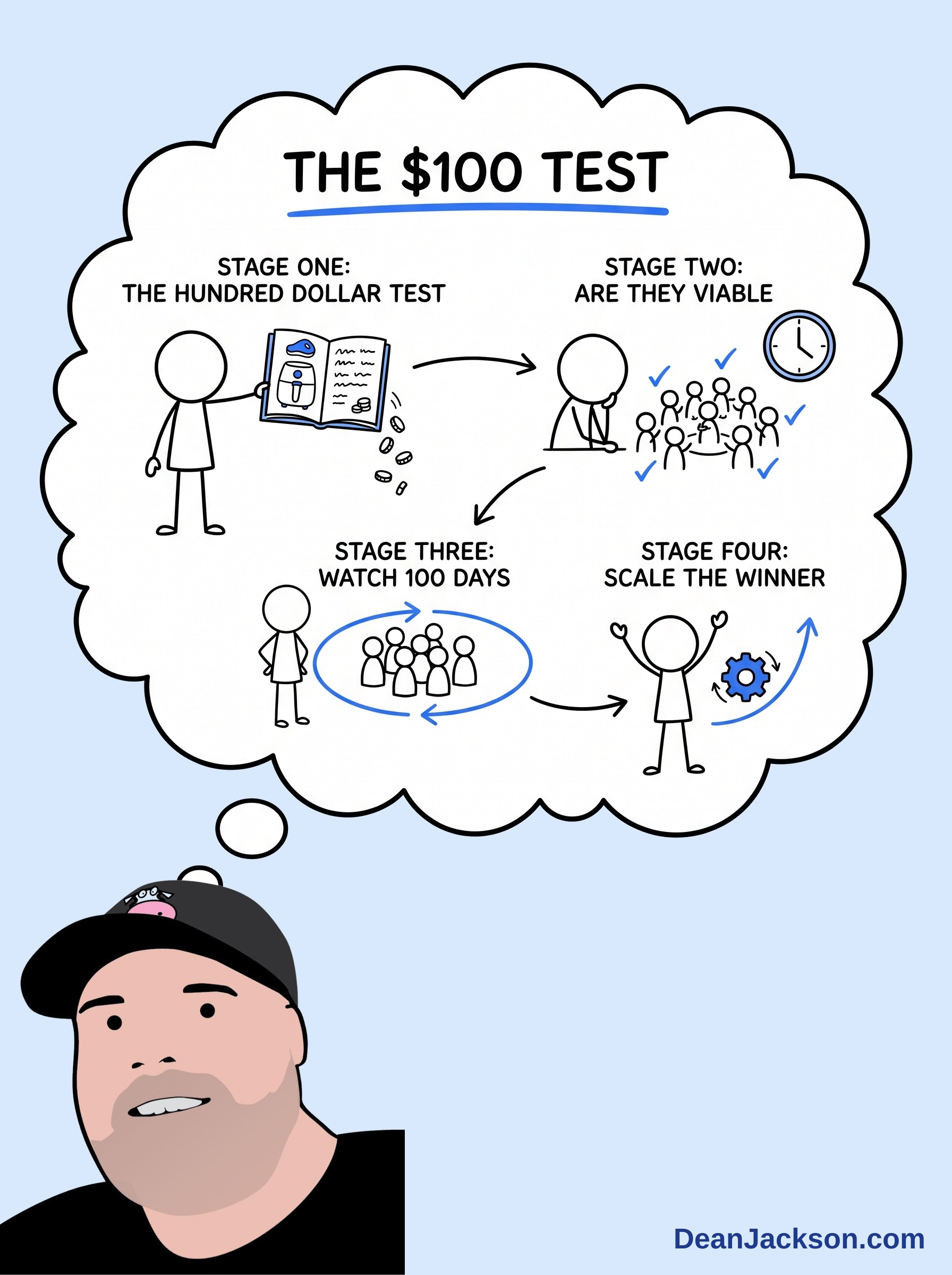
We do it in four stages.
Stage one is the $100 test.
Because to sell anybody anything, first you have to generate a lead. Find somebody who might be interested. That's the bottom line. Do you have an appeal people will respond to?
So we come up with a book title. A report. A catalog. Some offer. Can we identify the invisible prospects and get them to come to us?
Here's a recent one. I use Winter Haven as my little laboratory. No need to do anything grand.
We made a book called Air Fried Carnivore. Beautiful cover, an air fryer with a bounty of meat in it.
We go to a meat shop here every day, so the idea was to run this and generate business for the shop.
And the test is simple. $20 a day for five days. A hundred dollars.
And right away you can see. How many people respond. What the leads cost.
We could generate those leads for $1.68 each. Sixty-eight leads out of a hundred dollar test.
That's enough to move to stage two.
Stage two, we generate 100 leads. Should cost less than $200. Then we watch their first 100 hours. Are they opening emails? Clicking? Replying? Watching a video?
We want 50, 60, 70% engaged. Only then do we move on.
Stage three, we watch 100 days. Maybe $2,500. Twenty-five dollars a day for 100 days.
Do the leads stay stable? What happens to conversion from day one to day 100? That's the critical part.
Generate the lead. Spot the five star prospects. Educate and motivate them across those 100 days. And you get conversions.
Then it becomes a scale ready algorithm.
And it all started with Claude. Never do anything until you know the outcome.
Once you crack a code, it keeps working. I don't know why, but it's one of the most amazing things. Ads that run for years at the same cost per lead. Predictable.
And here's the funny part.
Somewhere along the way, entrepreneurism got equated with risk taking. Big bold moves.
And the more successful people get, the more daring they get. They've got money, so they'll waste it on something big because they think they need a bold move.
It almost seems ridiculous to walk into a multimillion dollar company and say, let's run a $100 test.
But that's exactly how you build a fail proof system.
You limit your downside. The winners are going to be the winners. And you'll know in a week either way.
Don't bet the big money.
Spend the hundred first.
Transcript
Auto-generated transcript, provided as supporting material. It may contain errors, and speaker labels are occasionally mis-attributed.
Good morning. I am excited because this will start a little series that I've been mentioning a lot of the books that I was reading in 1996, 97 and even earlier in my journey along learning marketing. And at this point 1997 had really only been turned on to direct response accountable advertising for five or six years. I learned 91, 92 is the beginning of marketing, my true marketing education. And now 30 years later, a book that I read, I don't know how many times I've read it, but I read it at least once a year and often even glance at it.
More than that is a book called My Life in Advertising by Claude Hopkins. And if you listen to any of the modern marketers, anybody who is someone you would know and follow, they can. There's a through line that goes all the way back to Claude Hopkins. I learned about Claude Hopkins from Jay Abraham. And Jay Abraham is a guy that personified all of the approaches of Claude Hopkins in his, in his life.
He's kind of the modern day Claude Hopkins and one of the greatest marketers to ever live. I owe a lot to Jay Abraham. But was I was looking in the book just to kind of see what are the specific things that I've applied. Like somebody might think what could possibly be relevant from a book that was first published in 1927, almost a hundred years ago this book was published and I owe so much to the lessons in this. And I'm going to give do a little series on the lessons that I've learned and applied and how I've applied them from My Life in Advertising.
So I think we'll call this little series My Life Applying My Life in Advertising. And right here in chapter one on the very first page of the book, one of the completely guiding things that I've done is take a conservative approach to advertising. The great thing about direct response advertising is it's very predictable and it's very formulaic. You know, once you get an appeal that works, it's durable. You've seen it, you've showed, I've shown you some of the ads that I was creating 30 plus years ago that are still working today.
But the reason that they work is that I've tested them and they are what Claude wrote a companion book to My Life in Advertising called Scientific Advertising and it's usually packaged together. But when he says in here, one of the greatest opening line of the book is the greatest event in my career occurred a year before I was born. My father selected for me a scotch mother and he goes on to say how she was very thrifty and she was very. Understood the value of a dime and could make that dime last and stretch. So he learned, was immersed in this idea of safety first and conservatism and treating other people's money like his money.
So he learned this very conservative thing, and this is very true because I've seen it happen again and again that he says on page two, all advertising disasters are due to rashness, needless and inexcusable. I do not mean advertising failures. All of us in this line attempt things what cannot be done. We're dealing with human nature, with wants, prejudices, and idiosyncrasies which cannot measure up. No amount of experience can guide us correctly in even the majority of cases.
That is why incaution is an advertising crime. In every advertising crime venture, we are dealing with a pig in the poke. And I thought, you know, it. The. The disasters that I've seen, I can't tell you how many people have come to me and said, we did this.
We spent $70,000 on meta ads or YouTube ads or direct mail or things that. That didn't work. And it's like, so. It's so. I don't know, it makes me kind of cringe.
It can't. I can't imagine that. Because what I've learned about direct response advertising is that it works right away if you've got a winner. And so here's how this has evolved to the approach that we currently take. I look at developing new marketing and as almost like a pharmaceutical model where you're pioneering and you're testing new drugs, and the way that the pharmaceutical industry does this is we've adopted this and we do what we call clinical trials of something.
And now, thanks to Meta, you can test something immediately and know whether you've got a winner or whether you've got a dud. And that's really all we're looking for in the beginning here. So we do it in four stages, where the first stage that we follow is what we call a stage one clinical trial is $100 test. So first thing, in order to sell anybody anything, you need to be able to generate a lead. You need to be able to find somebody who might be interested in that thing.
That's the bottom line. Do you have an appeal that people will respond to? So we will come up with a book title, or we'll come up with a report or a catalog or some offer to see. Can we identify invisible prospects? Can we get them to come to us?
One of the most recent ones. I live here in Winter Haven and I use all this as a little laboratory. Right. There's no need to do anything on a grand scale is we created a book called Air Fried Carnivore. And we had a beautiful cover with the air fryer with a bounty of meat in the air fryer.
And our thought was, because we go to this meat shop every day here in Winter Haven, that we would run this ad to generate business for the meat shop. And the thing was when we're testing like this, we take $100 test and run the ad for, you know, $20 a day for five days and we can tell whether we have a winner or a loser because we'll be able to see how many people will respond to the ad. It'll give us an idea of what the leads will cost. It ended up in our hundred dollar test that we could generate those leads for A$68 for. So every time we spent $1.68, we would get somebody who was attracted to the message of the Air Fried Carnivore.
We're given tips and recipes for air frying and the, you know, 68 leads came out of that for that hundred dollar test. And now that is enough to encourage to move on to stage number two is where we'll see what happens if we generate 100 leads. We should, that test should cost less than $200 to generate 100 leads at that and take them through our first 100 hours of them being in to see do we have viable prospects, Are they opening the emails, are they clicking on things, will they reply to something, will they watch a video? Just watch the activity and see whether we actually have viable leads for this. And our goal for this is that we get 50 or 60 or 70% of the people engaged after they've generated the lead and only then generated do we move on to phase three, which is to monitor this, see what could happen for 100 days.
So we may spend $2,500 on a stage three test where we'll do $25 a day for 100 days and we'll see that the leads stay stable. And what happens with the conversion process from day one to day 100. That's the critical point of this. And if you can figure out how to generate a lead in the beginning, identify who are the five star prospects, continue to educate and motivate them through that 100 days, we should be able to get conversions. And we get that now as a scale ready algorithm.
And that all started from this understanding In Claude's book of never doing anything until you know what the outcome is going to be. And once you crack a code, it continues to work. You've, you've, you've done it. I don't know why, but it's one of the most amazing things. We've got ads and lead generators that will continue for years to generate leads at the same cost.
It's very predictable. And so that's my, I think I owe that to Claude Hopkins from being introduced to that. And although I didn't have a scotch mother, I had a Canadian mother who was very similar in that way. You know, that was very conservative with, with money. And I learned from that, that same kind of in ground thing.
And I cringe when I see, you know, because sometimes the more successful entrepreneurs get, the more daring they get. And, and it's so, it's funny that entrepreneurism has been equated with risk taking and big bold moves. And I've seen again and again a lot of very successful companies, entrepreneurs, business owners that have money will just waste money on doing something big because they think that they need a bold move or they're taking a risk on something. It almost seems ridiculous for a multimillion dollar company to, when I propose something to them, let's $100 test or let's run three or $400 tests and see what happens. But it's the way of setting up a fail proof system.
You limit your downside and you, the winners are going to be the winners and you're going to know in a week anyway. Right? That's part of the, that's part of the big advantage of taking this approach. So that was very influential to me. And we're only on page two of the book.
So this series of my life applying my life in advertising, I think that'll be a really good interstitial here for us. So tune in tomorrow and we'll keep going. Every idea that I've had, every dollar that I've made over the last 30 years has gone through my brain, through my pen, onto a piece of paper in my journal before it went out into the real world. And if I can turn people onto that activity as a driver for what to do, what to think about, what to ask yourself to draw out, what the next most valuable action is for you and how to find the most profitable things that you can install in your business, I'm all for it. So this Friday at 1pm I'm going to do for the first time a 50 minute profit finder workshop.
And you're going to join me live on Zoom. And we're going to go through a 50 minute exercise. Bring your pen, bring a notebook or piece of paper, and I'm going to guide you through a thinking process that will help you identify where the lowest hanging fruit is in your business. And maybe some fruit that you didn't even know was there. But I'm going to show you where to look for it.
So it's free. It's for you. It's Friday at 1pm this Friday. Just watch. Go to.
What did we call the website, Josh Minute Profit finder. Just go to 50minuteprofitfinder.com and I'll get you all the details and hopefully you can join us then. Friday, 1pM.
Get BreakthroughDNA Free
Discover the 8 Profit Activators that can transform your business. Get the complete framework, free.