If you insist on calling prospects - just say this and shut up.
Watch
Listen
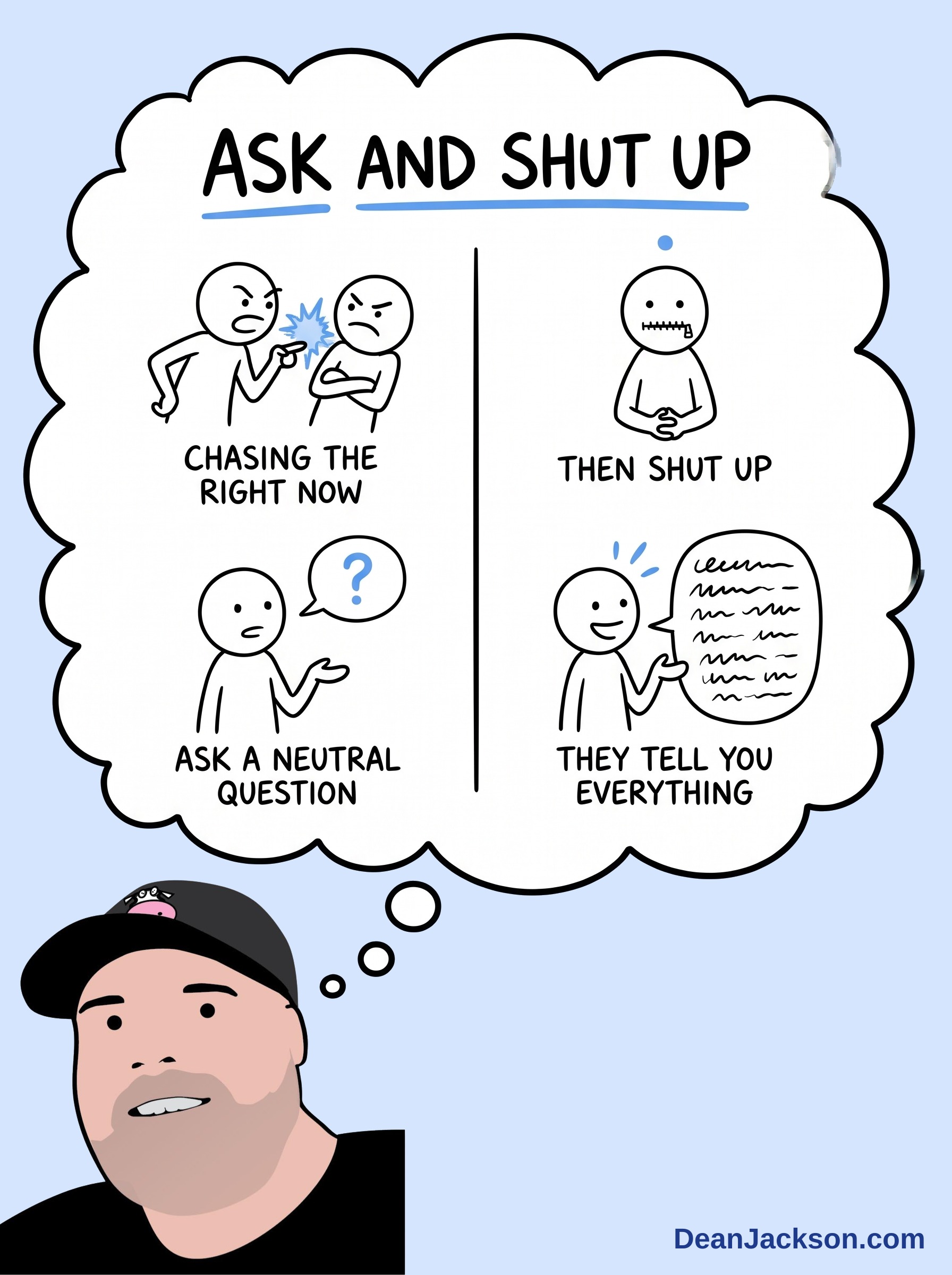
If you insist on calling your leads, ask one charge-neutral question, so what are you thinking of doing, and then shut up and watch what happens.
Good morning.
Journal number nine. First quarter of 1998. Winter Haven, Florida.
And yesterday I told you that you probably shouldn't call your new leads.
Because most of the time, in my experience, it only damages things more than it helps.
Think about the mindset of the person doing the calling.
They're calling to find out whether these are good leads or not.
And they decide the good ones are only the people who answer the phone and are willing to talk.
It's not true. It's just not true.
Now, one way to exempt yourself from feeling like you need to call at all... is to do a better job at the intake.
Give people more room to tell you about their situation. Voluntarily. Because it's in their own self interest.
Here's where I first saw it.
We were running recorded messages for our real estate guides. The guide to Winter Haven house prices.
And I'd say, thanks for calling, just leave your name, your address, your phone number, and we'll mail your guide out to you.
So they did. Name. Address. Phone. Click.
That's exactly what I asked them to do.
Then I added one line at the very end.
Also, tell me a little about the kinds of houses you're interested in, and I'll send some information specific to what you're looking for.
Night and day.
Suddenly people told me their whole situation.
And this ties back to Homer.
I found Homer McDonald in USA Today. We struck up a relationship and did a book called Stop Your Divorce.
Homer was an amazing mentor. I learned so much about psychology from him.
Even Gary Halbert called that book one of the best books about marketing... because it's more about human psychology than it is about saving a marriage.
It's just as relevant for getting any person to see things your way.
And when I unpacked Homer's sales process, here was the magic.
People would answer his ad, listen to a message, get a letter, then call to ask about counseling.
And Homer would just say, tell me about your situation.
That was it. Then he'd shut up.
And they'd tell him the whole story. Everything he needed to know.
See, the trick is to ask something charge neutral.
Because people can be oppositional. In NLP we call them matchers and mismatchers.
A matcher goes along with where you're leading. A mismatcher does the opposite.
And if you don't have the chops to read that and steer it, it gets frustrating fast.
But a charge neutral question gets out of the way. Now they have to tell you what they want.
So here's the one we settled on.
So what are you thinking of doing?
That's the whole thing.
And by the way, today you can have an amazing version of this by text or email without ever talking to anybody.
Because what we're really doing is discovering the five star prospects.
Somebody willing to engage. Friendly and cooperative. They know what they want. They know when they want it. And they'd like you to help.
All five of those.
But if they're not ready right now, they might be reluctant to start the conversation... because they know you're a trained salesperson trying to get them to do something today.
And most people only judge a lead by whether they're ready right now.
Instead of, are they willing to engage. Are they friendly and cooperative.
So if you insist on calling, focus on just that.
Hi Josh, it's Dean Jackson, I sent you the fence catalog by mail, wanted to make sure you got it.
Whatever comes back is said through a smiling face or a frowny face.
You can tell in the tone. Dismissive, contrarian, negative.
How things start is usually how things end.
But if they're friendly, and they're smiling, then you ask... so what are you thinking of doing. And shut up.
Now you get to see. Do they have batteries included? Do they know what they're trying to do?
Here's what's costing people so much money.
Before they'll even send information, they want a quick call, just a couple of quick questions, book a time.
Essentially saying, you get nothing until I know you're a good prospect.
And they're turning off more people than they gain.
So just see if people are willing to engage.
And sometimes the best thing you can do is be open to it being a while.
In text and email, my very first question is built to discover exactly that.
Hey Josh, I sent the fence and gate catalog, wanted to make sure you got it. Do you need a fence right away, or have you got some time to plan?
That either or gives people such freedom.
They trip over themselves. Oh no, we've got plenty of time to plan.
And when you say that's okay, you're already miles ahead of everyone else talking to those same people.
Because everyone else is only chasing the right now.
So ask the neutral question. Gather everything you want.
Then keep serving them. On all the levels. What I've come to call the lead conversion love languages. With no expectation that they jump on a call today.
You're going to win.
So if you insist on calling... just ask a neutral question. And then shut up and watch what happens.
Join me live on the next free 50-Minute Profit Finder call, Friday, November 27 at 1:00pm ET. Save your spot →
Transcript
Auto-generated transcript, provided as supporting material. It may contain errors, and speaker labels are occasionally mis-attributed.
Okay. Good morning. All right, we are back. Journal number nine, first quarter of 1998, here in winter Haven, Florida. And yesterday I mentioned that you probably shouldn't call your new prospects, call new leads, because in my experience, most of the time, it's only damaging the situation more than it's helping. Because the mindset that people have when they're calling is that they're calling to find out whether these are good leads or not. And they equate that only the ones that answer the phone or are willing to talk are the good leads. And it's not true. It's not true. But I was looking in this journal, if you remember.
I was just getting started with Stop your divorce. We. I found him, found Homer McDonald in USA Today. We struck up a relationship. We did a book called Stop youp Divorce. And Homer was an amazing mentor. I mean, I learned so much about psychology and so much so. Even Gary Halbert said the book about the book, Stop youp Divorce, Gary Halbert called it one of the best books about marketing because it's more about human psychology than it is about. About saving a. Stopping a divorce. It's just as relevant in getting any person to see things your way. And that's a pretty. That was a pretty core thing that I learned from Homer.
Now, there's a couple of things that are converging here when one way that you can exempt yourself from having or needing to call your leads is, or feeling like you need to call them is to do a better job at the intake of them, to give them more opportunity to tell you about what their situation is or to voluntarily ask for or volunteer more information because it's in their self interest. So one of the ways that I did this was a. When we were using the recorded messages, one of the things that I did was changing just the very end of the message we would have.
We were using it for our real estate guides for the guide to Winter Haven house Prices. And I started it out with the guide to Halton Hills. But when people called, I would just ask them on the message, say, thanks for calling. Just leave your name and your address and your telephone number and your email address if you have one, and we'll mail out your. Your guide to you. And then when I added at the very end of the message, just saying, also, tell me a little bit about the kinds of houses that you're interested in, and I'll send some information specific to what you're looking for.
And it was night and day. It was really amazing that the messages up to the moment that I made that change, people were saying they'd leave their name, they'd leave their address, they'd leave their telephone number, and then they'd hang up, because that's what I asked them to do. But as soon as I said, tell me a little bit about the kinds of houses that you're interested in, they would tell me their whole situation and. And fast forward. When I was working with Homer, one of the things that I did in kind of unpacking his sales process, we would run classified ads. We would get people to listen to a recorded message.
They'd leave their information, we'd send them a letter, and then they would call Homer for. To inquire about counseling. And Homer told me this, the magic phrase that he would say to people, he would ask them, what's your situation? So tell me about your situation. That was it. And then he would just shut up and they would start telling the whole story, and he would learn everything that he needed to learn about them and just kind of steer it in the right direction. And so I've used this model of not, I think in legal terms, you might call it like leading the witness, but when you use charge neutral things that they have to now tell you what they want, it's sort of a.
Because sometimes people can be oppositional or they can be, you know, in nlp, we call them matchers or mismatchers. So if you say a position of somebody is a matcher, they might go along and agree with you with what you're saying or where you're leading. If they're a mismatcher, they might go the opposite of what you're saying. And if you don't have the NLP chops to understand and interpret that and lead the conversation in the way that you want it to go, it can be frustrating. So the thing that makes it easy for anybody to get better results when they're talking to prospects is to ask a charge neutral question.
So we've started when we were doing the guides or the beach condo price report or any of the things that are inquiring or the. Any of the catalogs. The first question when we're talking with people is the. Is asking them, so what are you thinking of doing? So what are you thinking of doing? That is it. So the question, you know, when we would call with the catalog people, for instance, and by the way, in these days, we're in a situation right now where you can have an amazing interaction with somebody by text or by email without ever having to talk to them. So part of the thing that we want to do when we're filtering, when we're looking to discover, and I use that word intentionally to discover the five star prospects, people either are or are not five star prospects.
And that means that they are willing to engage, they're friendly and cooperative, they know what they want, they know when they want it and they would like us to help them. Somebody has to be all five of those. But if they're not ready right now, they may be reluctant to start the conversation because they know that you're a trained salesperson and your job, you're trying to get them to do something right now. And most people only evaluate the quality of a lead by whether they're ready to do something right now. Instead of the, those parameters of looking at the, you know, are they willing to engage, are they friendly and cooperative?
So when we're making outbound calls, if people are insistent on it, the main thing that we focus on is determining is somebody a five star prospect, are they friendly and cooperative and do they know what they want? Those are the first three things. And you can get that in the first 30 seconds of a conversation. If you call somebody and you're, you know, we just say to them, hi, Josh, it's Dean Jackson. I sent you the Fence catalog by mail. I wanted to make sure you got it. And there, whatever comes back from them, whatever they say is going to be said through a smiling face or a frowny face or a dismissive face.
You can tell by the tone if they're like dismissive, if they're in any way sort of contrarian or negative or any of that. How things start are usually how things end, right? But if somebody does say, yeah, I got it, or they say, oh yeah, and they're friendly and they're smiling and then you ask them, so what are you thinking of doing? And then shut up. Now we get to see do they have batteries included? Do they know what they're trying to do? And that can make the biggest difference in the way that these, the way that these go. Because I mentioned, you know, I often will ask for things just to see what people, how people respond.
And sometimes you get inundated where before they'll even send information to you, they want to jump on a quick call or just got a couple of quick questions or all of these things that are essentially saying you're not going to get anything until I know that you're a good prospect. And you know, it's a, I think it's costing people a lot. It's costing people a lot of money. They're turning off more people than they're actually gaining by being that, I don't want to say aggressive, but that insistent on that. Only the people that'll jump on a call or that'll schedule on your calendar book a time, all of those things that they're the real ones.
So just see if people are willing to engage. And sometimes the best thing that you can do is be open to it being a while. In email and text dialogues, the very first question that we ask people is to discern whether they're ready or want something right now or whether they are down the track. So when we say we would send the fence and gate catalog, we would text somebody as a follow up or email them and say, hey Josh, I sent the fence and gate catalog by email. Wanted to make sure you got it. Do you need a fence right away or have you got some time to plan?
Asking that either or gives somebody an amazing freedom to feel that it's okay. They trip over themselves to tell you, oh no, we've got plenty of time to plan. And that when you acknowledge that that's okay, you're already so much further ahead than everybody else who's trying to talk to those same people because they're only focused on the people that are right now. So when you do follow up or you do talk to them and you just ask that neutral, what are you thinking of doing? You're going to gather all the information that you want and then if you just continue to serve those people, to institute what I've come to call these lead conversion love languages, where you're touching people on all the levels and serving them without the expectation that they're going to jump on a call or that they're going to do something right now, you're going to win.
So if you insist on calling, just ask a neutral question and then shut up and watch what happens.
Get BreakthroughDNA Free
Discover the 8 Profit Activators that can transform your business. Get the complete framework, free.