How to know how much you can pay for leads
Watch
Listen
How much can you afford to pay for a lead? Start with what one transaction is worth, use the 1% rule, and work backward. A Realtor example.
Good morning.
Here's one of the most valuable things you can know. How much you can afford to pay for a lead.
I'm back in 1998 in the journals, and this is all over these pages.
The beautiful thing about direct response is that it's accountable.
The whole point is to get a response. Generate a lead. Find the five star prospects. Do business with as many of them as you can.
And once you've got a track record, you know your maximum allowable cost of acquisition. And how many leads it takes to get there.
But even the mechanics of how you think about the numbers matter.
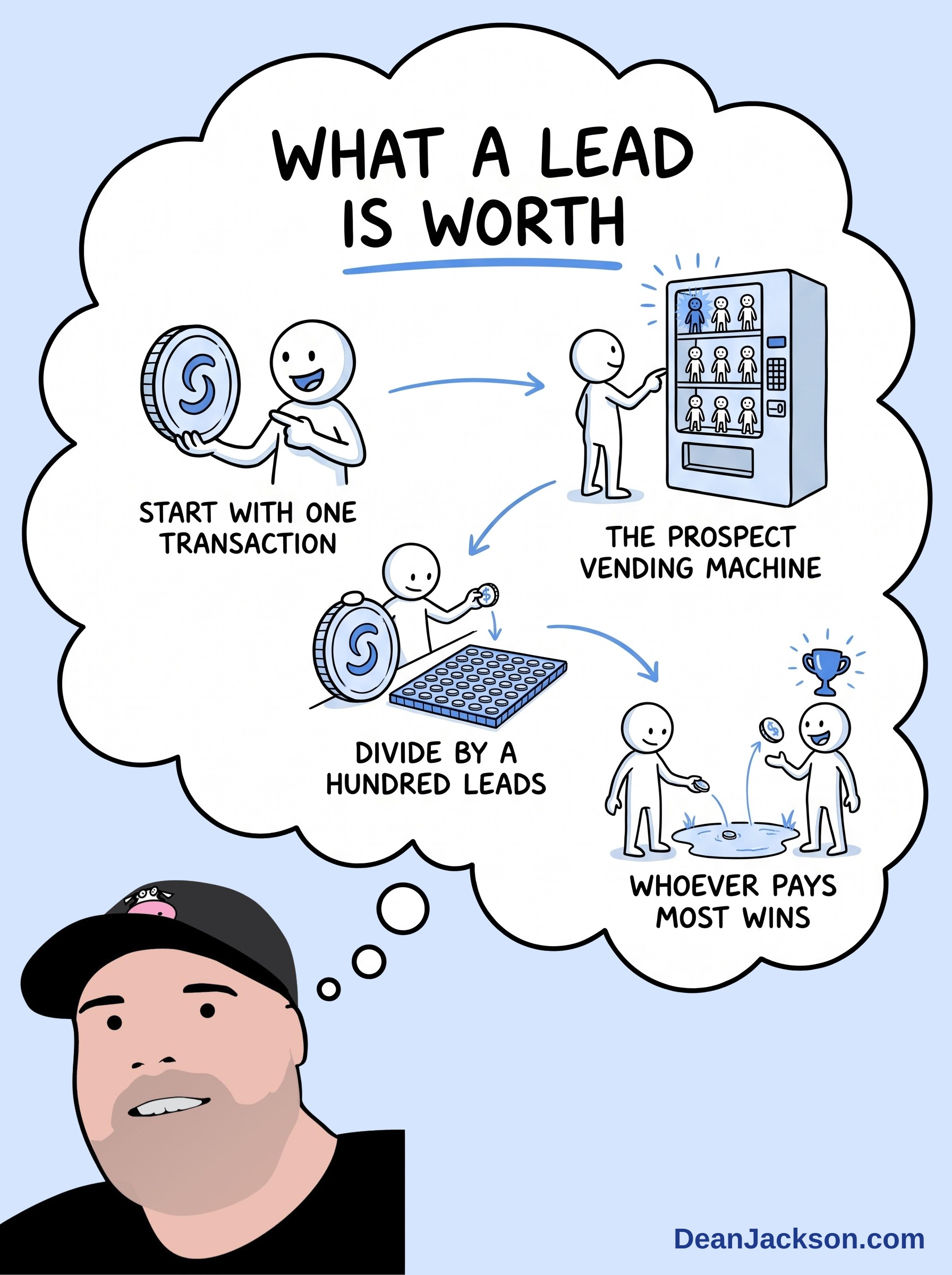
So picture the prospect vending machine.
You want that level of predictability. You know who you want to attract. You put them in position 1A. And you wire it up so when you press 1A, you know exactly what you can afford to pay to get them.
Begin with the end in mind.
Start with what one transaction is worth to you.
Let's use a Realtor. You can apply it to whatever you do.
Say a commission on one side is worth $10,000. A four hundred thousand dollar home, two and a half percent.
So when you land that buyer, that's a ten thousand dollar outcome for you.
Now the question. How much would you cheerfully pay to have that commission in your hand?
In real estate there's a whole marketplace for this. Refer a transaction to a Zillow agent, they'll pay up to 40% for it.
Dave Ramsey does the same thing. He's got an amazing audience that does what Dave says. His endorsed local providers pay 40% of the transaction to get it.
That's the certainty. You can buy the result.
But here's the game. Can you do it for less on your own?
You most certainly can.
So let's say your maximum allowable is $4,000. That has to cover all the leads, and how many leads it takes to get a client.
I treat these like clinical trials. Test what the leads cost, anticipate the conversions.
Let's be super conservative. A 1% conversion.
So you generate 100 leads and convert one.
Take the $4,000, divide by 100 people, and you get $40 per lead.
That's a good number for a real estate transaction. If you can generate leads for up to $40, you only need 1 in 100 to make it work.
That's the rule of thumb. Base your projections on a 1% conversion.
Which means you can afford to pay up to 1% of your maximum allowable cost of acquisition.
So say you sell something at $1,500 and you'd happily pay $500 for a sale.
One percent of that is $5 per lead. Generate 100, convert one, into your fifteen hundred dollar program.
And the good news is lower priced things usually have higher frequency.
But it's a great sanity check.
People tell me they want to generate leads for a $79 book. How much could you afford to pay for those?
Lead generation makes sense where you've got a nice margin to allocate.
I see this with services. Car detailing. Lawn care. A handyman.
Most people start out pricing on time and materials. They don't allocate any margin for acquiring customers.
You've got to begin with that in mind. Price it in.
Because here's the bottom line. The more you can pay to acquire a customer compared to your competitors, the better off you are.
Dan Kennedy says it. The person who wins is the one who can afford to spend the most to acquire a customer.
And the way you get to spend more is you have more opportunity with that one customer.
Bring them in, run them through your process, and multiply them all along the way.
Half of the people you do business with turn into an additional transaction. You nurture lifetime relationships. You get a 20% annual yield on that portfolio.
There's so much extra in there that you can afford to pay more.
And I'm not even counting better conversion over time. I'm just talking short term, 1%.
Whatever you do in the first 90 days is three to five times more beyond 90 days.
So there's real equity in stocking your pond with qualified leads.
Work out your number. Then go win.
Join me live on the next free 50-Minute Profit Finder call, Friday, November 27 at 1:00pm ET. Save your spot →
Transcript
Auto-generated transcript, provided as supporting material. It may contain errors, and speaker labels are occasionally mis-attributed.
Good morning. Okay, so one of the biggest questions that is an advantage for you to know is how much you can afford to pay for a lead. And I was noticing in my journals here, it's 1998. And, you know, the good thing about doing direct response advertising is that it's accountable and that, you know, the whole point of doing it is to get a direct response to generate leads, identify who the five star prospects are and do business with as many of them as you can. And when you have enough of a track record of that, you establish what your maximum allowable cost of acquisition is and what the number of, the number of leads that it takes to get that.
But here's how even just the mechanics of how you think about those numbers matters. So I always talk about this idea of setting up a prospect vending machine. And we want that level of predictability. We want to know who it is that you want to attract. We want to put them up in position 1A on that vending machine, and then we want to wire it up so that when you go over here and press 1A, you know how much you can afford to pay to get those, to get that prospect. So we begin with the end in mind. Let's work it out on what one transaction is worth to you.
So I'll use a Realtor as an example and then we can apply it to whatever your situation is. But if we look at it that on average, let's say that an real estate commission, one side of a transaction now, is worth $10,000, $400,000, average price range, 2 1/2% as at least kind of what, what people are going to get there. So we know that when you get a $400,000 buyer, you're going to get a $10,000 outcome for you. Now the question becomes, is how much would you cheerfully pay to have that $10,000, that $10,000 commission in your hand? And in real estate, there's an established kind of marketplace for this, that if you're with, if you're one Realtor referring another transaction to somebody, you're a Zillow agent, that they will generate the lead for you, refer the lead to you, and you'll pay up to 40% of the transaction for being the person that you are.
Dave Ramsey does the same thing. Everybody, he's got an amazing audience that does what Dave says to do. And he has a whole network of what he calls his elp, which is, are his endorsed local providers. So they're willing to pay 40% of the transaction to Dave, to get that. Now that's the certainty. But here's the game is can we do it for less on your own? And you most certainly can. Now here's how we think about it. That let's say that we were targeting. We know that your maximum allowable is $4,000. So that has to account for all of the leads that we generate and how many leads it takes you to get a client.
So when I look at this, I've got lots of, you know, when we were setting up these benchmarks, I mentioned how we look at things as clinical trials where we look at things to see how much we can get the leads for and anticipate what our conversions are going to be on those. So let's just use super conservative at a 1% conversion rate. Let's say that we generate 100 leads and we're going to convert one of those. So in the easiest terms, if we're willing to spend $4,000 for, for a guaranteed transaction and we're going to convert at least one of a hundred of those into a, into working with us, that means that we can divide that $4,000 by 100 people and that gives us a number of $40 per lead.
Now that's a pretty good number for a real estate transaction. If you can generate those leads for up to $40, that means that you only need to convert 1 in 100 to make it work out for you. So if you've got a lower priced thing, but there's maybe more frequency involved in it, our rule of thumb for what we're looking for is to base the speculation or our projections on a 1% conversion. So that means that we can afford to spend up to 1% of what your, your maximum allowable cost of acquisition is. So let's say that you sell a product that sells for $1000 or $1500 and you'd be willing to pay up to $500 for a sale for that $1500 sale.
If we take that 1% rule of thumb, that means that you could afford to pay $5 per lead to generate 100 leads and, and convert one of those people into your $1500 program. Now the good news is that typically on lower priced things, they're usually indicative of something that there's a higher frequency on. But it's a really good way to kind of do a sanity check for your thing. I've had people say, well, I want to sell a, you know, I want to sell a $79 book and we're going to generate Leads for it. How much could you afford to pay for those? It generally makes sense to do lead generation on things where you have a nice margin to be able to allocate a cost of acquisition.
And we find this happening with services that often people who are doing services, if you're doing car detailing or lawn service or a handyman service or something, where you're going to do a one time thing for somebody, most of the time when people start out with that, they're just basing their pricing on their time and materials and they're not really allocating any margin for acquiring customers. So you've got to begin with that in mind and price this into whatever it is that you are doing. But the bottom line is the more that you can pay to acquire a customer compared to your your competitors, the better off you're going to be.
Dan Kennedy always says the person that wins is the person that can afford to spend the most money to acquire a customer. And the way that you get to a point where you can afford to spend more is that you have more opportunity with that one customer. Where if you've got something that every time you bring in a new customer, you put them through your process and you're multiplying them all along the way, that 50% of the people that you do business with turn into an additional transaction and then you nurture lifetime relationships with them and you're going to have an annual yield of 20% on that relationship portfolio.
There's so much extra in there that you can afford to pay more for your clients. And that's not even accounting for doing a better job of converting those people over time. I'm just talking about the short term 1% conversion. And we know that whatever you can do in the first 90 days is going to be three to five times more beyond 90 days. So there's real equity in stocking your pond with all of these qualified leads. So I was just noticing as I'm looking in the journal there, all a lot of these things that I'm doing are the calculations of how I know how much we can afford to pay.
And I hope that helps for you.
Get BreakthroughDNA Free
Discover the 8 Profit Activators that can transform your business. Get the complete framework, free.