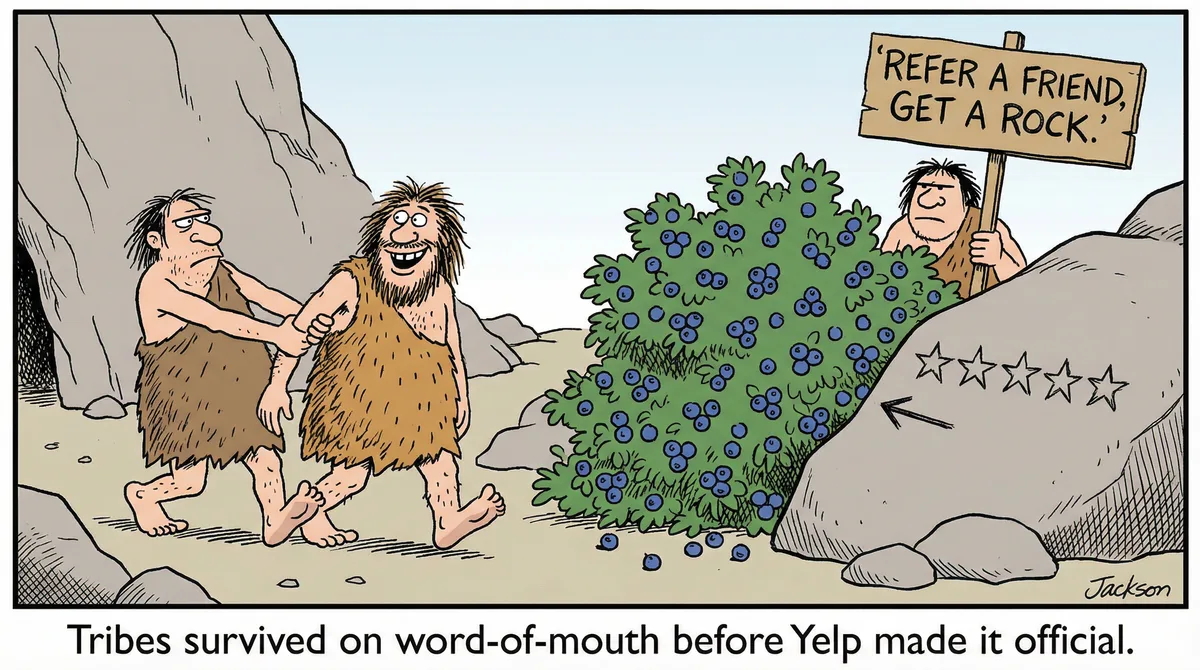
Did you know it's literally in our DNA to refer to things?
Just think about how many times throughout the day you're introducing new things to people: movies, restaurants, podcasts, books, and service providers. If you have a great experience, you'll likely spread the word about it. And, along the same lines, when you have bad experiences, you're going to make sure people hear about those, too.
"Oh, don't go there. That restaurant is no good," or, "Oh, that movie was so bad. I walked out in the middle of it..." or, "I couldn't even read this book."
The reason why we're doing it is that it makes us feel good when we add value to our friends. Or when we protect them from bad things. And that "good feeling" had a specific purpose from an evolutionary psychology standpoint. It goes all the way back to the times when we were living in tribes. For us to survive as a species, we had to be constantly on the lookout for good and bad things.
For example, if you were out on the trail and found a bountiful blueberry bush, your tribe had greater chances to survive if you were incentivized to spread the good news about it. Likewise, when Joe from your tribe tells you, "Well, watch out next time you go pick those berries because behind the bushes I saw a tiger on the way over here," he's protecting you to make sure you bring those berries back to the tribe.
However, if it's true that we're wired to refer things, why are so many businesses doing such a bad job when it comes to referrals? The thing is, most people think about referrals the wrong way. They look at it as a reward for doing a good job. They wait until after the service has been provided and then ask for the referral as a favor.
"Did we do a good job? Do you feel that we were helpful? If so, would you be willing to refer us to other people?"
And that's why it doesn't work. You don't need to incentivize people to refer. Most of the time, an incentive will have the opposite effect. But what you do need is to realize two things:
- First, that all referrals happen in a conversation.
- Second, that we all have a wired-in desire to tell our friends about good (and bad) stuff.
Providing an excellent During Unit experience (with results) takes care of that wired-in desire of ours.