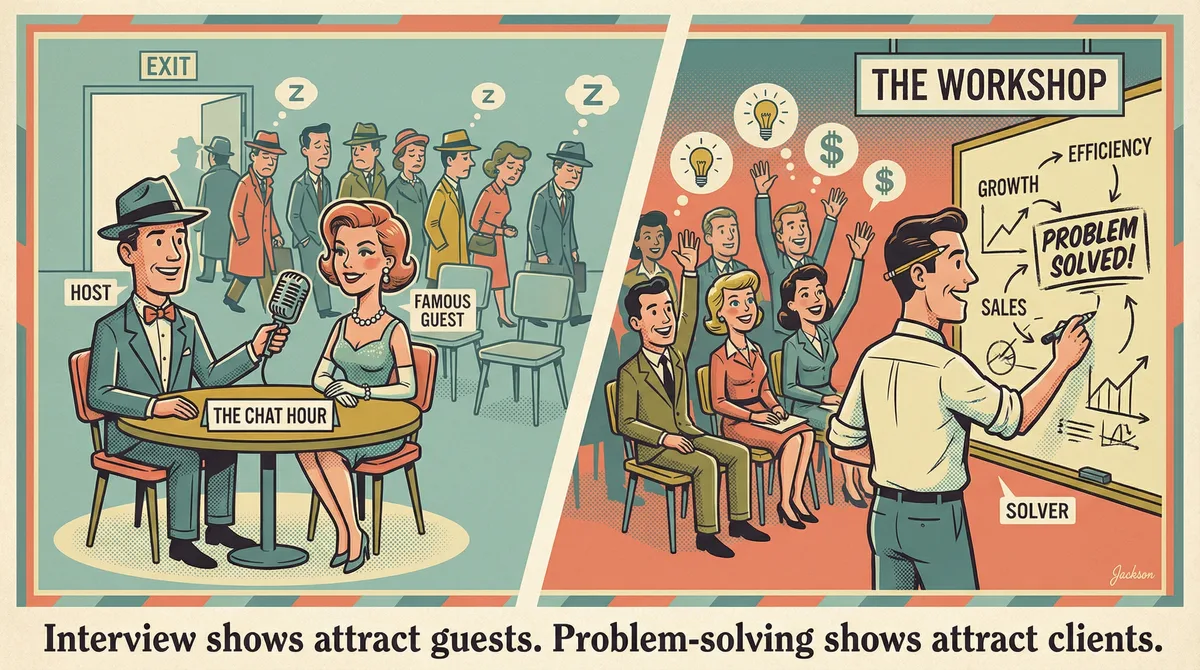
There are three models of podcasts that currently exist.
The most common model involves one person interviewing a celebrity or people who have notoriety in a particular niche. So you get thought leaders, authors, and brand-name people, and the audience is attracted to and comes to listen to the interview with that person.
But how many different versions of somebody interviewing Simon Sinek about the power of why do you think people want to hear? The interview model is not very useful to anyone.
The second model is a podcast where you have an ongoing conversation about a specific topic. Like the podcast I do with Dan Sullivan, the Joy of Procrastination: It's just Dan and I having a conversation about procrastination and everything around productivity. And what listeners are doing is voyaging in on that in-depth look at a topic that's relevant to them.
And then there's the third model. My favorite so far: It's a podcast model where you actually help somebody solve a problem, or amplify an opportunity. And the purpose of this type of podcast is to educate and motivate people to start working with you.
My podcast, More Cheese Less Whiskers, falls into this category. Its purpose is to apply the 8 Profit Activators to many different businesses. Week after week, my audience gets to hear me "solving" one more business case, using the exact same framework over and over.
This type of podcast is my Profit Activator Three lead conversion tool, as opposed to a lead generation tool.
The audience gets to hear so many different ways to take the standard context of 8 Profit Activators and apply them to new businesses. While at the same time, the podcast demonstrates all of the things that are essentially the next steps for people in my world. Like the live Blueprint event… the 90-minute book… the Email Mastery program… and so on.
The real purpose of a podcast is to support the bigger picture of what you're trying to do—the service or value you're looking to provide in exchange for money.