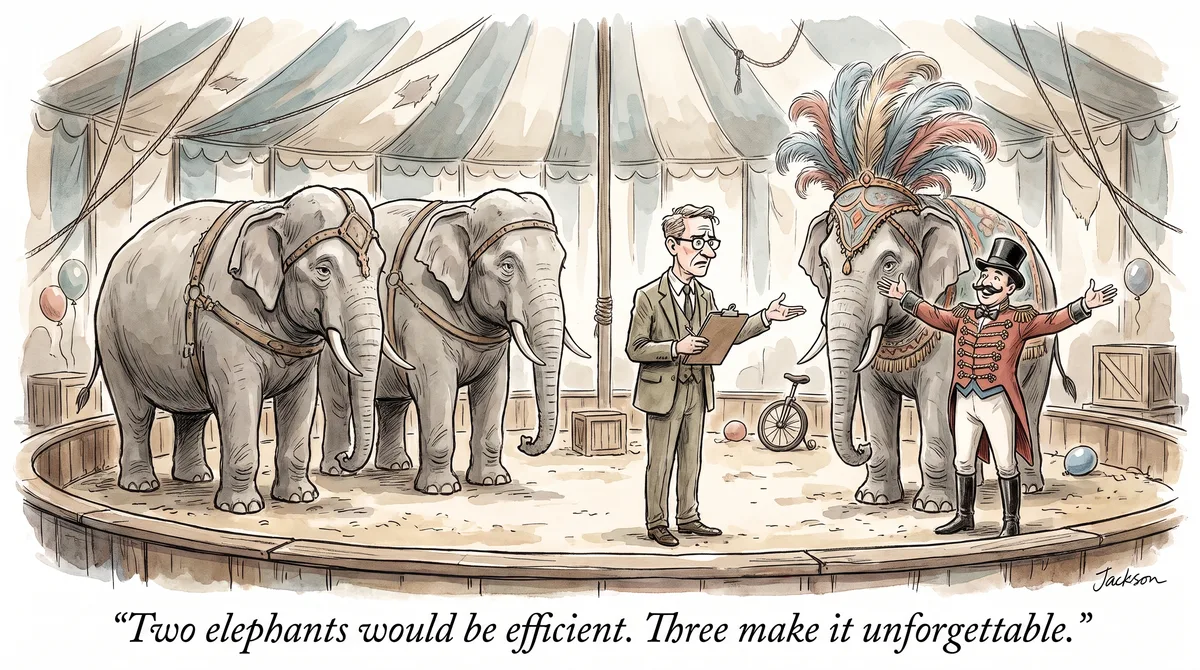
There was one part of my little circus parable from 1997 that really jumped out at me this morning.
The main character was an accountant.
Very practical.
Very efficient.
Everything viewed through the lens of:
Does this make economic sense?
The imaginary ringmaster takes him back to the glory days of the circus and the accountant starts looking around at everything.
Three elephants?
Why three?
Two elephants could do the same thing.
All these performers?
Surely we could eliminate a few.
All these costumes and decorations and extravagance?
Couldn’t we put on essentially the same show for less money?
And that’s when the ringmaster explains the flaw in his thinking.
They weren’t promising:
The Most Efficient Show on Earth.
They were promising:
The Greatest Show on Earth.
That’s a very different standard.
If you’re trying to create the most efficient version of something, your natural instinct is to start removing things.
How little can we spend?
How few people can we use?
How much can we automate?
What’s the minimum viable version?
But if you’re trying to create the greatest version of something, you ask completely different questions.
What would make this unforgettable?
What would people tell their friends about?
What could we do that nobody else would even consider doing?
That’s the lesson I’ve carried forward into what I call the Procter & Gamble approach:
Build the very best product from the customer’s perspective.
Not the cheapest product you can profitably deliver.
Not the easiest product for you to provide.
The best possible experience from their perspective.
Cirque du Soleil is probably the modern example.
It’s what happens when you combine unbridled creativity with what appears to be an unlimited budget.
You walk out thinking:
I’ve never seen anything like that before.
And maybe that’s the question worth asking about your business.
If you temporarily stopped worrying about efficiency…
If you stopped asking how you could do it with two elephants instead of three…
What would the Greatest Show on Earth version of your business look like?
You can always figure out how to make it efficient later.
But first you’ve got to imagine the third elephant.
But first you’ve got to imagine the third elephant.
Dean