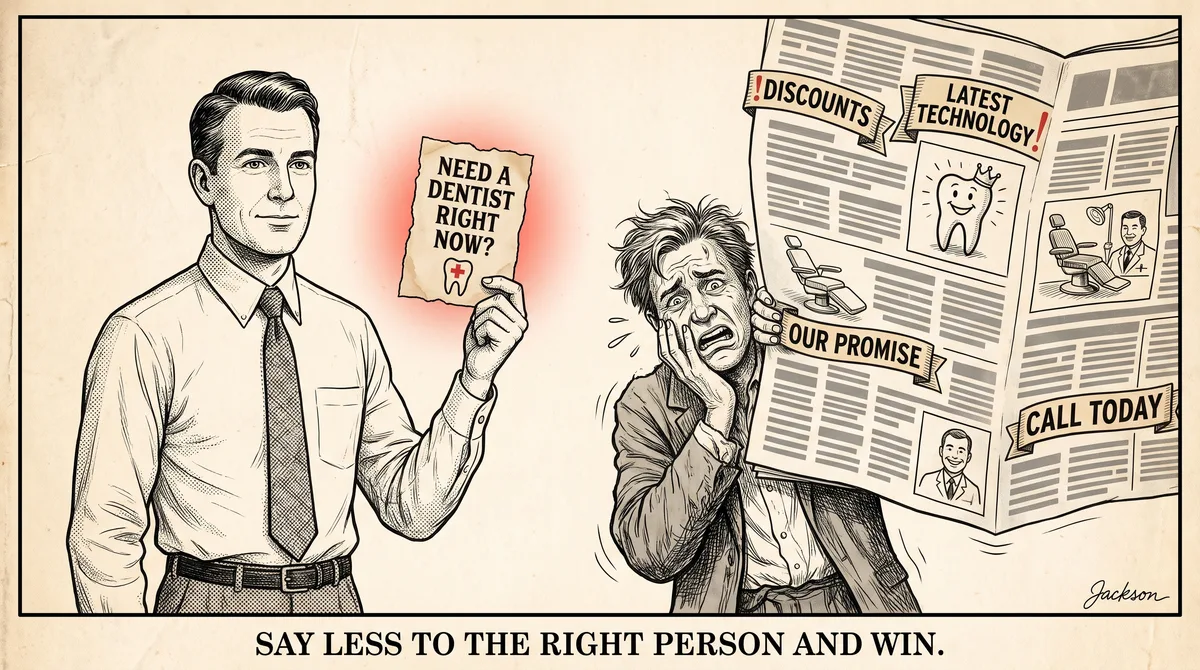
One of my favorite ads I’ve ever written took up less than one-eighth of a page.
It wasn’t clever.
It wasn’t beautiful.
It didn’t win any design awards.
But it tripled the response. So there’s that.
The interesting part is that it only happened after we stopped trying to appeal to everyone.
A dentist asked me to look at the full-page Yellow Pages ad they were spending a fortune on. It looked exactly like every other dentist’s ad.
Family dentistry.
Years in practice.
Accepting new patients.
A long list of services.
If you covered up the logo, you couldn’t tell one ad from another.
So I asked one question:
Who is actually opening the Yellow Pages?
Back then, nobody flipped through the Yellow Pages for entertainment.
If you were looking under “Dentists,” there was a good chance you had a problem you wanted solved today.
A toothache.
A broken tooth.
A dental emergency.
So instead of talking to everybody, we talked only to them.
The headline became:
Need a dentist right now?
That was it.
The ad looked more like a news announcement than an advertisement.
Instead of trying to explain everything about the practice, it gave one simple instruction: call this recorded message to find out how quickly you could be seen.
Response tripled.
The ad was one-eighth the size.
The cost per new patient dropped dramatically.
That’s when I learned one of the most valuable lessons in marketing:
The moment you become crystal clear about who you’re talking to, you automatically know what to say.
The moment you become crystal clear about who you’re talking to, you automatically know what to say.
Most marketing gets weaker because we keep adding things.
More benefits.
More features.
More audiences.
More explanations.
Better marketing usually comes from taking things away.
The narrower your focus, the more powerful your message becomes.
Ironically, that’s often how you reach more people.