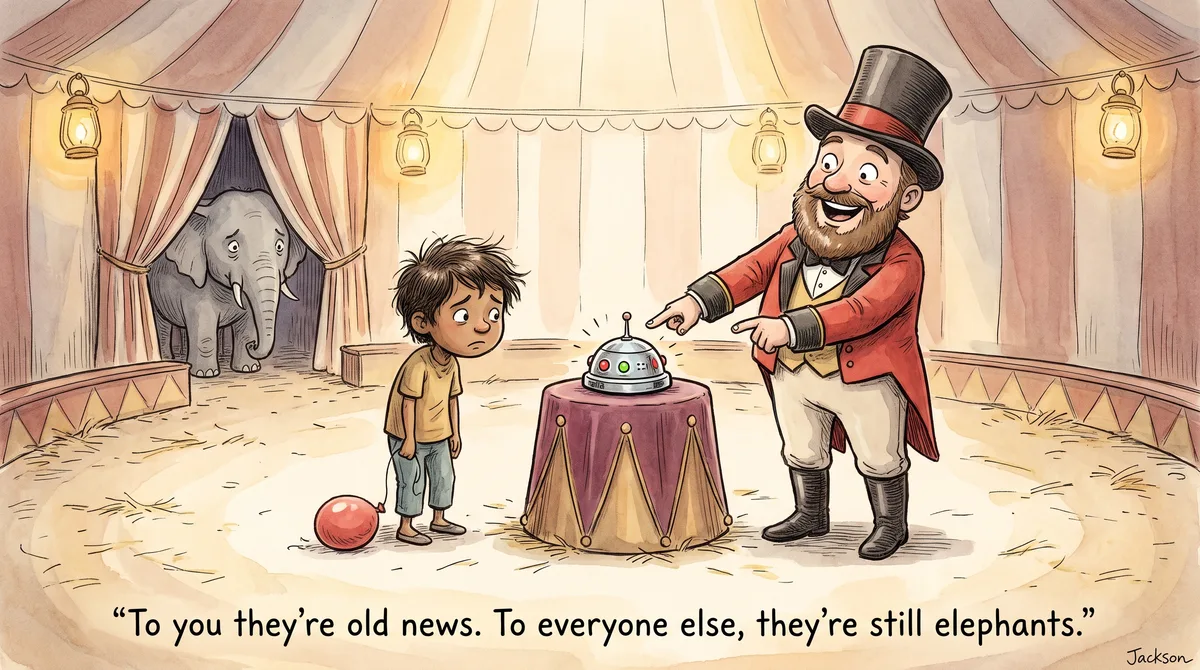
Yesterday we talked about one of the problems with putting on The Greatest Show on Earth.
Eventually…
You’ve already seen the elephants.
That’s why the circus would come back to town with banners announcing:
ALL NEW! NEVER SEEN BEFORE!
They understood they needed something new to give people a reason to come back.
But here’s the other half of that lesson.
They kept the elephants.
They didn’t say:
“Well, everybody saw the elephants last year. Let’s get rid of those.”
They kept the elephants.
They kept the trapeze artists.
They kept the big top.
They kept all the things people already loved about the circus.
And then they added something new.
That’s an important distinction.
Sometimes businesses get so excited about innovation that they start replacing the very things that made people love them in the first place.
New branding.
New product.
New pricing.
New experience.
New everything.
And suddenly the longtime customer is standing there thinking:
Wait. Where are the elephants?
Innovation doesn’t have to mean replacement.
In fact, some of the most valuable innovation is simply adding a new reason to pay attention to something that already works.
That’s why I like this distinction:
Don’t replace the attraction.
Add a reason to return.
If you’ve got something people love…
keep it.
If you’ve got something that reliably produces a result…
keep it.
If you’ve got something customers associate with you and would genuinely miss if it disappeared…
for goodness sake…
KEEP THE ELEPHANTS.
Then ask…
What can we add?
What can we improve?
What can we introduce that gives someone who already loves what we do a reason to get excited again?
That’s a much safer form of innovation.
You’re not betting the circus on an entirely new show.
You’re building on something you already know people want.
So before you change something that’s working because it feels old to you…
remember:
You’re at the circus every day.
Your customer isn’t.
It may feel old to you because you’ve seen the elephants a thousand times.
To somebody else…
they’re still elephants.
Dean