What's in a name
Listen
Naming is everything. The closer a name gets to exactly what someone's looking for, the more it sells, even when the product inside doesn't change.
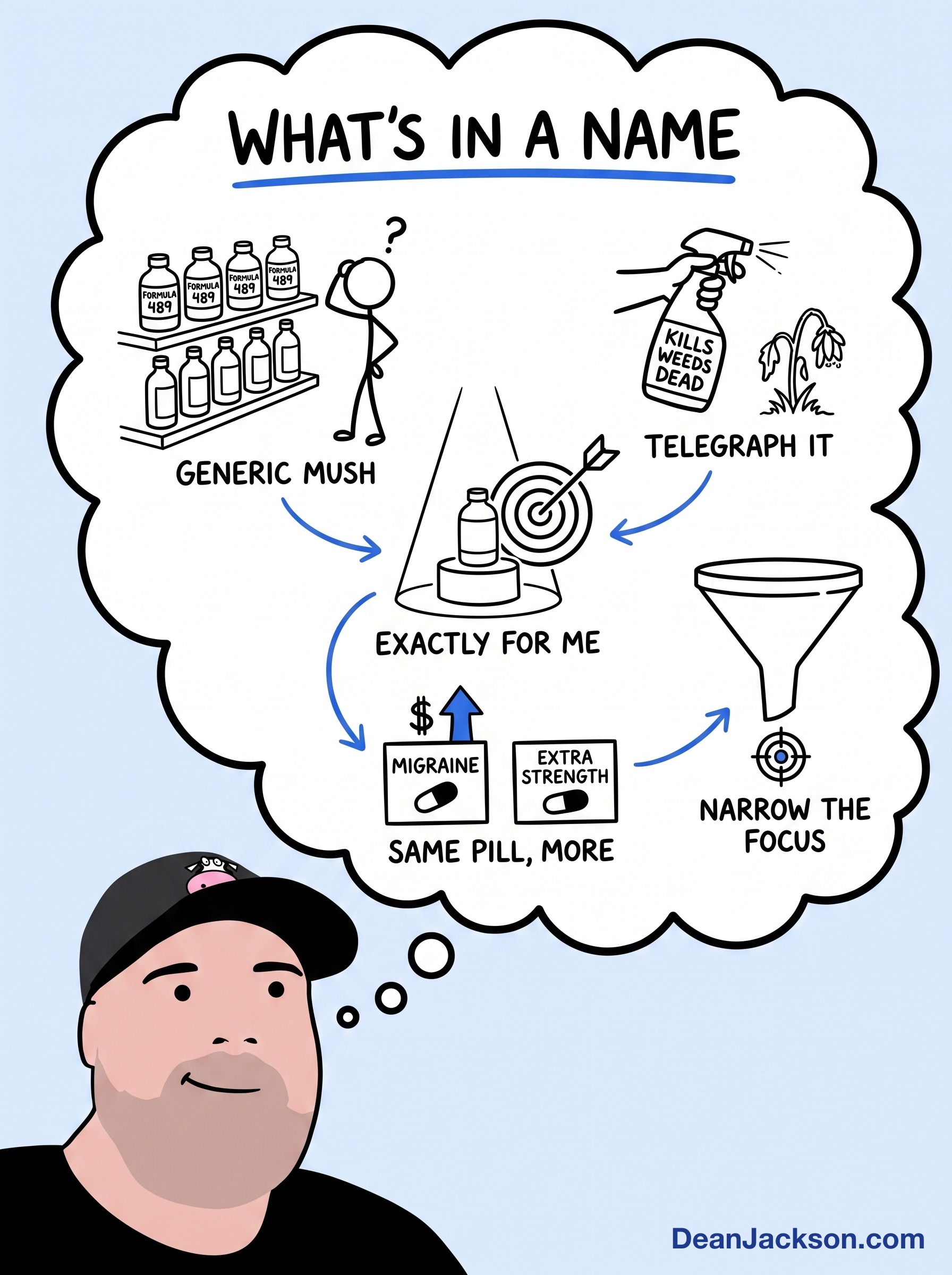
This one came out of a discussion at the I Love Marketing meetup about naming products, and my view is simple: naming is everything. A name that telegraphs exactly what your product does beats a clever one every time. Dan Kennedy turned Formula 489 into Kills Weeds Dead, and suddenly it's obviously the right product on the shelf.
There's a photographer in London who skipped the generic commercial photographer label and built weshootbottles.com, nothing but beautiful shots of bottles. If you sell a product in a bottle, they head and shoulders beat every generalist. And when they want cans, they just spin up weshootcans.com. Same studio, same lights, new specialist.
Sometimes the product doesn't change at all. Excedrin Migraine and Excedrin Extra Strength are the identical pill, but the Migraine box sells for up to a 30% premium because it names exactly what someone's looking for. Any time you can narrow your focus to the person you most want, that's where the benefit lives.
Join me live on the next free 50-Minute Profit Finder call, Friday, October 9 at 1:00pm ET. Save your spot →
Transcript
Auto-generated transcript, provided as supporting material. It may contain errors, and speaker labels are occasionally mis-attributed.
Hey, good morning. I am headed to celebration today, about 30 minutes from my house. We meet with some clients over there and I wanted to talk a little bit today about something that came up at the I Love Marketing meetup group the other night. We were talking about naming, we were talking about naming products and, you know, we had a really good discussion.
I've got some pretty interesting views on naming and I wanted to kind of talk a little bit about them because that's one of the things people ask me all the time, what should I name or how important is naming something? And I really believe naming is everything. I mean, you think about the difference that it can make if you have a name that's crystal clear that telegraphs what your product actually does. I remember hearing Dan Kennedy talk about someone who came to him with a weed killing formula and that, you know, they were very proud of the chemistry that was involved in the formula that they had created.
And they were naming it, you know, Formula 489 or something similar like naming it about the chemistry of it. And, you know, Dan suggested changing the name to Kills Weeds Dead. And you imagine, imagine this whole thing, you imagine the situation where you're in the hardware store or you're in the store looking for weed killer and you don't know what kind of, you know, you don't know what kind of weeds you have or whether what formula is going to be the right thing. And you're looking at all these ones that are, you know, Formula 489 or whatever the other, what the other ones are called.
And you come across one that says simply Kills Weeds Dead. That sounds like exactly what you want. No muss, no fuss, that sounds like the right product. Now, you know, when you start thinking about all of the, the other ways, you know, that you can use naming, it's really to telegraph to people that this is exactly what you're looking for.
The closer you can get to that. Exactly. That's where all the real benefit is going to come. You know, so often people try and name things to be inclusive, where you're trying to make a name that will accommodate lots of different target audiences.
Right. So when you think about, as a great example, as a, you know, when I think about naming, I'm thinking about the name of your product, the name of your service, your domain name, even your book title would fit in the same kind of category that you want people to look at it and say, that's exactly. For me, one of my favorite examples, I use this in the Breakthrough DNA book. Is there's a commercial photographer in London that they, instead of naming themselves, something to do with commercial photography.
Which commercial photography, let's face it, is a very inclusive, generic term. You're trying to say, well, a commercial photographer that hopefully telegraphs to people in their mind that they can do all kinds of things with commercial photography. Catalogs, product shoots, you know, portraits, you know, all of the things that would go into creating photography that you could use for commercial purposes. com the thing that you see is nothing but beautiful pictures of products in bottles.
And if you're the owner of a product that comes in a bottle and you're looking for a photographer, you know, you've got a choice of, you know, either choosing a commercial photographer who in the laundry list of all the things that they do that they list on their website says bottles and. Or you can choose somebody who apparently focuses only on shooting bottles. Now, you know, when you look at that website and I encourage you to do that, you see that it would head and shoulders raise itself above any other choice if you have a product with a bottle. Now, when you start thinking about that may be limiting, though, you know, sometimes people think, well, I don't want to limit myself because I also shoot cans and I also shoot pac as well.
com and when you think about it, how easy is it to plug in cans instead of bottles? It doesn't require any new equipment. It's the same lighting, the same studio, the same cameras, the same infinite white backgrounds. All of that stuff.
We're just showcasing for your audience that you are a specialist in area that you're highlighting the only thing that matters to them now, you know, we've seen so much evidence of this. Books do this all the time. How many Chicken Soup for the Souls are there? You got a great core book, Chicken Soup for the Soul.
You got Chicken soup for the expectant mother, chicken Soup for the grieving parent, chicken soup for any type of thing you can imagine. Nobody, you know, nobody wants just plain old chicken. Chicken Soup for the soul. When you can have the specifically formulated chicken soup for your specific type of soul.
Right now, Michael Gerber, the E Myth, you think of all of the books that he's written. The E Myth for contractors, the E Myth for physicians, the E Myth, you know, all of these different types of things. Sometimes you don't even have to change your product at all. One of my favorite examples is if you go into a CVS right now, now, or look it up on Amazon.
If you go to a CVS and you go to the headache aisle, there is a product called Excedrin Migraine. And there's also a product called Excedrin Extra Strength. Now, what you probably don't know is that there is zero difference in the pill that's in the bottle. Nothing.
No difference in the formula. It's the exact same form, but they put it in a box that says Excedrin Migraine and it sells for up to a 30% premium. Now, just think about that. It's exactly the same product selling for more money because it specifically addresses what somebody is looking for.
So anytime you get a chance to narrow your focus, even if it means you know you've got something that could appeal to three different types of people, if you could with, you know, 10% or 20% little change to it, make it appealing specifically to that person, that's going to make a big difference for you. You take the same general idea and you package it specifically for the different, most attractive types of clients that you could. So that's my thoughts on nam. And I thought you might enjoy hearing what we talked about at one of the I Love marketing meetups.
So that's it for today. I hope you have a great day. I'll talk to you next time.
Get BreakthroughDNA Free
Discover the 8 Profit Activators that can transform your business. Get the complete framework, free.