Working backwards
Listen
The man who ran the MGM Grand booked the gap between what he earned and what he could earn as a loss. That mindset changes everything.
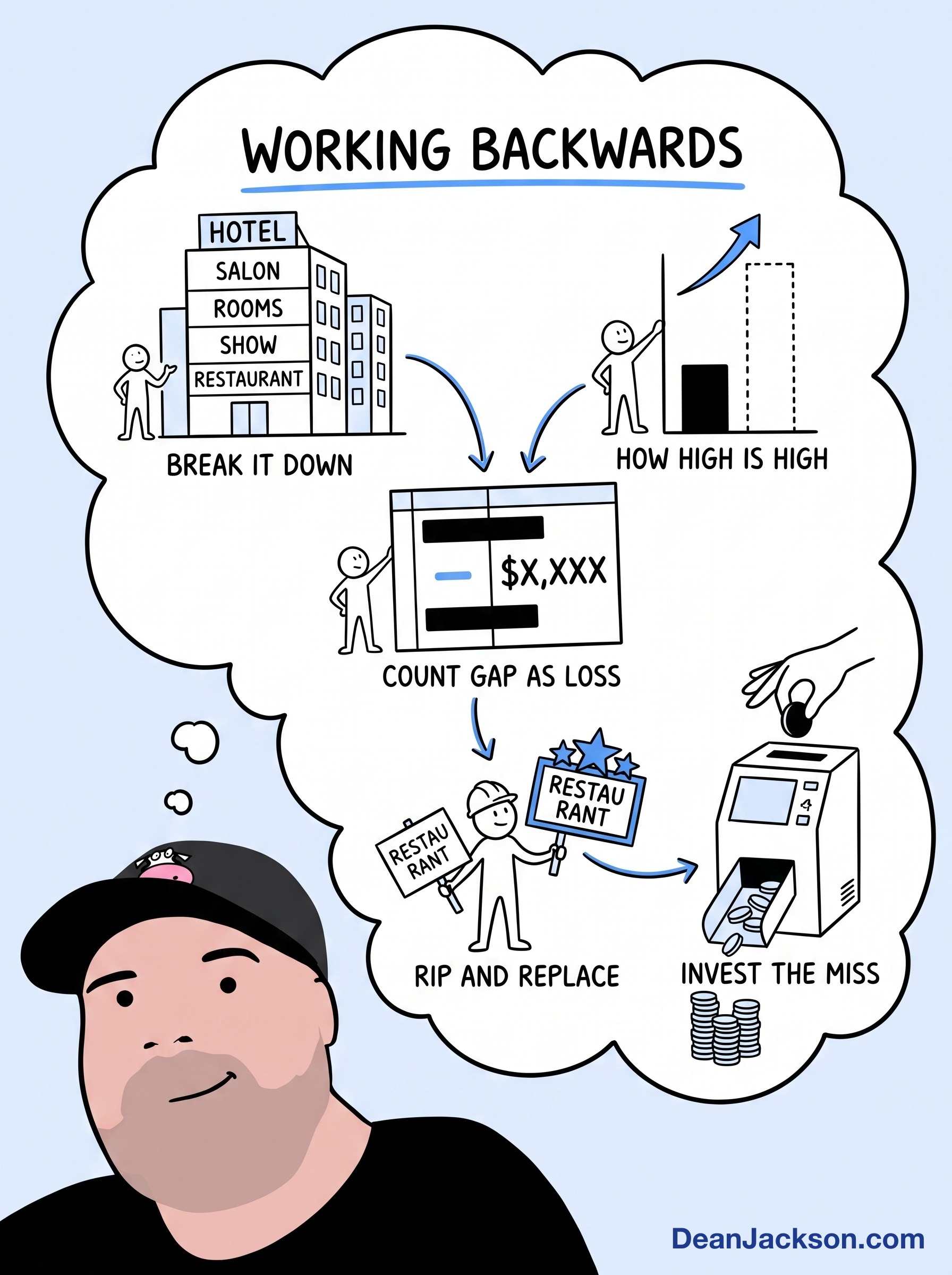
Gamal Aziz ran the MGM Grand, and his approach stuck with me for years. He broke the hotel into all its components, restaurants, entertainment, retail, and for each one asked how high is high, then counted the difference between that and current results as a loss.
They had a profitable $4 million restaurant, but he watched guests leave every night for celebrity restaurants elsewhere. In his mind they were losing $4 million a year, so he tore it out, partnered with Michael Mina, and did $11 million the first year. Same story with entertainment: a $28 million show became a Cirque du Soleil doing $120 million. Even $40 haircuts became $400 stylings.
He called it working backwards, and it's the opposite of chasing a 20% annual improvement. It's instant and radical. Go through your own components, ask how high is high, and treat the gap as money you're actively losing. That framing gets your attention in a way that a comfortable profit never will.
Join me live on the next free 50-Minute Profit Finder call, Friday, October 9 at 1:00pm ET. Save your spot →
Transcript
Auto-generated transcript, provided as supporting material. It may contain errors, and speaker labels are occasionally mis-attributed.
Good morning. This is part two of the Miami Mixtape. The South Beach Mixtape. Driving in the middle of nowhere on my way to Miami.
Two and a half hours left to go. You know, this story that I want to tell right now is about a guy who ran the MGM Grand Hotel in Las Vegas. Gamal Aziz is the guy's name. 0 magazine in, I think, 2006.
But it was that impactful that I think about it all the time. I bring it up and talk about it in my events and use it as a great lesson. Now, Gamal has a long history in the hotel business. He was with general manager Bellagio before he moved over to MGM grand.
And now I believe he's at Macau with Steve Wynn. But here's the process that was amazing. He, when he moved into the MGM grant, had an approach to looking at what to do, figuring out where they should spend their time and attention and money, what projects were the things that were going to move the needle the most. And he had a unique approach to it.
He looked at all of the elements of the oper, meaning broke it down, divided it into, you know, the hotel revenue, the gaming, the restaurants, the entertainment, the conventions, the retail, all of the different elements, the components that were providing revenue for the operation. And he looked for how high is high? What could we be doing here? What's the highest potential that we could do if we were 100% focused on just this element?
And when he looked at the restaurants, the first thing that he found was they had a restaurant that was profitable, doing well, $4 million a year, restaurant profitable in house. And night after night, he would sit in the entrance of the hotel and he would see people leaving the hotel, getting into cabs or limos or where. And he'd ask them, where you going? And they would say, we're going to Nobu or we're going to another celebrity restaurant, you know, at Spago.
And he knew because they were the largest hotel in the world at the time, 5,500 rooms, that if they had a celebrity restaurant, a destination restaurant in their hotel, that they could be doing probably 8 million doll a year instead of the $4 million a year. And his approach to this was to book that difference as a loss. So in their, in his mind, their four million dollar profitable restaurant, they were losing four million dollars a year on this by not having a celebrity chef. So they a celebrity restaurant.
So he went to the board, got approval to rip out the restaurant, same footprint, same amount of squ. But rip out the restaurant, redo it, partner with Michael Mina and open up a restaurant called Knob Hill. And first year after they open it up, they did $11 million in sales from the same amount of space. Now that wasn't where he stopped though.
He went through all of the, all the components of the hotel I mentioned. He went to entertainment. They had a show there that was a staple of Las Vegas called fx and it would altern with David Cassidy and Tommy Tune in the lead. And it was doing $28 million a year in ticket sales.
And it was a long term staple of Las Vegas. And he knew that if they had a Cirque du Soleil show, that they could probably be doing $80 million a year. And so again he went to the board, got approval, they ripped out the theater, they partnered with Cirque du Soleil, they put in a Cirque du Soleil first year out, they do $120 million in sales. Because all of his thinking was going that they were losing $52 million or whatever the difference between 28 and 80 million by not having a Cirque du Soleil show in their, in their theater.
And that thinking led to so many changes that they did at the hotel. They had, you know, casinos do. They had big suites that they would reserve for high rollers and they would give them away as perks to people who were gambling and all of those things. And when he really looked at it, he realized that the MGM grand was not a pure gambling hotel.
What MGM grand is, because it's the biggest, it was really a convention hotel. That was their big thing. So he came up with the idea of turning the top two floors into sky lofts. And they made these really fancy suites that were available for the executives who are at conventions, who want to use them for entertainment suites or VIP suites or you know, to have parties or to do greet their their customers.
And they turned that into a profit center where those skylofts Now Ren for $3,000 a night or more. And so that again, looking at the asset that they had, looking for how high is high? What could we be doing? And counting that difference as a loss.
They went through the retail. They had a hair salon that was doing $40 haircuts and they knew that if they had a celebrity stylist that they could be doing more. So now they' $400 hairstylings instead of $40 haircuts that were just a serviceable thing to reach those because of all the people there. So the lesson in all of this is to look at all the things you're doing right now and to realize or look at them and say, how high is high?
How much could we be doing if we just focused 100% on doing this one? Counting that difference as a loss. And for me, there was something profound about the way that that shifted my mindset about things, that it's very different if you're actually losing money on something. It would have your attention, you would get the attention focused on stopping that losing money.
And I thought, you know, that's a really brilliant kind of way of thinking about it. Gamal called it working backwards. And I' heard anybody else talk about it like that because most of the time people are looking on coming into something and going, how can we overall get a 20% annual improvement? How can we improve this by 20% each year?
Constant and never ending improvement. And he's looking for instant and radical improvement. And I think that there's a great exercise for you to kind of go through your components of your business, identify each of the components, identify how high is high and what you're doing right now, and look at the difference as a loss. Dan Sullivan has a great quote that there's never any room for improvement, but every improvement creates more room.
And I think that's true if you replace room with improvement with money. You know, there's never any money for improvement, but every improvement creates more money. So you start thinking about investing. Investing in not taking out of the profits that you're currently making, but as an investment in capturing the profits that you're missing out on.
So you can look that article up on Google. If you go and do a search on Gamal Aziz, good to grand, that's where you'll find that article. And I think that you'll enjoy it. Let me know what you think.
Get BreakthroughDNA Free
Discover the 8 Profit Activators that can transform your business. Get the complete framework, free.