Execution arbitrage
Listen
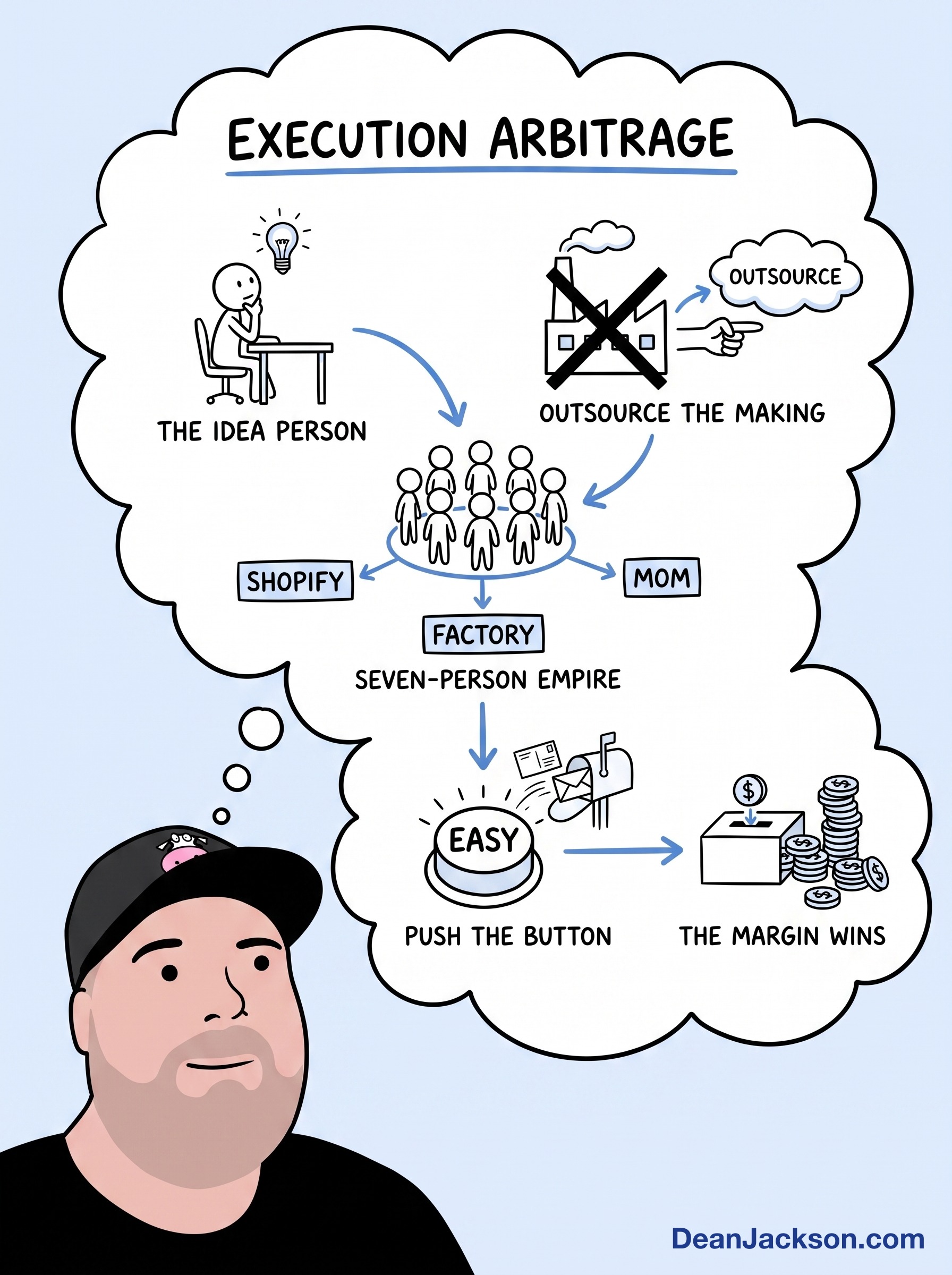
There's never been a better time to be an idea person. Bundle up a high-value outcome, outsource the execution for a fraction, and pocket the difference.
I woke up with words for something I've been watching for a while: execution arbitrage. Right now you can get almost anything executed on demand, at scale, which means the idea person who sees how pieces fit together is positioned to win. Kylie Jenner runs a $350 million cosmetics company with seven core people because everyone else, the manufacturing, the e-commerce, the distribution, is outsourced.
You see it everywhere once you look. Airbnb and Uber are just interfaces between people who want an outcome and people with the capacity to deliver it. My own Getting Listings program for real estate agents works the same way, push a button and we handle all the execution.
Execution is becoming the commodity. So look at the outcomes your business is paid for, ask how much of that could be handed to someone else, and get paid for the bundle. That's the arbitrage.
Join me live on the next free 50-Minute Profit Finder call, Friday, October 9 at 1:00pm ET. Save your spot →
Transcript
Auto-generated transcript, provided as supporting material. It may contain errors, and speaker labels are occasionally mis-attributed.
Good morning. Hey, it's Dean. I woke up this morning with words for a concept I've been observing and paying attention to over the last little while here. And the words that I came up with were execution, arbitrage.
And what I'm observing and what I'm seeing here is the opportunity right now more than ever to take advantage of the ability to have something, anything done, executed on demand, at scale. And I'm starting to see it on, in small things, and I'm seeing it on really big things. And what I mean is that there's never been a better time than right now for somebody who is a idea person, a creative thinker, someone who can see how pieces go together and can combine ready resources to produce something that has value. And let's go to the top level here because it's happening on big things where we're able to react, really partner with outsourcers, with other companies that can provide manufacturing or services or execution of anything really.
And it's one of the greatest examples of it is Kylie Jenner. And I remember reading when she was on the COVID of Forbes magazine as almost 900 million, almost a billionaire with her Kylie cosmetics. And they were, it was funny because even Forbes magazine was sort of apologetic about it. They're like, we can't believe it either.
But honestly, even with our conservative multiples and our discount, she's legitimately worth $900 million and probably over a billion. But here's the thing is with her Kylie cosmetics, she's did $350 million in sales and her core team consists of seven full time people. And every other element of the business, aside from the creative element of it, is done by other people. She partners with Shopify to do all the e commerce.
She partners with a manufacturer and distributor to actually make the cosmetics. She doesn't have any factories. She hasn't figured out how to, you know, handle the, the business of making cosmetics. She partnered with a white label company that makes her cosmetics and packages it and distributes it for her.
She partners her mom, her mom's business runs the business of the business, her mom's team. And she has a core team of seven people that are the creative team and they come up with the ide, the colors, naming the colors, the design of what they want them all to look like. And of course, she then is an evangelist for it, spreading it to her 110 million Instagram followers and pointing people in that right direction. But the reality is she's running a $350 million a year company with seven core people.
Now you start to see this on other levels too. I was just live Streaming Peter Diamandis Abundance 360 event and one of the things, one of the people that was there is a gentleman who runs a company that does 3D printing for automotive parts. And they're one of the leaders in the industry, you know, millions and millions and millions of dollars each year. And they don't own any 3D printers.
They outsource to the outsource to, you know, remnant or over. What's the right, what's the word I'm looking for. They using excess capacity of other people who have 3D printers. And so you start to look at those things now where you've got an opportunity to have your idea and see how things all fit together, but look for ways to get the execution of it completely outsourced.
And so I've been really paying attention to this because it's something that we do. I try and provide that type of service for people, you know, for our real estate agents, specifically for entrepreneurs. We have a lot of services like this where I'm looking to be a provider of an outcome for somebody that they can just push a button and get that result. And so we, you know, I look at it from our.
com with our real estate members, we have a program called Getting Listings. And we've got a way that people can mail postcards into an area where they want to get listings and mail newsletters each month as follow up to the people who respond to the postcards. And they never have to make any outbound phone calls. All of it stimulates people to call them to come and list their house.
Now what they really we've got it to the point where all they have to do is push a button. We have our easy button program where they can push a button and we can do all of the execution of that program. They just pay for the postcards, pay for the mailings and pay for the had to have the execution done. But the outcome is a huge multiple of the money that it costs to do it.
And that's where the arbitrage comes in. If you're paying attention and you kind of look for opportunities where you can use existing applications, outsourced services to provide an outcome that is worth a, you know, a significant amount of money and make it so that you can get the execution of it done for a fraction of what the ultimate value of it is. You are positioned to win even if you can make a fixed margin on things. I mean, you look at the biggest companies right now who are doing this are companies like Airbnb and companies like Uber, where they are an interface between people who want to get from point A to point B and don't have a car or don't want to get a car, or they're traveling in a different city.
And the interface between them and people who have a car and excess time and want to make some money by taking people from point A to point B and they create this interface of the app called Uber, so that it's push button easy for people to get that outcome. You start to see all of these things now, you know, Uber Eats or grubhub for an interface between people who have excess time and want to make money and people who want to get something locally delivered right to their door. And the arbitrage is the interface between providing access to each other. Right.
So there's that really cool opportunity there. And so I would encourage you to kind of, if you want to get used to thinking like this, is to look at the outcomes that your business produces, right? Look at the outcomes that you are paid for and how much of what you do could be outsourced to somebody else. You know, is that a possibility?
I think about, you know, I've got a friend in Toronto that is a print. He's a. I don't know whether I call him a print broker, but he's a creative printer who used to own a printing company, did, you know, $20 million in printing, but made very, very tight margins on the, you know, on the execution of the printing. And he switch model to where he provides creative ideas and outcomes from printing, but then brokers the execution of the printing to a wholesaler to actually get the printing done at the lowest possible price.
So we're really at a point where separating the ideas from the execution and getting paid for the bundle of it, the executed idea is the execution arbitrage opportunity. So that's kind of my first thoughts about it. I hope you understand what I'm saying there. I think I'll give you some more examples to clarify that, but that I think if you kind of look for those opportunities, we're starting to see more and more those opportunities available.
com with Nick Sonnenberg, that I spent some time with him in Phoenix and Miami last week, and they're a company that will do execution on demand, for whatever it is that you want to do. So if you think about the if you can bundle up and create an outcome that has a high value and you could do it for get it executed for a lower value, you are on your way to an infinitely scalable pretty cool execution arbitrage opportunity. So that's it. Let me know what you think.
I'm excited to have the conversation about this. Send me an email deanejackson. Com, and let's talk about it.
Get BreakthroughDNA Free
Discover the 8 Profit Activators that can transform your business. Get the complete framework, free.