Specialized data
Listen
Richard Viguerie hand-wrote 12,000 donor names to own a list no one else had. In a world run by algorithms, the hard-to-gather data is the edge.
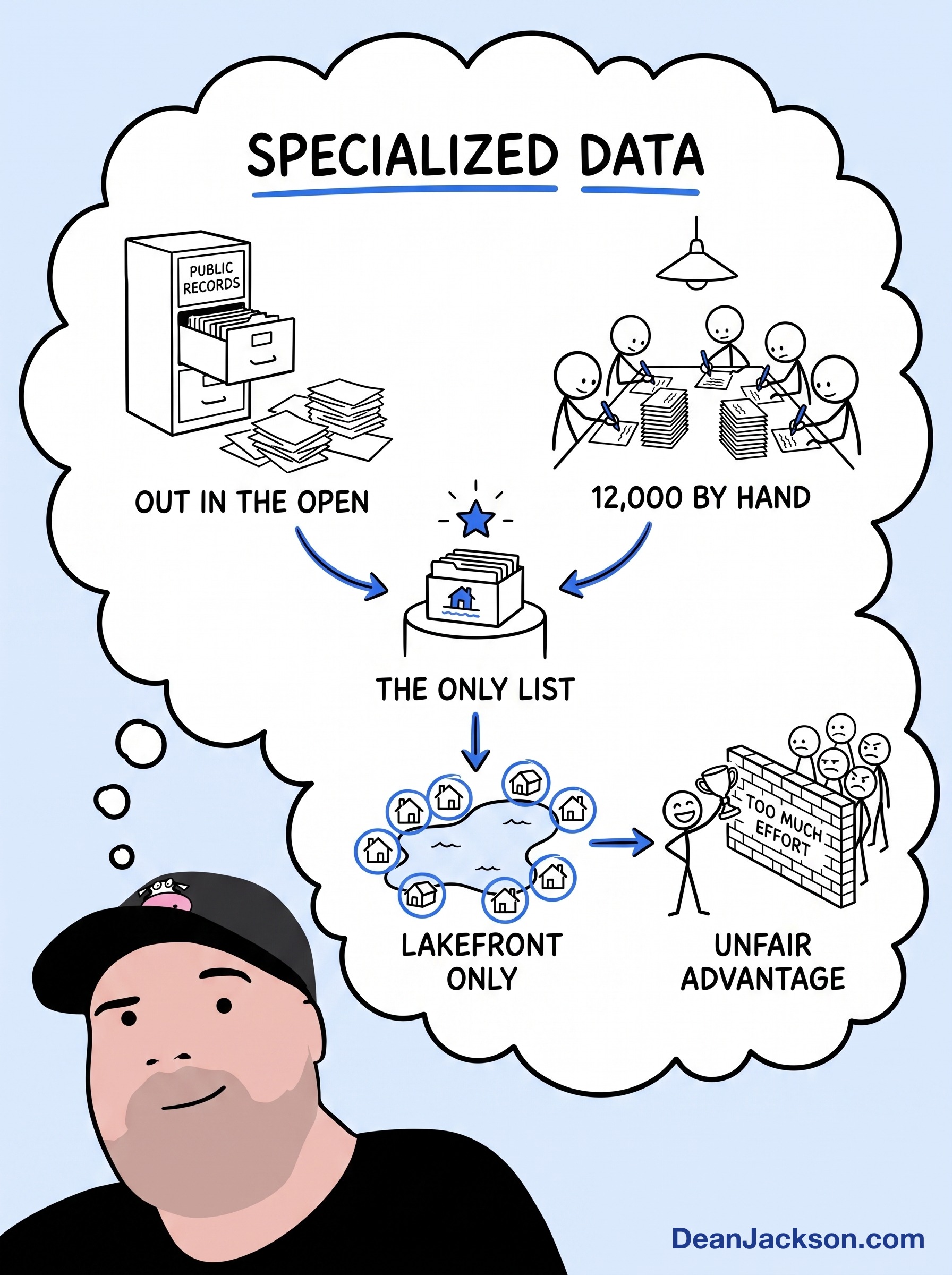
Over dinner in Miami I got thinking about Richard Viguerie, the father of conservative fundraising and the guy largely credited with getting Reagan elected. In 1962 a new law made large political donors part of the public record, so he took six ladies into the records office and hand-wrote 12,000-plus names and addresses onto index cards.
That list was an asset nobody else had. He rented it out, kept gathering every donor from every campaign, and built an empire on being first in and the only one with that information. What struck me was the willingness to do the hard, unglamorous work almost no one else will do.
We've done our own version of this, hand-correlating the 2,100 lakefront homes in Winter Haven, the homes with mountain views in Paradise Valley, oceanfront condos in other markets. In a world where everyone's using the same algorithmic data, that qualitative information you have to work to gather is a real advantage. Don't be afraid to put in the effort.
Join me live on the next free 50-Minute Profit Finder call, Friday, October 9 at 1:00pm ET. Save your spot →
Transcript
Auto-generated transcript, provided as supporting material. It may contain errors, and speaker labels are occasionally mis-attributed.
Foreign hey, it's Dean. Welcome. I'm back from Miami. Had a great week in Miami last week and had some amazing insights.
We had a really action packed week and there were some really cool people there. Had a dinner with one of my favorite people that you might not know the name, but his name is Richard Vigory. And I would recommend that you listen to the I Love Marketing Episode 142 that Joe Polish and I did with this gentleman. And he's the topic of one of the things that I want to talk about today because this, I found this so impactful and just such a life lesson that I've seen happen and play out in a few different areas.
But let me kind of give you the short story here is Richard is the father of conservative fundraising. And by what I mean by that is he really invented the category and has been a powerhouse in the conservative fundraising world and is largely credited with being the guy who really got Ronald Reagan elected to, to office in the 80s. And here's the story that is the, that the lesson is embedded in Richard. In 1962, when the presidential election was going on, he heard about a new law that required that anybody that donated more than $100 to a political had to be recorded.
And so that information of course was available to all US citizens through freedom of information. And so he went into where they keep all of these records, took six ladies with him and wrote out by hand, by hand on index cards the name and address of 12,000 plus people who had donated than $100 and to the political, to the conservative candidate. And he from there built an empire on that specialized knowledge because at that time he had the only list of conservative donors available. You know, putting this together, just thinking about the data that's out there, information that's available, and thinking about, well, what could we use this for?
And even if it takes great effort to compile this list, that's what really struck out for me is how many of us would be willing to go and hand write with a, you know, Siri, with a, with help of course. But how many people would be willing to hand write 12,000 names and addresses in order to have something that nobody else has. The moment. As soon as he had that list, as soon as he had it then transcribed and put onto magnetic tapes, he had a asset now that he was able to rent out.
And it's fun to hear him tell the story of the first time that he rented it out. He knew that he was onto something and he started then gathering as quickly as they could all of the names of all of the donors for every political campaign that was going on. He would go to state records and get people who had donated to the governor or to Senate campaigns, all of those things. And he built this huge list of all of these people.
And he's built an empire around being the first in and being the only guy with that kind of information. And I thought, you know, the lesson from this is really to think about what kinds of things do we have access to that even with great effort, would be worth gathering. I think about, you know, here in Winter Haven, we did a campaign for a local realtor that we work with here for lakefront homes. Now, lakefront homes here in Winter Haven are the most expensive homes.
They're the ones that are the Most valuable. There's 2,100 of them here in Winter Haven. And. But you can't readily get a list of lakefront homeowners because it's not categorized like that.
I mean, you can get the tax records, you can get everybody who owns homes. But we had to go in and, you know, hand kind of correlate the true lakefront lots, you know, the addresses of the lakefront homes and the tax records to gather up that information. But we had then a list of 2100 people who own lakefront homes that nobody else had, you know, unless they're willing to take that amount of effort. But the good news is that nobody is.
Most people aren't, you know, and you can have that kind of an advantage. We've done the same thing in, in Paradise Valley. I had somebody get. Gather up all of the addresses of people who have homes with views on Camelback and the other mountains looking over the valley, because you can.
That is a valuable asset of the. The information that you could use that you could market to people, homes with views that you wouldn't be able to get that list otherwise. And so we've done that same thing in other markets. We've done oceanfront homes, we've done oceanfront condos, you know, all of that kind of thing of gathering that information, even if it takes a little bit of effort to have an asset that can be a, you know, a real advantage for you.
And so I start to think now in a world where algorithms are and data are ruling everything, they're readily available, people are using information that is, you know, available to everybody. But what if you take something that is, you know, a little bit harder to gather and you add that one other layer on it, you know, non algorithmic information, I call it qualitative information where you can, you know, really see something that is of value to somebody, somebody else, and it can be a total advantage for you. So I think you'll really enjoy that episode with Richard Vigory. But the, the lesson that I want to leave you with that is don't be afraid to put in a little bit of effort to gather specialized information that nobody else has, but that you see a special use for.
Get BreakthroughDNA Free
Discover the 8 Profit Activators that can transform your business. Get the complete framework, free.