Establishing a BRAND
Listen
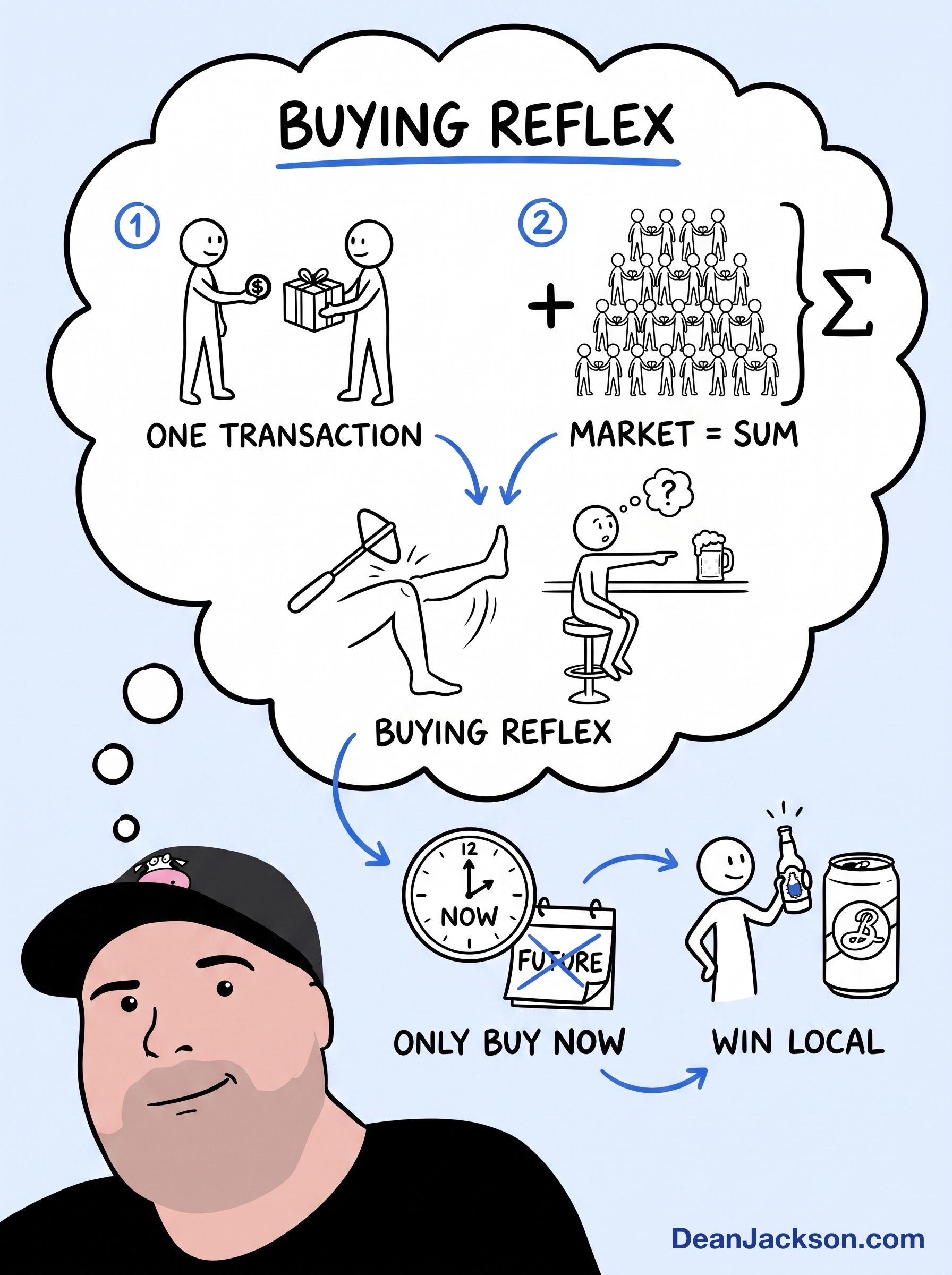
A brand is a buying reflex affecting now decisions. You don't have to beat Coca-Cola, you just have to win the individual moment someone chooses.
What does it actually mean to establish a brand? As a direct response guy focused on results, I've always felt the tension with the branding camp. Then a Ray Dalio video on the economic engine clicked something for me. A market is just the sum of individual microtransactions, one person trading money with another. A brand works the same way.
So here's my definition: a brand is a buying reflex affecting now decisions. The only time anyone can buy is now. Buying intention and buying history feed into it, but you can't bank those today. Coca-Cola and Budweiser have simply built that reflex in billions of individual minds over time.
That's actually hopeful. The microbrewery in Punxsutawney owns the reflex in its own town, often just through proximity, recency, and a clear message. Figure out the exact moment someone chooses, then make your reflex the one they lean toward.
Join me live on the next free 50-Minute Profit Finder call, Friday, October 9 at 1:00pm ET. Save your spot →
Transcript
Auto-generated transcript, provided as supporting material. It may contain errors, and speaker labels are occasionally mis-attributed.
What does it mean to establish a brand? I mean, it's one of those words, we hear it all the time and it's a whole industry around branding and everybody's all, you know, figuring out what we got to do to build our brand. And I've been thinking so much about it because as a direct response guy, the thing that I've always been focused on is the result. Right, that's what we're looking at.
I think it's been, you know, kind of this creative tension between the branding camp and the direct response camp, which are really just looking at the results and, you know, branding being more ethereal or more, you know, the look and the culture and the feel and the story and all of those kind of things, which for people who are in business, you know, small businesses looking to grow their business, they see these things and everybody points to Coca Cola and Apple and you know, Budweiser, the biggest brands in the world as the. That's what you kind of have to establish. So it seems kind of daunting. And I saw a great video by Ray Dalio, the guy who wrote Principles, big hedge fund guy, and he did a 30 minute video explaining the economic markets.
And this was eye opening to me and I knew it. It's all simple stuff. But something clicked for me and I really got a lot of clarity out. So I'd say, like, look up that.
Ray Dalio, the economic engine, I think is what it's called. But what he was saying is that, you know, we talk about this thing of the market. What does the market mean? Like what's when they talk about the automotive market or the beverage market, what does that mean?
And he really broke it down to the micro elements of it. If you're saying that the. It breaks down to micro transactions between one person and another person. Somebody trades their money for somebody's good or service and that's a, that's a transaction.
And the size of a market is just the aggregate of all of those microtransactions in that specific category. So, you know, the size of the auto market is broken, is just a summation of how many individual people bought cars in any given period of time. And so that I think really translates to what we're trying to do with a brand. Your brand is, you know, we talk about big brands like Coca Cola and Budweiser as, you know, the king of beers and the world leading brand for beverages.
That what they've really done when I got down to it is they just have more individual people who, when the Time is right. Choose Coca Cola or choose Budweiser. And so I got to this definition. I'm a big acronym guy because I like to think of memorable things to hang my ideas on here.
So brand in my definition here now is what we're trying to establish is a buying reflex affecting now decisions. A buying reflex affecting now decisions. Because I realized the only time we can ever buy anything is now. We can't buy something in the future.
We can have a buying intention. We can have a buying history, but none of that. You can't. You know, if you're a small business, you can't bank that today.
So both of those things, buying intention and buying history, certainly go into the likelihood that somebody will buy today when they're faced with the opportunity. And so now that we know if we take this brand definition, we're trying to establish a buying reflex that what are the moments? Where would somebody be in the moment that they would be faced with a choice between your product or service and anything else that's in the marketplace. And how can we make that reflex lean in your direction?
Now, when you look at it from an overall standpoint, it's very daunting to think that you could take on Coca Cola or Budweiser because they've been doing it for so long and they've reached so many people, you know, but when you think about it, that all they've done is, is they've established a brand in the minds of billions of people over time, but they're all individual people. That explains how something like, let's say, Budweiser, you know, the king of beers in the US More than any other beer, they have established that buying reflex, that when somebody says, what would you like, Ava? Bud? That's the number one reaction.
But there's also room that I believe if you were to go to Punxsutawney, Pennsylvania, I don't know this to be true, but this is anything about microbreweries everywhere. But you go into the. The Punxsutawney Pub, and they have a microbrew called the Punxsutawney Pale. Alex.
And if you were to ask some number of people there, would you like a beer? They'll say, give me a Punxsutawney Pale Ale. Because they have established a buying reflex in their minds. You know, I grew up in Toronto, just outside of Toronto.
And there was. The next town over was a town called Guelph, and they had a beer called Sleeman's. And, you know, when you're in that sort of area of the world, a lot of people drink Sleemans because they support local. That's the reason why they've established that buying reflex.
Now, you know, I live in Florida now. Nobody sort of Sleemans, so nobody's even going to order it. And so that gives us hope. When you look at what we're trying to establish is one consistent message in somebody's mind that when they're faced with that buying opportunity for your product or your service, that they make that decision in your favor.
And often that can mean just being in proximity or recency being on their mind and with a clear message so that they know what it is that you've established for them. So that gives us some hope. And I want to set that up as an encouragement is identify for you what is the moment, what is the now decision that you want to establish that buying reflex and what would make it so desirable that there would be no choice but that they would want to experience you. That's it.
That's my thought for the day. On my way to the coffee shop. I hope you're having a great day and I'll be back.
Get BreakthroughDNA Free
Discover the 8 Profit Activators that can transform your business. Get the complete framework, free.