I journaled everyday for 30 years & here's what I know so far...
Watch
Listen
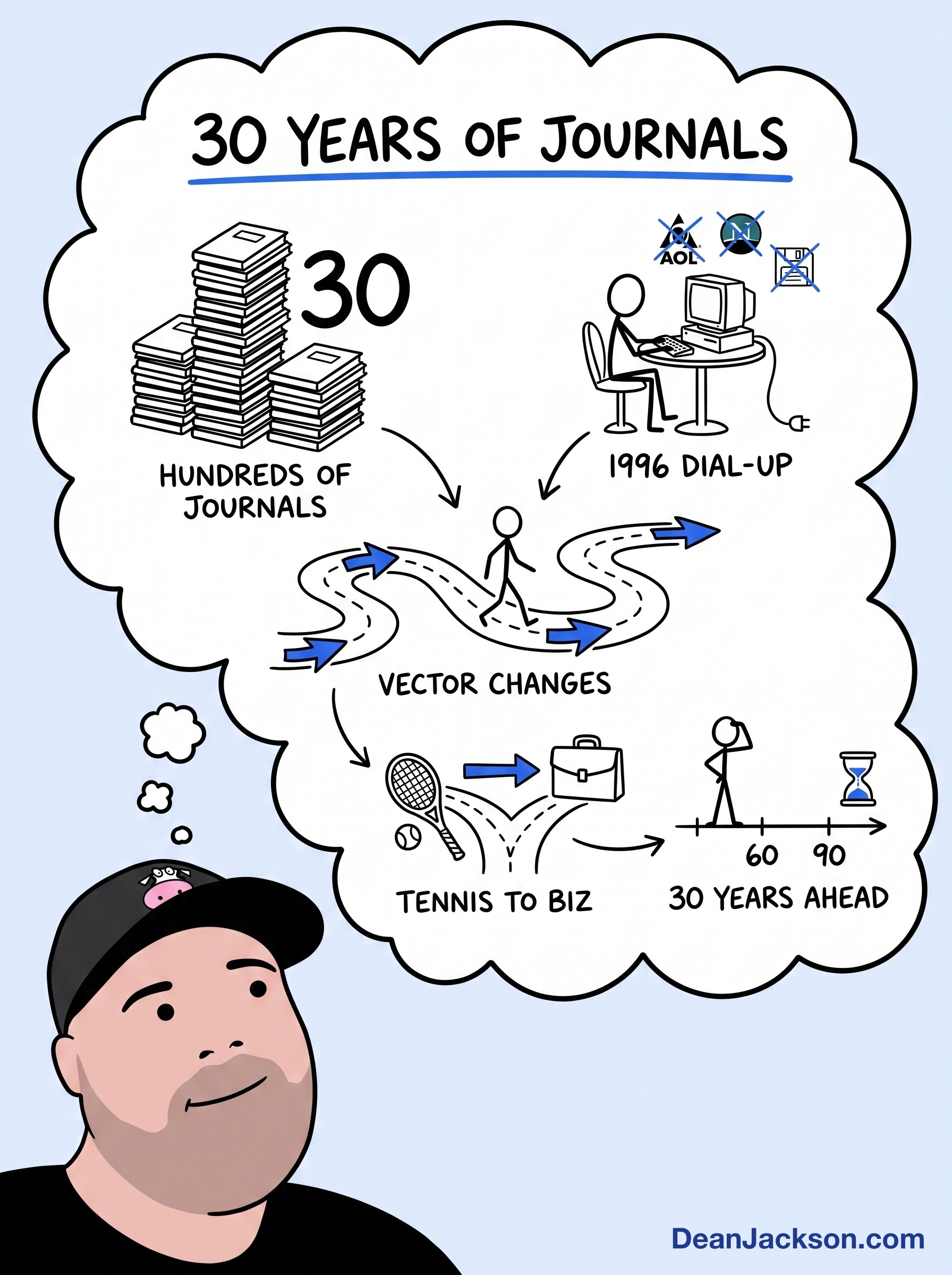
Turning 60, I opened the first of hundreds of daily journals I've kept since 1996 to trace the vector-changing moments that shaped everything.
I just turned 60, and to mark it I went back to the Eagle Ridge Mall in Lake Wales where I sat with my very first journal in 1996. I've written in a journal every single day since then, and there are now hundreds of them.
Back in 1996 there was no Google, no YouTube, no Facebook, and Apple was failing. Looking back, I can see my whole life as a series of vector-changing moments, the handful of times something happened and I ended up pointed in a completely new direction.
The biggest one took me off the tennis court. I trained at Rick Macci's academy alongside future champions, but at 22 I realized I didn't want to still be grinding on tour at 30. A story a former player told me on a boat in Vero Beach made me pivot to business, and that's how I ended up back in Florida starting this journaling adventure.
This is the start of a series. I'm opening journal number one and working through all of them, pulling out the insights that still hold true and the opportunities I saw but didn't act on. Hope you'll come along.
Join me live on the next free 50-Minute Profit Finder call, Friday, October 9 at 1:00pm ET. Save your spot →
Transcript
Auto-generated transcript, provided as supporting material. It may contain errors, and speaker labels are occasionally mis-attributed.
It's Dean Jackson, reporting live from the Eagle Ridge Mall in Lake Wales, Florida. And I thought this is the perfect spot to come back and kind of reflect on something that's happened over the last 30 years. I just turned 60 um this month and I've been as part of that going back and picking out samples of the journals. Every day since 1996, I've kept a journal.
And it's hundreds of journals. And I look back at them and it's amazing. I've been like taking core samples and just kind of reading through the journals to see all the thoughts that have developed, all the cuz everything that I've done in the 30 years started in this journal. And I've done some pretty cool things.
But when I go back, if I look back at 1996 I just want to put things in perspective because this mall was sort of brand new in 1996. It was the cool place to be. It's a great movie theater. It's still here but it's dead.
I mean the movie theater is still going but it's kind of like all malls, it's not the thriving place that it that it was. And nobody could really see that coming in 1996. You know, I realize if you go back that far, let's just think about the things that have happened since 1996. So, when I sat right here at this table in 1996, the internet was just getting going.
It was dial-up. You know, you had to use the dial-up on your phone. The The most uh high-tech thing you could really do was send email or be in bulletin boards. That was the extent of it.
To download even a single image was painful. You know, but you could send email. And you could communicate in chat rooms and things like that. You could see that the internet was going to be something, but this is before Google existed.
This It In 1996, Apple was failing. And it was right before they hired Steve Jobs to come back and turn them around in 1997. So, no Google, Yahoo was just kind of getting going. Amazon was just getting going selling only books.
You had no YouTube, no Facebook, no Instagram, no Tesla, none of the things that we look at as instrumental to today were even in existence. They were an idea in somebody's journal. I imagine that Jeff Bezos, before launching Amazon, probably had a journal similar to this and would sit and think about, "I bet I could sell books on the internet." And when you figured that out, you know, look what that became.
Uh but looking back at these journals, I realize there are some things everything in in my life that's happened since 1996 has been a series of vector changing moments. And you probably, if you reflect on your life, there's probably been a handful of those moments where something happened and you were in a completely different direction. So, in order to fully tell this story or set up the story, I need to go back to 1986 to give you an idea of how I got from there to here. So, in 1986, this was the center of my world.
I spent so many hours on this tennis court playing tennis all day, every day with the pursuit of being a tennis player. You know, it's 1986 and I remember what the vector change that got me onto this path was 1976 watching Björn Borg win Wimbledon and getting hooked on tennis. Up until 10 in Canada, if you are under 10, it's like mandatory military service to play hockey. So, that was the whole world up until then, but from 10 on it was all about tennis.
And that path ended me up here at what was at the time the premier tennis academy in the world, Rick Macci Academy right here. And we had people coming through here. We had Jennifer Capriati, we had Andy Roddick, we had Venus and Serena Williams, um Lindsay Davenport. All of these top players would come right here to this court, and there were so many courts at this tennis center to train with Rick Macy.
And many of them went on to be the top tennis players in the world. And I mention that because there's some things that vector changes move you in an entire different direction. So, in 1988, two years after being here, I'd spent from 1984 to 1988 full immersion here playing tennis. I had a doubles partner from Sweden.
And he we were playing in tournaments that were the equivalent of like minor league baseball on your way getting up to playing aspiring to play professional tennis. And the thing that I noticed, I was starting to see at 20 years old, I was already starting to see like, where does this path go? And I it was I remember the moment because it was 1988. We were in Vero Beach.
We were with one of the friends of my doubles partner, Johan, who was also from Sweden. Former tennis player. Guy was in his 40s. Got to be 180 in the world and had a knee injury that he was telling us this story.
And he thought, you know, I am 26 years old. That's what he was at the time when he had the knee injury. I'm There's in theory, there's only 179 people in the world that are better than me at what I do, and I'm living, you know, kind of hand-to-mouth, spending all the money I'm making, being out on tour. And I may not make it back to the same level that I was at.
This knee injury may take me out. And I remember him saying he had this epiphany, thought to himself, I wonder what the 180th ranked businessman in the world's making right now. And when he said that, we were out on his boat in the Intracoastal in Vero Beach, a beautiful night. And I remember that just sinking in to my soul.
Because I was already seeing playing tennis at that level, at the getting up to playing at the Wimbledon and the ATP events is a very unglamorous thing. And you start to see there's guys that are 30 that are out there still grinding, or they've been up to play in the top tournaments, and then they've had an injury, they have to come back and earn their way back up. And I realized, man, I don't want to be that. I don't want to be out here grinding at 30.
And I recognized early on that my runway for doing this was shrinking. You know, I was already 22 at the time, and it just struck me. We had played in the tournament, and it was Andre Agassi's first professional tournament. Johan and I were there, and Andre was this 15-year-old kid with blue hair and this rocket forehand.
And he won the tournament. And then that summer he had his breakthrough summer and beat John McEnroe in Vermont and went on to be Andre Agassi. But I realized if I could pivot to business right now, I would be like the Andre Agassi of business. I'd have a super long runway.
All my peers, all the people that I might graduate in class and stuff, they were still 2 years away from graduating college. And if I could start in business and take the things that I had naturally, which were a competitiveness and energy, and I had you know, a winning personality, and I didn't mind doing sales, and I knew that if I could take that and get started on business, that I would have an advantage. And by the time everybody came out, that was that was absolutely true. So, I told you that story just to put in the context of being in the Eagle Ridge Mall in 1996 with my first journal, there were 10 years between being right here and ending up there, where I started my real estate career, and got to that point where now I'm transitioning back to Florida, and I've started my 30-year journaling adventure.
So, here it is. This is journal number one of hundreds of these journals. And what I'm going to do, I want to do this I mean, I hope there's I think there's some real good insights over 30 years of doing this. I've seen a lot of stuff happen, and I don't think when I was 30 that I have an appreciation for even a conceptual understanding of how long 30 years in the future is.
Like I could I couldn't even have imagined that. Um, you know, at 30 years old you don't have That was my whole life. I'd only been on the planet 30 years and that you know, sort of think back. But now looking back from 60 to 30, it went so quick.
And I think about in these moments, 30 years is a super duper long time. You could do anything in 30 years. You know, I I look at it that the next 30 years from 60 to 90, that's it's kind of crazy. That's you're talking Warren Buffett uh stage now, right?
Warren Buffett 30 years ago was 60 something, already still hitting the peak stride of his uh of his career. I look at Dan Sullivan, who's 82 this month, and you know, having bigger and better aspirations than he's ever had. So, I look at it and I could have gone any direction from right here at this table in 1996. And you know, to put it in perspective in some real clear ways, like 1996, I was I talk about Max Martin, who's a guy who's written the most number one songs on the radio or in on the Billboard charts in the history of the Billboard charts.
The list goes Paul McCartney, Max Martin, John Lennon. 28 number one songs on the on the Billboard Hot 100. In 1996, Max Martin hadn't yet had his first number one hit. He hadn't written one yet.
He was just getting started. If you remember Ace of Base, uh I Saw the Sign and um those were all that was Max Martin producing those, but it wasn't until Backstreet Boys, which by the way weren't even in existence yet, NSYNC, all of these things that came after 1996. It's just amazing to think. So, I'm going to look back at these journals.
I'm going to start with journal number one and I'm going to go through and I'm going to highlight some of the insights that I had then that are still true today and the things that I could have done something about but didn't. Dan Sullivan calls this guessing and betting. And I looking back you know, I've had a really good intuition about where things were going and I've made some right moves, but there's also some missed opportunities. So, this is going to be cathartic in a way of looking back and doing this for me even just to analyze it, but I thought, you know, I might as well record some of these and you might find it interesting, too.
So, 30 years of journals, we'll start with number one and we'll go till I'm done. Hope you can join me on the journey.
Get BreakthroughDNA Free
Discover the 8 Profit Activators that can transform your business. Get the complete framework, free.