If I Ran Your Marketing, Here’s Exactly What I’d Do...
Watch
Listen
Exactly how I'd rebuild your marketing from scratch, from picking the highest-value market to using a book to make your best prospects raise their hand.
This one's a full walkthrough. I take you through exactly what I'd do if I walked into your business tomorrow and took over the marketing, starting with the before unit, the part that finds people who want what you do.
I'd begin with fresh eyes and one hard question. What could you do if you only got paid when the client got the result? That's where the real money is, and it's how the Koch brothers grew their company by investing in the outcome alongside their partners.
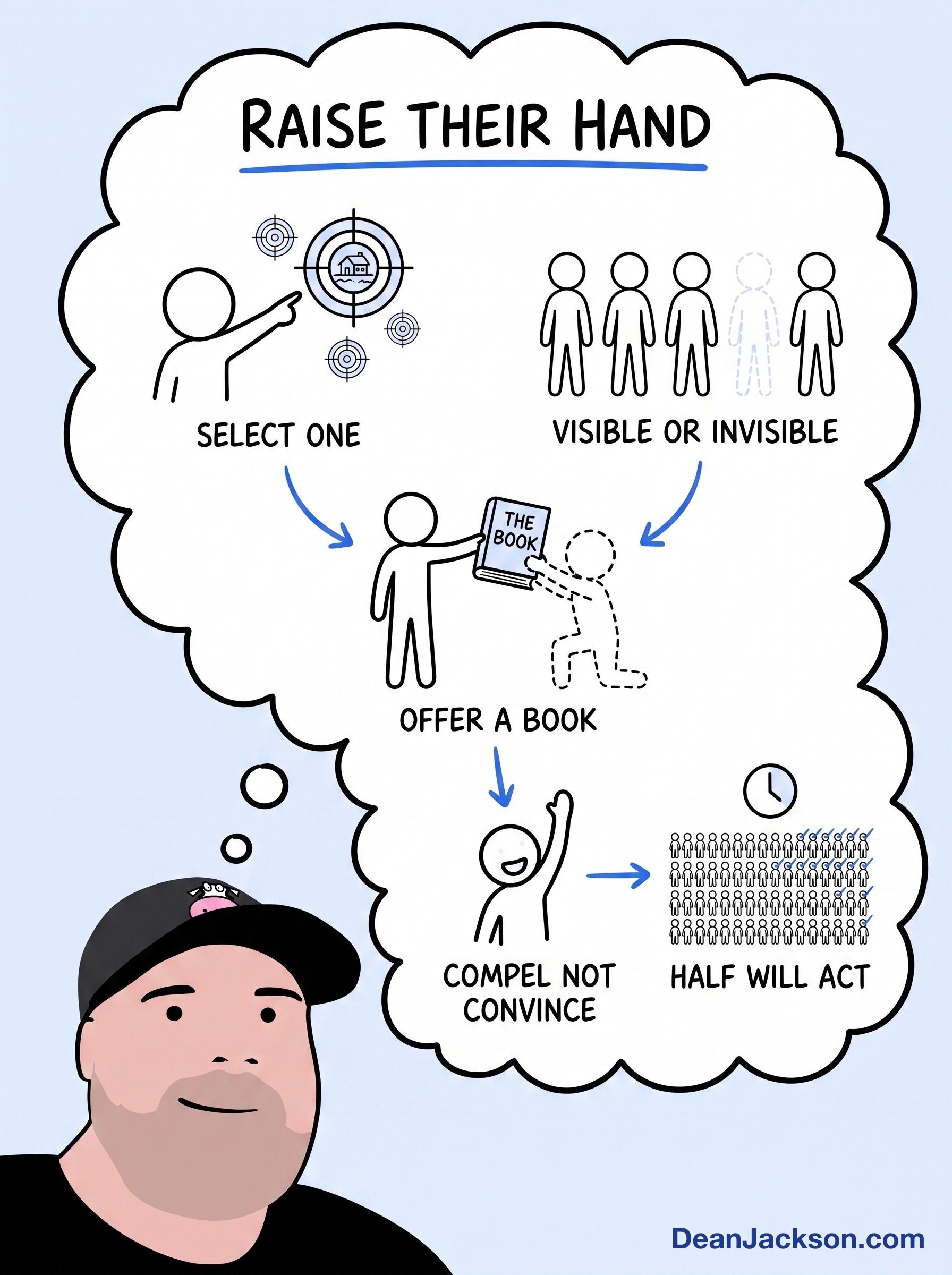
From there it's selecting a single target market at the highest level, then figuring out whether your prospects are visible or invisible. The best way I know to get invisible prospects to raise their hand is to offer a book, so I walk through my five title formulas and the word palette I use to build them.
Once someone raises their hand, I show how I think about them as an asset, why about half will act within 100 weeks, and how to greet them and make an offer so easy they can't help but take the cookie. It's the whole profit activator model in one sitting.
Join me live on the next free 50-Minute Profit Finder call, Friday, October 9 at 1:00pm ET. Save your spot →
Transcript
Auto-generated transcript, provided as supporting material. It may contain errors, and speaker labels are occasionally mis-attributed.
let's go through a process of exactly what I would do if I were coming in and taking over the marketing department of your business. Let's think about it. You know, we talk about here this idea of the before unit, the during unit, and the after unit of your business. And let's focus this morning on the before unit, the part of your business that finds people who want to do what it is you do and delivers them to the during unit, where you can help them.
And so, this is the thought process that I would go through if I were coming into your business right now and going to take over the marketing. It starts for me, whenever I'm I'm thinking about this process here, I want to begin with the end in mind. And for me, what that means is let's establish the market here. Let's establish if we're going to do some marketing, it's going to be around what is the market.
And I love how Ray Dalio talks about the market of something is really just a way of talking about the aggregate number of times somebody, two individuals, exchange money for goods and services. So, we've got to start with the good or the service that we're going to to offer. So, I always love to think about this as like fresh snow. And often the advantage that I would have coming into your business is that I'm not burdened with the backstory of your business.
I'm not burdened with the present moment hassles or logistics or problems or patterns or routines that you've established. I can come in and look at it with fresh eyes. And that's really the best way to think about the before unit because what we're talking about here is creating something that doesn't exist. You may be thinking through the logistics goggles, we call it, of your business that thinks about the way you've always done things or the way you do things or the people that you traditionally have worked with or the people that you tend to tend to gravitate to you.
When we're coming in to look at creating a brand new before unit for you, we're starting from scratch. We can get whoever we want to come to your business. So, I always like to like separate you from that and start to say, "Okay, what would be the best thing that you could do?" And you know, a great clarifying question for that, and it sometimes terrifies people at first, but I ask people, "What would you do if you only got paid if your client gets a result?"
And it's a really, you know, at first it's a terrifying question because most people don't like to think about, "Oh, you know, I can't really I I I don't know what to to say about that. I don't know how to how to frame my thinking around that. You know, what do you mean people aren't going to pay us until we get a result? I can't be responsible for for what they do."
And it kind of, you know, people backpedal a little bit. And I'm saying, Well, just let's just think that way hypothetically. Let's just It's just you and me. Let's have the conversation about it and let's think, what are you so good at right now that you would be willing to sign your name to it and depend on you getting that result?
Is there anything that you do? And if there's not, that's a bigger problem. Right? No amount of marketing in the world is going to solve you not being able to get a result for people.
So, when I look at that and I start thinking, okay, what what would you be able to do if people would just get out of the way and let you do it? You know, where you're not burdened with thinking about it from a way that you've always done or the pricing structure that you've typically had or what you think that people might pay for something. You know, if we were removing all of the barriers, what's the greatest thing you could do? Often, I find, especially people who've been in business for a while who are up and have a successful business, they maybe started out doing something and serving one particular segment of the market, but they've grown.
Their abilities have grown. They've built an amazing track record in uh in the business, but they haven't really evolved to doing things at the higher level. So, I want to think about for you, what's the highest level you're capable of right now? What's the highest level of result that you could get?
You know, regardless of what it has to cost, you know, and that's kind of the the thing that I look at. People are often able to deliver more of a result than their self-esteem or their uh you know, ex- experience or their fear will let them imagine charging somebody. You know, you're often able to create a better result for people than what you think you could convince people to pay you for that result. And it's a pretty profound thought, but let's just go through that exercise for you and really think, what would you do if you only got paid if they get the result?
What are you capable of? Right? And so, that is often there That's where the highest amount of of money can come in your business when you're working at your highest capability with the very best prospects who uh would appreciate and need or want what you're able to deliver for them. So, when we think about that, we inventory, what are your cap abilities?
What is it that you know how to do? What have you done so well that you would be willing to say, I could do this and put my money on the line, that I'm only going to get paid if they get the result. And you know, what guided my thinking on that is uh uh many different things, but one of the ones that what really brought it home the clearest for me is is Charles Koch and the Koch brothers uh who have maybe the the uh most valuable privately held company in uh in the United States, certainly, maybe in the world, Koch Industries, over a hundred billion dollars. And when when Charles and David took over the company from their parents, uh it was already doing well in the '60s, they were doing 28 million dollars a year.
And which was a lot of money, uh but they've grown it 5,000-fold since Charles and David took over the company. And what he did, what their approach was, was really thinking about the other person. You know, other person, thinking about what is our capability that can produce a result for somebody else. Now, at that time, they were in the oil refinery uh business.
They still are, then all the, you know, ancillary products that come from that. But the most important thing in their business was gathering oil. They had to get oil and convince oil companies to to sell them their oil so that they could you know deliver and refine the oil and get all the results. And what they did was very different than the other companies.
They would go to oil exploration companies, oil drillers, and instead of waiting for the oil drillers to strike oil and then all of these refiners descend on them and try and work out the contract to remove the the oil from the fields and take it to market, they would go to the oil refiners and say, "Hey, listen, you are exploring for oil over here. I know that you're you haven't found anything yet, but if what if we were to build the pipeline now in anticipation of you finding this? We'll do that at our expense. We'll take on all the expense, build the pipeline, get everything ready so that as soon as and if you do strike oil, then we can get it right to market without any delay."
Save them months of time to start capitalizing on this oil that they've that they've untapped. And companies would be completely amenable to that because they didn't have to pay anything up front and it really would be a benefit for them. So, they invested in their potential partners' results alongside them and participated together in the outcome. So, when you start thinking about that, just you know, it helps you think if you were unfettered by, you know, trying to convince people to give you money to get the result that you're traditionally getting for people, what would it look like if you were to think about it as aligning your goals with theirs and participating together to create that outcome.
Dan Sullivan of Strategic Coach calls that the Free Zone. And it's a really interesting thing when you start looking at and developing your capabilities to get a result for someone else, it opens up a whole new world for you. There's zero competition. It's like I talk about going around to the receiving dock instead of the purchasing department.
You're not going to the purchasing department trying to convince people to give you a purchase order to maybe get results in the future, you're going around to the receiving dock where you're met with open arms bringing in a result for the for the company. So, that's the first thought process that I would have is what is the thing that you can do that would have the biggest the biggest impact. Now, we can think about who would be the ideal client for you to do that. So, a lot of times people, you know, we want to select who is your ideal prospect.
What would be the characteristics of the person that you're working with? And you know, when you start looking at your your ability to price and build your service offer or your good or service around what your capabilities are and then find who would be the ideal market for that, both of those things have to be um, true. Both of those things you have to address both of them. You have to find the thing that you're going to be able to do better than anybody else, and then find the ideal person that you would like to do that with.
So, we'll give you, you know, an example, a couple of examples. So, when I think about with realtors, well, I do a lot of work with with real estate agents and financial advisors and coaches and um, people like that who are are transformation kind of, um, uh, making transformation offers. So, if I'm coming into a real estate business, I want to look at what's the highest thing that we could do. What is What's the best thing in the market here?
Could be oceanfront homes or oceanfront condos or lakefront homes. What are the most expensive things that we could do? The most desirable. Let's start with that.
Because if you're going to do the work, you know, it's the same kind of mechanics of finding somebody who wants to buy a home, helping them go through the process of looking at homes, exploring, finding the one that they want, then we've got to negotiate an offer, then you got to get the offer from contract to closing. Those are the mechanics of what's happening and it's really the same mechanics whether you're selling somebody or helping them buy a $200,000 condo or a $2 million oceanfront home or condo. So, or a lakefront home, whatever it is. Let's start at the highest end.
Let's start with with what there's a market for. And because, again, remember, we're doing the selecting. We're not waiting for people to select us. Profit activator number one is select a single target market.
That means you doing the selecting. Not hoping we're not going to cast as wide a net as possible and hope that people discover us. We're going to select the target market that we really want. One at a time.
One target market at a time. So, we take oceanfront homes. I think it about my friend Kenny McCarthy in in Cape Ann, north of of Boston, where, you know, the most uh most desirable thing on Cape Ann, of course, is oceanfront homes. So, rather than trying to earn your way up to that or to get to a point where maybe someday you get to work with one person who wants to buy an oceanfront home, why can't we think about what would it take to dominate the oceanfront business in on Cape Ann?
So, we start with that and now we're selecting them and putting the blinders on so that all we're focused on for this division of the before unit of our business, the only purpose of it is to dominate the oceanfront business, the oceanfront part of of um real estate on Cape Ann. So, when we think about that, now the good news about real estate is that it's 100% a you only pay when you get the result model. You know, you they charge a percentage of the sale when they sell the house or they get paid a percentage when they help somebody buy a house, but it doesn't cost the buyer or the seller anything to uh engage, they only pay for the result. So, there's an established kind of norm like that.
And that's why real estate agents get among the highest uh commissions of any kind of commission sales people. There's a There's a lot of opportunity there, way more than they would get if they had to get people to pay up front. That's just a side uh thought there. But when we look at it now, what we need to decide for you is do you have visible prospects or invisible prospects?
Because it's going to change the way that we try and approach them. Um let's say I do a lot of work with different types of doctors or health uh providers. I work with a a podiatrist in uh Milwaukee who's works with, you know, the the big things that happen with your feet, you know, with uh with plantar fasciitis and uh heel spurs and Achilles heel pain and toe bunions or toe fungus, all the things that could potentially go wrong with your foot are all individual markets. So, we're looking for who are those people.
Now, we know that he can provide instant relief for anybody who has plantar fasciitis pain. But they're invisible prospects. So, how do we draw out both visible or invisible prospects? One of the best things, and this is what Profit Activator number two is all about, is that we're just trying to compel people to raise their hand.
Compel our best prospects to raise their hand. Now, the best way that I know of to get somebody to raise their hand is to offer them a book or information, something that is just 100% focused only on getting them to raise their hand. And I call this the difference between compelling and convincing. And a lot of times what people are doing when they think about approaching a new market like this, they're trying to convince people in their ad that they need to buy this thing or to take this action.
They're trying to compel or convince people to think a new thought. And now here's the best place that is the easiest to access, the easiest thing to test your ideas on is Facebook marketing for invisible prospects. If you can't point to them, like you know, in real estate, the good news is oceanfront homeowners are visible prospects. You can point right to them and you can send postcards or direct mail or email right directly to them individually, one person at a time.
You've got addressable media opportunities there. For invisible prospects, meaning people that you don't know specifically who woke up this morning with plantar fasciitis pain or who woke up this morning thinking about I'd love to find an oceanfront home. See, so for the for the realtor, oceanfront sellers are visible prospects. Oceanfront buyers are invisible prospects.
For a podiatrist, anybody with foot pain specifically is an invisible prospect, but you can get in front of the people around the area where you are that may contain some number of people who have plantar fasciitis. You just need to get in front of them. You need to identify them. Same thing for back pain, for foot pain, for um adult acne, for anything.
Think about what is the problem or the solution that your the desire that your prospects are looking for so that you can um identify who they are by offering them something that would compel them to raise their hand. That's why I use books. You know, books are the the most compelling thing that we've established in society as valuable. You know, books are revered in our society.
We you know, we have huge government-owned buildings dedicated to housing books and all of the information that's available uh for people. And since the Gutenberg Press, we've been writing stuff down and cat- cataloging it all, having it in in buildings that we all know and we gather in hushed tones to be in the presence of books where we revere it. Authors of books are, you know, revered as authorities. That's where author comes from.
They're geared as someone who's who's above other people. They've They've done something. They've compiled information so we respect people who are authors. All these things are working um in our favor it without us having to do anything.
You know, these are just things that are societally there. So, we're going to tap into that desire that when we're looking for new information we turn to books, right? That's a great uh place for us. So, when I look at it is how can we encapsulate in a book the the thing that would get your ideal prospects to raise their hand and that all starts with the title of the book.
So, when I look through this process here, the first thing I'm starting with is what would be the title of the book that my ideal prospect would definitely pick up if they saw it. What would that be? What would that title be? And so, you know, we've been helping, you know, a thousand plus people write and publish books over the last several years that we've developed some real formulas around this.
I observe and I see how things work. And so, let's work through the process for you. This is how I would do it if I was coming in to your business. I'd think about, okay, here's some here's some things that are going on with your prospects.
I would start with what I call a word pallet. And the word pallet is really just taking some time, sitting down, and kind of brainstorming. I use my remarkable tablet here or you could use a piece of paper, you can use your journal, whatever it is. I sit down, I set my timer for 50 minutes cuz everything I do, I do in in 50-minute focus finders.
And my thought is what are all of the phrases and the words and the questions or the things that are on the mind of my prospects. What are are there any misconceptions that they have? Are there thoughts? Are there sound bites of things they might say that I can look at and use as a palette just like a painter if he was going to paint a picture.
The first thing you do is, okay, what kind of picture am I going to I'm going to paint a you know, a a beautiful ocean scene. So, it's a bright sunny day. I'm going to have the blue sky and the yellow sun and the sand and the colorful bathing suits that people might have it be all bright colors. So, I would start I'd get my palette and I'd start mixing up the paints and the colors that I might use in painting this picture.
And the same thing is true. What we're going to do with your prospects is we're going to put a palette of all the words and the thoughts and the fears and the hopes and desires and the goals and the misconceptions, the myths, the um natural things that come up in conversation around your topic for your book. For you know, your prospects, what are they going to think? And we're going to use those to conform them into some formulas that we have for creating books.
So, the title, here's how I would title your book. I'd go through the process and I would look at these formulas and I would look at those words and I would try and think, how could we use this formula to title a book for you? So, let's start out. Num- the there's five book title formulas that we have.
And the first one is what I call name it and claim it. And those are book titles that if you just see it see the words on the cover, you're going to say, I want that. That's what I want. And so, we're trying to tap into the conversation that's already going on in your prospect's mind.
So, here's a couple of examples of great books that use that title formula. Um, The 4-Hour Workweek is one of those. The 4-Hour Workweek is a great book title because you could see that and say, "Oh, I want that." Especially if you're really busy running around doing 60-hour weeks or 70-hour weeks and you see a book title called The 4-Hour Workweek, you're immediately stopped in your tracks and you say, "Oh, I want that."
Another one is Financial Peace. Dave Ramsey, I think there's probably never been two better combination of just two words that convey so much that if somebody's in stress, they're in debt, they're concerned about money, they're worried about it, it's keeping them up at night, they hate that knot in their stomach that they have all the time, and they see a book called Financial Peace, they recognize immediately that that's exactly what I want. I want that. And it almost feels like if you just take the book and hold it to your chest, that it's going to lower your blood pressure.
You're going to get a sense of of calm, not even having read the book. You just get the book and hold it in your hands because you recognize immediately that that is something that I want. I mentioned the the plantar fasciitis. So, what would somebody want if they say they want that?
So, we offer a book called The Plantar Fasciitis Solution. I do the same thing with uh Luba for our uh one of the things that she helps people do with all of their her uh facial device is helping people with adult acne. So, we did a book called the adult acne solution. We were calling it the adult acne cure, which is a great title, but we had to adjust a little bit for Facebook.
I you can use cure in the title of a book, but for some advertising networks in order to get it in front of people, you have to change and adapt to whatever they want. So, solution is a second best word of that, but the adult acne solution is enough to get the invisible prospects in a 15-mi radius of Luba's studio right here in Winter Haven to raise their hand and ask for the book, knowing that now we're in conversation with someone who probably high probability has adult acne that they don't want. Same thing with the plantar fasciitis solution. So, when you start thinking to yourself, what would be the thing what would be what would people make people say, I want that?
And I would go through that process with you and we'd come up with the best title for it, if it could be a want I want that title. Then the second format is what I call just do it titles. That's a great title by the way on its own, just do it. Uh but here's some books that fit in that category is Think and Grow Rich.
Very popular. You know, that's been a perennial best seller for so many years that we don't even uh you know, you can't argue with it. It says right on the cover, that's what we want. I want to do that.
That's what I'm going to do. I'm going to Think and Grow Rich. I wrote a book 24 years ago now called Stop Your Divorce, which still sells to this day. We've sold over $5 million worth of that one book with those three words that say exactly what somebody going through a divorce that they don't want would resonate with.
They'd say, "That's what I want. I want to do that. Stop your divorce. How do I do that?"
That's the next thing that people are going to go. Um Eben Pagan, a good friend, we wrote He wrote I worked with him on on getting the model set up, a book called Double Your Dating. That's a action-oriented thing. Here's what you're going to do.
You're going to double your dating. We [clears throat] wrote a book for reverse mortgages called Double Your Retirement Dollars. Now, see, there's a perfect example that you've got something, a reverse mortgage sometimes comes with connotations. Something comes with some misinformation and misconceptions that people might think, "Oh, I don't want to I don't want to reverse mortgage.
I don't want to give my house away. I want to I want to keep my house." Which is not what a reverse mortgage is about. But when we focus on what is it able to do for people?
Let's focus on what they can do is double your retirement dollars. If we show people how they can buy a home with 50% down instead of buying the whole thing with cash, that leaves that extra money for them in retirement. So, for the right people, it's an amazing thing. But we're starting with this concept of double your retirement dollars.
That's compelling and not convincing. We're not trying to convince people to get a reverse mortgage. We're getting in front of the people who are already aligned with the thought of doubling their retirement dollars. That sounds interesting to me.
Or stop your divorce. That sounds interesting to me. We're going to gather all the people that are going to be the right fit for what you're ultimately able to offer people. Okay, the third type, the third format is how to.
And this is one of my favorites because we use and you interchange these all the time, by the way. You you should be thinking about these kinds of titles because even if it's not going to be the title of your book, we're going to use it later in all of the content that you're going to create to educate and motivate people all the way through the process. But right now, we're just talking about compelling people to raise their hand. How to, you know, the great thing about how to titles is that you can't say the words how to without finishing that sentence with something valuable.
Some kind of benefit, some kind of transformation that's going to come after it. How to win friends and influence people. That's a great I'd like to know how to do that. We've got a book called Find Your Own Buyer.
How to sell your house on your own, save a ton of money, and laugh to yourself at how easy it was. Now, that's a compelling title for somebody who's thinking about selling their house. How to get your dream job in 30 days or less. That's a great type of how to title.
So, when you can think about what you do in terms of uh how to, where you're going to show people how to um do that, that's going to be a wonderful opportunity for a book title for you. The next one is an information goldmine. That's number four. And there's lots of ways that you can package up information to appeal to people in the research phase of gathering information.
They're starting to do something and they're going to research and they're going to want to know get their ducks in a row, right? Whenever people are starting things. So, I talked and about in in previous episodes a party rental company. The approach of instead of you know, trying to advertise and convince people to choose your party rental company.
When I asked the party rental company that I was working with, what would be a dream come true? Who's your dream client? Remember we talked about selecting at the very beginning who's going to be the right the best person for us to attract, they said an outdoor wedding, which means they're going to get tent rentals, tables, linens, chairs, generators, lighting, all of it. So much stuff goes into having an outdoor wedding.
But choosing a party rental company is not a very sexy decision and brides who are planning on an outdoor wedding are invisible prospects. So, how do we find them? We don't make our priorities their priorities. We get in line, get in alignment with their priorities.
What are they thinking about right now? What would be the most useful thing that we could do to serve them right now? So, we put together a directory called 100 great places to have an outdoor wedding in Toronto. Now, that is a compelling piece of information to anybody who's got a dream of having an outdoor wedding.
So, instead of advertising the party rental company and that we've been in business since 1963, family-owned and operated, you know, that whole thing is falling on deaf ears. Doesn't matter. What really matters to the bride-to-be is what's among the first decisions they're going to make. Where are we going to have the wedding?
You know, you got to have a you get First they say yes, then you've got to have a when and where. That's the top decisions. So, if somebody's having an outdoor wedding, everybody loves to have options. And these guys, because they'd been in business for 40-plus years, they knew a lot of places to have outdoor weddings and nobody would even think that you could have an outdoor wedding there.
So, putting that information together gathers the right people. Now, you've got a list of people who are visible prospects for an outdoor wedding. We did the same thing with a hockey scholarship directory. We do the same thing right now with the guide to Winter Haven lakefront house prices or the Longboat Key beach condo price report with the you know, beach condos profiled for people to give them and all the information that they would need of all of the condos on the beach in Longboat Key with an idea of how much they sell for, how many units are there, do they allow short-term and long-term rentals, um what's the selling price of those, how many units do they have, what's the square footage of the units.
So, people can in the information gathering stage really have an advantage. It's like getting the teachers' edition of your high school algebra book. You can see all the answers right there rather than just depending >> [cough] [clears throat] >> rather than just depending on what is available on the market right now. And this way, you as a realtor don't have to have beachfront condos or oceanfront homes or lakefront condos because you are gathering the information that's going to identify those buyers without you having to have a listing to do it.
And the same thing, if you're a party rental company, you don't have to have an outdoor wedding venue in order to do it. You're just thinking ahead that what has to happen before people ever get to where they need our services. And maybe you're in a situation like that where your service is one part of a multi-service, multi-step process that people are going through. So, when you start thinking about it that way, you can think what would be the info that the people who are going to do this and this works on the smallest level to the top level.
We've done I worked with a company that did um mainframe outsourcing for Fortune 1000 companies, big companies. These you know, clients were um you know, high six figures into the millions of dollars in um engagements for them. But, instead of convincing people to use their service to find to to switch their mainstream, we started out by putting together a guide to mainframe outsource pricing. Right?
What's the thing that people would want to know? What is it that they're in the information gathering stage going to desire as far as it goes with your service and offer that to people. The fifth type of of book title formula is I was just thinking that. That's what I call it.
And it's tapping into the mind that's going on the the thoughts that are going on in their mind right now before they're doing anything with your with your service. So, a great example of a book in that I was just thinking that um formula is What to Expect When You're Expecting. It's a perennial bestseller and it's exactly getting into the mindset of first-time parents. People who are pregnant for the first time they're wondering, "Oh my goodness, what what do I expect?"
That's it's articulates it perfectly. What how what am I going to feel? How long am I going to be sick like this in the morning? When am I going to start showing?
When is it What can I do and and not do? All of these questions, how do I do pregnancy right? But, What to Expect When You're Expecting is one of those great titles. Then at 90-Minute Books, we worked with someone who we had to play on that title called What You Don't Expect When You're Expecting.
You you can tie into a book that's already really popular and sometimes the opposite of that is equally true. Years ago there were I saw this at the airport. There was a book that was very popular at the time called The God Delusion. And it was a There was a a book that was written is uh is The God Question.
Which was tapping into the all the people, you know, they really were using the Amazon search thing at the time so that when somebody was searching up The God Delusion, up on top of it would be The God Question, a you know, companion thing to The God Delusion that asked the questions that will help you really think through what they're saying and that. And I thought, man, that's amazing. So, that's kind of the genesis thought of how you get to something like what you don't expect when you're expecting. Um then one that we did with the a financial advisor, one of the things that we did was a book called How Much Is Enough?
And that came directly from the word palette exercise of thinking through talking with the financial advisor, what are you hearing people saying? What's How come we articulate in their mind what the question is? What is that What's on their mind when they're approaching retirement? And they're kind of I've I saw it in action in my friends I got friends that were um late 50s, early 60s, rich, thinking about retiring, but it was funny because none of them ever really thought like they had enough.
Like it was so funny to see someone with $3 million thinking, I need $5 million should be enough. And people with $5 million thinking, I need $10 million, but they're not really thinking through, well, how much is enough? How much do I need to live my life in perpetuity. And so, we did a book like that.
And that's been a great uh a great thing. We created a postcard for the book, again using this word palette format uh formula to be able to get the raw materials that we're going to use both for the book title, but how to get the message across to people. And we did a postcard that said free book reveals three avoidable surprises that derail even the most cautious retirement plans. And we talked about it and we offered the book how much is enough.
And that was a a big win. It was a great um responsive um book that you know, using that formula can can work for you. So, that's what I would be doing um with your business. Now, we once you've got that the purpose of it is to as I said, get people to raise their hand.
So, how do we do that? One of the the easiest things to do is if you've got visible prospects, we send postcards directly to them. You know, with financial advisors, we can identify people who are 60 1 to 67 years old who are homeowners, who are within 15 miles of your office, who have 1 to 3 million dollars investable assets. That's the ideal audience.
I know because we just ran the numbers for here in Winter Haven. If that's your target audience, there are 1,423 of those people within 13 miles of right where we're sitting right now. If we go down to half a million dollars, there's an additional 2,200 of them. So, you know, you look at it, there's 3,500 people who have a half a million dollars, are married homeowners living within 13 miles of where we are right now.
Those are visible prospects. So, we can go directly to them. We don't have to run Facebook ads or ads that try and draw them out. But, at the same time we're also doing a program where we're trying to approach lakefront homes here in Winter Haven.
So, we put together the guide to Winterhaven lakefront house prices and we're drawing out the invisible prospects there and at the same time going to the visible prospects, the people who own the lakefront homes. So, that's what I would be looking at for you is how can we get in front of your ideal prospect. Now, the thing that happens when you when you write a book like this, when you write a book and you run an ad and somebody responds to your ad the book has done its job. That's why we focus on just writing a book that is enough to meet the requirement of being a book without being going overboard, without doing too much.
There's absolutely, and I promise you this, zero difference in response. Cuz that's what we're talking about, right? The job of work that we're hiring the book to do is to get your ideal prospect, if they're invisible, to raise their hand and become visible. Now, they will do that regardless of how many pages your book is.
Regardless of how many hours you spent writing it or how cleverly you worded the second paragraph chapter three. Nobody cares about any of that. The only thing that matters when we're doing that is that you have a book and you've got a title that upon reading it, your ideal prospect says, "I want that book." And you've got a way for them to get it.
Go to this website or click this button to download that book right now. Now, as soon as they do that, they don't care whether it's 50 pages or 250 pages. They're asking for it because you're offering them a book with a title that completely resonates with what they're looking for. Now, this is where we take this process to the next level here.
What have we got? Imagine if that opt-in button, the send me the book button, the you know, the toll-free number that they dial to ask for the book, what if that was a magic portal to your office? And as soon as they push that button, they're magically ported to your office. And they knock on the door, they poke their head in, and they say, "Hey, I'm here about the plantar fasciitis solution book."
Or I'm here about the adult acne solution book. Or I'm here about whatever we decided is the book title for you. That That's what the job of work is, is to get those people to knock on your door. So, when we start thinking that way, what is it that is going to compel not convince, compel your prospects to raise their hand because there's zero friction.
Right? I definitely want this. I want to know about what you're offering here. Please, give it to me.
So, now what have we got? We've got somebody who's in turned from an invisible prospect to a visible prospect. And they're self-presenting with the need that you've already identified as a prerequisite for somebody being your ideal client. Right?
If you want to help people with plantar fasciitis pain get out of pain, the prerequisite is that you got to be in plantar fasciitis pain. Which is a minority of any audience, but within 15 mi of your podiatry practice, there are hundreds of people right now who have plantar fasciitis pain. And that's who you're identifying. So, once we get them there, what are we looking for now?
Now we enter into the process in profit activator three of your before unit of educating and motivating people. So, we've got to be prepared for them to come in. Right? We've got to be prepared.
We've got to know and we engineer the process in advance that when these people knock on the door, how are we going to greet them? And what are we looking for? And what are we likely to find? So, let's start with that.
What are we likely to find? If 100 people I always like to think of things in in cohorts here rather than think of them as just rules, you know, solid rules here. I look at things I take the scientific approach to everything. So, I'm looking to gather a cohort of 100 people.
And let's say that we get 100 people to ask for your book. And we've spent $5 each for them to do it. So, we've made a $500 investment. And that's the way I think about it is we've created we've made a capital investment not an expense, a capital investment of $500 to buy an asset of a bundle of 100 people who have self-identified as someone with plantar fasciitis pain or someone who's looking for an oceanfront home or a lakefront home or someone who's got adult acne or whatever it is that we've identified as as what you're looking for there.
We've got 100 of them. For $500. Now, what is that worth? If we're creating it thinking about it as an asset, what do we know about them already?
We know that from years and years of lead conversion study and everything that I've done experimenting, we know that our rules of thumb on this are that just over half of the people who inquire about anything are going to do something about what they've inquired about within the next 2 years. So, I take it at 50% and 100 weeks. So, I'm looking for what is the value that the the you know, the return uh value on this asset of 100 leads over 100 weeks. So, we've spent $500.
We've identified 100 people who knock on the door I'm here about whatever the problem is that you've identified for them or whatever the the compelling offer is. How many of them now, what would it be worth if half of them did something about it? Now, they're we're not saying that half of the people are going to do business with you, but studies have shown for years and I've confirmed them that half of the people are going to do something about what it is that they are asking about. So, you know, I based it and I've talked extensively about the study on they called the Did You Buy surveys, where they would call people back over a period of time and found that they would just ask them a question, you came you inquired about faucets, did you buy any faucets?
And half the people over 100 weeks will have bought faucets. Now, it doesn't mean that they bought them from you or that they're uh in the market to buy them right now, but just the fact that if you just observe them, tag them, check up on them, that if we were just to look at it 100 weeks from now, half of the people have likely done something in the category that they raised their hand about. Outdoor wedding guide, probably half of the people that inquired have gotten married within 100 weeks of that. So, knowing that that's what we're looking at, and knowing equally that when leads start out in the beginning, all you've got is a name and a email address, maybe a phone number, maybe a physical address, but you just have the identifying information, no qualitative information about them.
You don't know what their real desire is, but that's our job now in Profit Activator 3 is to identify who are the five-star prospects. Who are the ones who are likely to be our best client? And, you know, the universal thing that we use for a five-star prospect is someone who's friendly and cooperative, or willing to engage in a dialogue. Friendly and cooperative.
They know what they want. They know when they want it, and they'd like us to help them. That's our objective in Profit Activator 3 is to get into a relationship with the five-star prospects. And it's about discovering them.
It's not about creating them. It's about discovering them patiently, systematically, being in a relationship with them through that entire 100-week process, so that when it's time that they know that you're the one to work with. So, when we look at it, again, our first job is to identify the five-star prospects. So, if we're going to if they have to be all five, we We as well start with who's willing to engage in a dialogue and is friendly and cooperative.
We don't need to try and convince them to do anything. One of the biggest mistakes I see people do in lead generation is they're treating it like an expense-based approach with an urgency that they need to compel or convince these people to buy right now. So, the first words out of people's mouths are "Hey, your info's on the way, but before you go, this here's the offer and you better buy this now because this is the lowest price you're going to get on it and if you don't buy it in the first 24 hours, I don't you're never going to see this price again." You're trying to start at the bottom with here's what you need to do and here's when you need to do it.
We're trying to impose our timeline on them so that you can run [music] the ads and get a return on ad spend in the first 30 days. What are the earnings per click? We're completely wired that way in the whole internet marketing industry. That's the way we think about things.
It's the way we look at the the process there, right? The whole industry is wired like that. But, if you're taking this approach, let's say that you you know, it's you're on average it's going to be a $2,000 solution that you've got for whatever it is that you do. Maybe it's 5,000, maybe it's 10,000, maybe it's 500, whatever it is.
Just think about that and then multiply that by 50 and that's what we're looking at as the potential opportunity. And the first thing, it may be that the lifetime value of them is worth way more than that. So, it's worth investing in the relationship with people and just starting the process by finding out are they willing to engage and are they friendly and cooperative. So, what would you say to people the first time they walk in the store?
Greeting people is a big art. You know, I look at I use the story of Jennifer Leathers, the the furniture store. All they sell are leather sofas. And when you walk in, they don't say, "Hey, welcome.
Can I help you?" To which the immediate and scripted response is, "No, thanks. I'm just looking." But they don't say, "No, thanks.
I'm just looking for a red leather love seat I can take home today." So, how does Jennifer Leathers overcome that? Everybody that comes in, instead of saying, "Can I help you?" they say, "Welcome.
Have you been to Jennifer Leathers before?" And they say, "No." And they say, "Well, welcome. Let me explain how it all works.
All of the sofas you see are available in any of the leathers on the back wall. They're all in stock, immediate ready for immediate delivery, and they're guaranteed for life. My name's Dean. Take a look around.
Got any questions, I'm happy to help." Now, that greeting immediately overcomes the biggest objections and the reasons why somebody might leave without buying a sofa cuz they don't want to make a special order. They don't want to wait for it. They don't want They might not think that if they see a a blue sofa that that's available in red, and they've got five furniture stores on their list today, so they're just going to go to another one.
So, we want to think about what would be the best way for you to greet people and convey the most important things for them. What is it that What are the offers that we're going to make that are going to be the best, easiest solution for people to come experience what you've got. So, when you look at it, if I think about the ocean front homes, if somebody's looking asking for the ocean front house price report and they're a homeowner, I know that the odds are that at some point in the next few years, they're probably going to sell their house. So, what would they want to do next?
Some of them, they might want to know how much their house specifically is worth. They might want to know what to do or not to do to get the house ready to sell. Or they may just want if you have a buyer for you to bring that buyer so that they could just sell and and move. Those are three different motivations, but we wrap an offer around them that makes it super easy and you've already taken the initiative for them.
You know, that's the biggest thing that we want to have for you is that you take the initiative to anticipate what their need is going to be and make it super easy to get that result. So, instead of saying, "Hey, if you've got any questions, please feel free to reach out to us." You know, I meant I always use the hospitality example. It'd be like me bringing you into my living room and saying to you, "Hey, I'm super happy you're here.
If there's anything you want to eat or drink, there's lots of stuff in the fridge. Go ahead and help yourself." And even if I mean it and I want you to feel comfortable to do it, odds are you won't because that's not how we were brought up. So, when I look at that and I transfer it to anticipating somebody's needs, if I went into the kitchen and I came out with a plate of freshly baked cookies and I came right up to you and I said, "Hey, would you like a cookie?"
Odds are that you would take the cookie. It'd be very difficult for you not to. So, when we start thinking about that, how can we bake those cookies for your business? What's the thing that's going to get people to raise their hand and say, "Oh, yeah, I'd like that."
So, if you think about the oceanfront homeowners and their three motivations, the price, the condition, or maybe just apathy or moving, if they you know, convenience for things. So, we offer them, "Whenever you're ready, perfect time." You know, I always use those words, Whenever you're ready, here's three ways we can help you. Number one, you've got a pinpoint price analysis.
Show you exactly what your home would sell for in today's market compared to all the other homes that are on the market. Number two, we've got a room-by-room review booklet and checklist that takes you all the way from the curb to the closets, tells you what to do and not to do to get the most money when you sell your house, or we may be able to sell your house in as little as 24 hours without even putting it on the market in our silent market. And we offer to just reply to this email and put any of those three things in the subject line, or click here for any of those. And when somebody raises their hand for them, we're ending up in the same place.
We're going to be in the kitchen with them talking about selling their house. Or you're going to have a podiatry patient in your office to get instant relief in 10 minutes. Or you're going to have somebody with adult acne coming to your studio for a free treatment to see how you could eliminate the adult acne from your life. So, that's as simple and profound as it is, that's the formula.
And that's what I've been spending the majority of the last 30 years focused on is developing and really refining that system to go into any business and overlay that profit activator model on your before unit and help create a systematic way to get all the prospects that you need to grow your business. So, that's been our 50 minutes here and you know, I I think that that was a pretty good articulation for you of the way that I would think about um your business with that. So, if you're whenever you're ready if you want to continue this conversation, one of the best things is be a guest on the podcast here. Be a guest on More Cheese Less Whiskers.
com and click on the be a guest button and that will bring you to a place where you can tell me a little bit about your business and maybe we can come on and brainstorm and talk about your business forever, whatever it is. You want to try your our profit activator scorecard. We've got a scorecard online where you can go through all eight of the profit activators and see where the eight profit activators growing or slowing your business right now. So, that's some way that you can kind of get some insight into your business.
And if you want to work with me one-on-one to work on your business, I'm happy to do that, too. com and just put one-on-one in the subject line and let's talk. Let's go from there. That's it for this week.
Have a great week and I'll talk to you next time.
Get BreakthroughDNA Free
Discover the 8 Profit Activators that can transform your business. Get the complete framework, free.