Cold Calling Worked. That’s Why I Stopped Doing It.
Watch
Listen
Cold calls work, but the result stops the moment you do. That's why I put everything into intellectual property that keeps working for years.
I'm a creature of habit, and going through 150 journals made me see how much of life is a kind of Groundhog Day. What kept jumping out at me was the growing wake of intellectual property I've built up over the years.
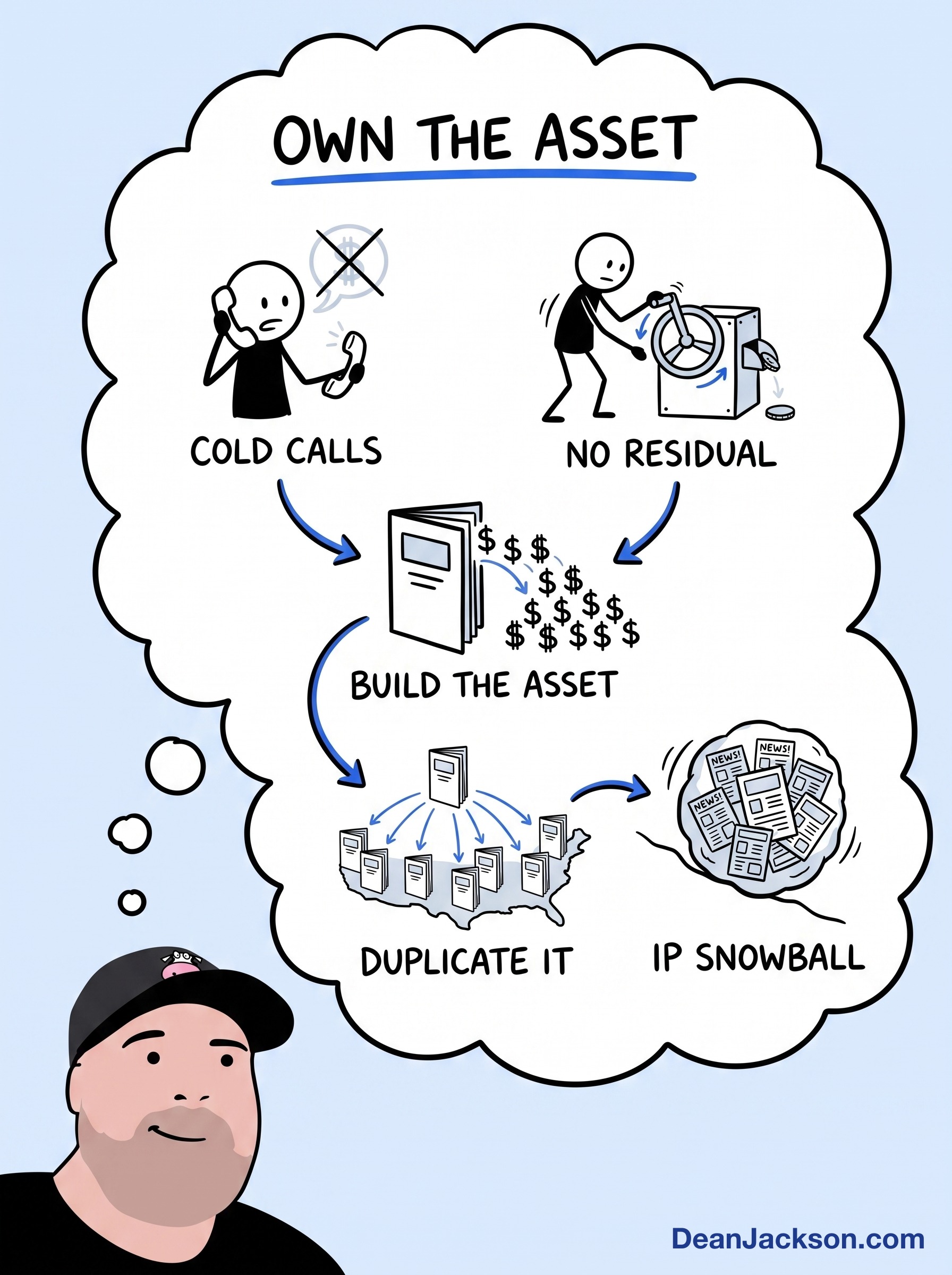
Cold calls work. That's not the problem. The problem is there's no residual value, so the second you stop, the results stop. Michael Gerber's E-Myth taught me to put things into a format I could use again and again, which is how I built the Halton Hills guide and licensed it to 40 agents.
One project in this journal was the Home Buyer College, a set of education pieces we mailed to people who'd buy a home in the next year or two. It started as physical mail and became the email follow-up sequences we still use today. Eben Pagan and I would mine Cosmo covers for headline formulas to make it all land.
The lesson I keep seeing is how valuable it is to package and document what you know. Every piece builds on the last, and 30 years later they're still creating value in the world.
Join me live on the next free 50-Minute Profit Finder call, Friday, October 9 at 1:00pm ET. Save your spot →
Transcript
Auto-generated transcript, provided as supporting material. It may contain errors, and speaker labels are occasionally mis-attributed.
Good morning. m. right now on a Tuesday morning and I'm doing something that we do every day and I've been thinking about as I, you know, write in these journals, I realized what a um creature of habit we we all are. actually wrote an email a while ago about a you we're all kind of living this Groundhog Day where we have a very similar intersecting life with all the people that are around us as well.
Like right over my shoulder there's a couple that's sitting here that comes every morning. It's a father or a mother and a son. And I just love like consistency. I realized as I looked at all of these journals now 30 plus years of journals.
I looked at them all. We've got them all uh stacked up in my dining room and there's probably 150 journals of uh you know a daily ritual daily habit of of writing in my journal. And as I'm going through this, I'm in journal number one right now, and I'm starting to realize the importance of and the value of the growing wake of intellectual property. That's a, you know, fancy word, but of things that I've created over all of these years.
Like, so this is 1996 in journal number one. And if I think about everything, the thing that got me out of the daytoday of being a real estate agent, making cold calls and working in my business is reading Michael Gerber's book, The E-Myth. And I learned the concept of working on your business and creating things that are going to have value and utility beyond what you're doing. And you know, I realized that making cold calls is a very useful thing and effective in that it works, but it's a very immediate payoff with not much future uh you there's no value in it in terms of residual value.
You're it's the effort that you're getting uh that you're getting that's creating the result. And as soon as you stop doing it, it stops creating the result. And when I really got that on a deep level, I started realizing that putting things into a format that I could use again and again and again, it was the most valuable thing that I could do. And that's when I immediately went to create the guide to Halton Hills that became cuz I followed Michael Gerber's plan of treating it like something I was going to duplicate 5,000 times.
So, I had that whole intention and creating a duplicatable system out of these uh the guides and the the um ads and all the assets that you would need to run this successfully in Halton Hills. I was able to license to 40 different people around all around Toronto and then that was what got me into the relationship with Joe Stump. And now here we are traveling around the country doing teaching this same idea and creating assets for realtors that are sort of one to many. You do it one time and many many people are able to use the uh the things.
So, I was laughing because I'm looking in here and I realized one of the sort of major projects that I was working on in this journal at this point in time was something that I was calling the home buyer college. And it was a series of newsletters and education pieces that we could mail to people who were not ready to buy a home right now, but were going to buy a home in the next 12 months, 24 months. We started out. So I was creating all of these uh I was brainstorming all the things that we could send to people.
So I the first 12 are on my uh are in this journal which you know this got very expanded and became you know we had created uh 26 uh 26 issues of this now that we still use to this day except instead of being delivered as mail in an envelope they're delivered as emails in a follow-up uh you sequence. So to be able to give somebody a plugandplay system that you know we you this became the foundation of the followup of what would become money-making websites and all again this is 1996 before the internet and so it started this journey of gathering all of this intellectual property that has value still 30 years later. Like if I think about some of the topics like the first one was on credit and how it affects your ability to buy a home, how to repair your credit, um consolidation loans, all of the things that you might want to know about that. The second one was about down payments.
And the one thing that I used to spend a lot of time in these journals is coming up with headline ideas. And we were Eban Pagan and I would be like we were crazy about headlines. I mean we would it our greatest joy was to get the latest issue of Cosmo magazine. If you remember Cosmo at the grocery store, the women's magazine, and they had the most amazing headlines on the covers, and we would take those formulas and we would adapt them to many different things.
So, the idea of getting really good at buying headline or creating headlines was uh an amazing skill. So, one of them, the down payment headline was why saving for a down payment doesn't work and what to do about it. And so, we started coming up with all of these um all of this outline for this uh for this IP. And I realized, man, that has become an amazing thing and one of the very first like real valuable pieces of IP that I created.
The six dumbest legal mistakes smart people make when buying a home. all, you know, adapted from the pages of Cosmo magazine and the National Inquirer and Weekly World News and Women's Home Journal. And at the time in the '9s, if you got on a good mailing list, there would be constantly something called magalogs that would be getting sent to your your house. I've got a whole tickle trunk full of of all of these kind of uh magalogues and I'll I'll show you some of these as we uh as we move forward.
But that alone just this idea of if I could take one encouragement for you is to think now about packaging and documenting all the things that you know. put it into something that somebody else could use. It's a really it it's um you know it's deeply satisfying when you see other people having success with something that you created. You know, it was re it was really interesting because I'm looking through here and you know, I was um in the very beginning I was working with some of the the very most successful realtors in Canada at the time of creating this.
And there was a, you know, a young guy called Brad Lamb. If you're in Toronto, you of course know who Brad Lamb is. But he was, you know, young like me at the time, just kind of getting started. but he had a focus 100% on condos.
And we did a condo guide with uh with Brad Lamb using this Toronto and Beyond model and ran little classified ads in the Globe and Mail, which was the big uh newspaper there. And I remember, you know, him and I talking about how exciting it was the first time people started calling to ask for the condo guide, which was literally like saying people saying, "Hey, I'm interested in buying a condo." And uh so exciting stuff to to think all the way through that, you know. Um, I started thinking now like I think the the ongoing stuff like that today my Dan Kennedy newsletter arrived which I always look forward to and I realized listen I've been a uninterrupted subscriber to the Dan Kennedy newsletter since I discovered him in the early 90s.
And you think about the consistency and the value of this collection of intellectual property that he has put out, you know, 16 pages a month for, you know, 35 years at least that I've been subscribed. And then something else that arrived in my mail today, I've been subscribing to these uh if you're on Instagram or you're on Facebook, you probably start to see these letters by mail subscriptions and you see how it's funny to see the pendulum swing from in 1996 there's no internet and email was like so rare that AOL made a sound every time you got one. you've got mail. And it was such an event that quickly went away.
But we've all now come full circle to where we love to get physical things in the mail. And there's lots of different services, lots of different subscriptions that you can use to or um get that once a month send you a uh you know, send you an interesting mailing. And I thought this was the this is what the home buyer college was when we when I first created it of you know the idea was to have a monthly mailer that we could send to everybody that requested one of the guides until they were ready to uh to buy their home. So, I'm having fun going through these uh journals.
And I think that's the big lesson for today is to, you know, how valuable the intellectual property is. And as we continue to go through these, we're going to see more and more and more of this building snowball effect of every piece of intellectual property that I create building on top of each other all the way to here we are 30 years later and they're still being used in creating value in the world. So there we go. This is Dean Jackson reporting live from Winter Haven looking through 30 years of journals.
Take a look at all the videos. We're going to make our way through all of them and hopefully it take less than 30 years for us to get through them. But we're having fun.
Get BreakthroughDNA Free
Discover the 8 Profit Activators that can transform your business. Get the complete framework, free.