Why the Best Marketers Make Ads That Don't Look Like Ads
Watch
Listen
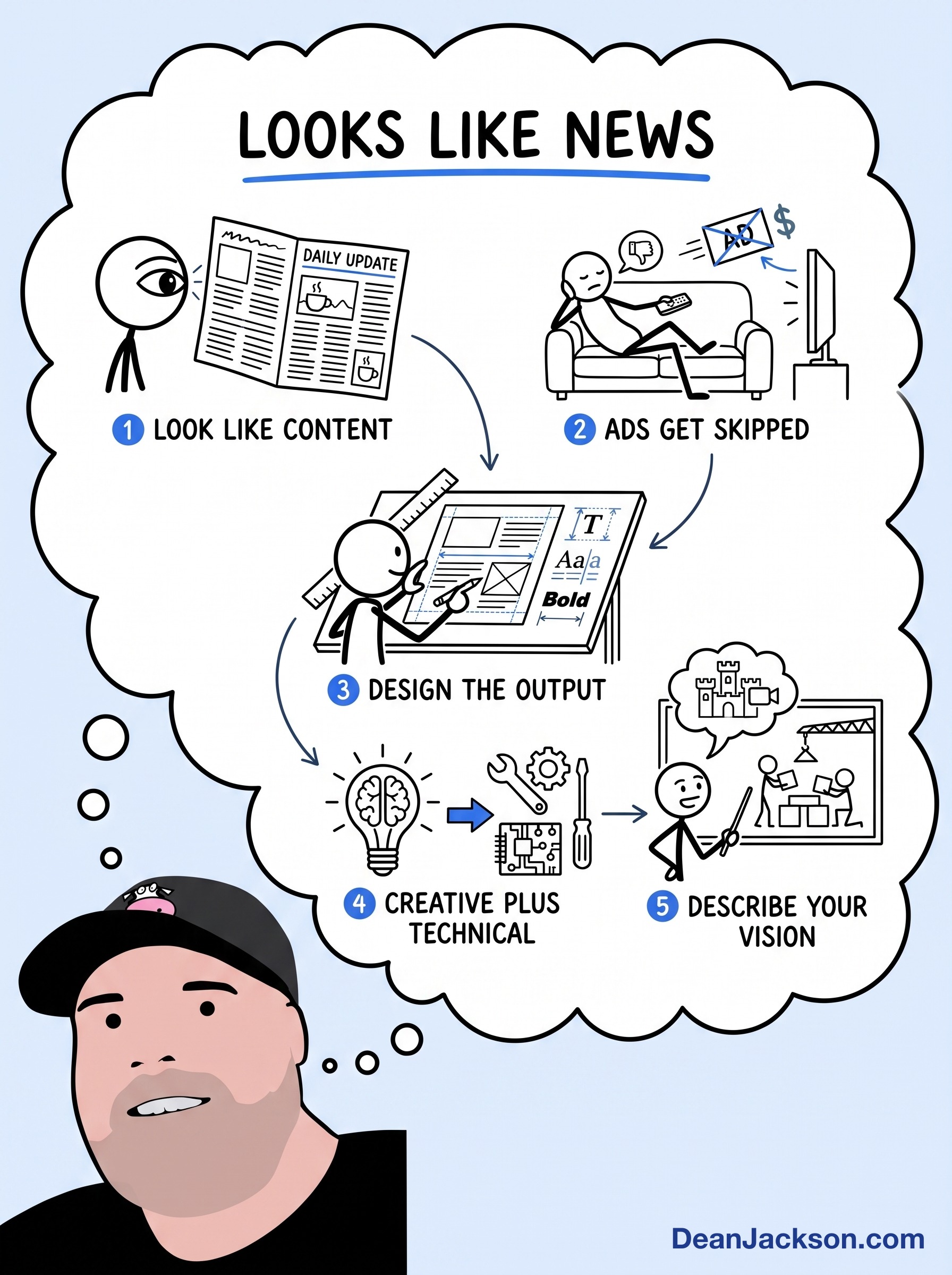
The fourth cornerstone of an enduring marketer is design: package your message so it looks like content, not an ad. People read content differently.
This wraps up my little series on the four cornerstones of being an enduring marketer. We've covered behavioral psychology, your own frameworks, and copywriting. The fourth is what I put under the umbrella of design, meaning how you package and present your message so people actually consume it.
One of the most durable things I picked up early is making something look like news instead of an ad. When your message looks like content, people read it through a different lens than they use to filter advertising. I'm not talking about flashy or artistic, just practical presentation that draws the eye.
Spending a day with Jerry Ballinger, I saw how much attention he paid to layout, and I decided to learn to do it myself in PageMaker so there was zero friction between my ideas and getting them into the world.
I use two filmmakers to make the point. Robert Rodriguez says learn the technical skills and become dangerous. Terry Gilliam told Tarantino your job isn't to get your vision on the screen yourself, it's to describe it clearly and hire the best people. With AI and today's tools, that second approach matters more than ever. The four cornerstones haven't changed, only the ways we create and distribute them.
Join me live on the next free 50-Minute Profit Finder call, Friday, October 9 at 1:00pm ET. Save your spot →
Transcript
Auto-generated transcript, provided as supporting material. It may contain errors, and speaker labels are occasionally mis-attributed.
Okay, welcome back. We are winging our way through a little four-part series on the four cornerstones of being an enduring marketer. And we talked about the first three. We talked about understanding behavioral psychology as the anchor of everything.
Nothing's changed in the human brain and the way we react to things over thousands and thousands of years. So, it's a great investment that you can make to know that for the next 30 years, understanding why people do what they do [music] is going to be a good investment of your time. The second is understanding and [music] developing your own mental models and your own frameworks for the way that you interpret the things that you understand about psychology and through your own experimentation, applying them to your own business. Now, you can the great thing about frameworks is they're transferable.
So, I've spent 30 years developing these frameworks and I've got frameworks for getting leads, for converting leads, for multiplying the transactions that you do, and for getting referrals. And those are things that I'm able to transfer to people through all the live events that we do, the zooms that we do. Those are the cornerstone of what makes my unique approach to marketing valuable to me and to other people. And that's my advice for you is developing the ability to get a result for somebody else or to [music] get a repeatable result for yourself.
And then we talked about copywriting. And copywriting as a, you know, overriding term for being able to communicate your message in a way that conveys a message to people and moves them towards action. And we talked about the you know, the the through line of you get benefit now and not being able to go wrong with that. Now, the fourth cornerstone of this is [music] what I called design.
And I'm putting that under that umbrella. And that's being able to present your ideas to package your ideas in all the things that all the ways that people consume your message. So, if we look at all of the uh you know, delivery devices, there's really just a few basic things. We have to be able to write words and put words on page in a way that is drawing the eye in or spacing things out so that people respond, understanding the fonts and the look of things.
One of the most durable things that uh I learned early on and have kind of taken as a signature is making something look like news. It's much better to have something look like content than it is to look like an ad. And I want to be clear that when I'm talking about design, I'm not talking about making things look flashy or making things look um you know, from an artistic standpoint. I'm talking about from a practical production of what it is that you're doing uh in a way that people can consume it.
So, I learned like making something look like news is a great way. So, when you're running a newspaper article, the reason people are reading the the or a magazine is because they're reading it for the content. And if you can make your message look like content, your the readership and the attention that you get is going to be going through a different lens than through than people are evaluating advertising. When something looks like an ad, we know to filter it differently than when it looks like information.
I shared that one of the first uh you know, exciting kind of new style things we did was with the Unix programmers in Ottawa. We did in the um in the tech journals. We wrote what looked like newspaper articles that said, "Unix contractors commanding $55 per hour." And then two columns of what looked like a newspaper article just directing people to action.
So, having the ability to recognize the best formats or the best ways to um to send things is a skill that's worth developing. Now, when I met Jerry Ballinger, when Eben and I spent the day with him and got to see his environment, what I was struck by was how much attention to detail he put into actually laying things out. He had this style of making things look like news, and uh but also using these cartoon clip art uh types of things that really like added to communicating the message. And I made the decision then at the the um you know, guidance of of Jerry to learn how to actually do that to become self-sufficient.
So, that's where I went into learning Adobe PageMaker and the ability to have zero friction from getting my ideas, putting them in place, and actually getting them into the world. That's a a really valuable skill when you're young and you don't necessarily have a team or a big network or resources to outsource things like that. I look at You know, around that time there were two independent filmmakers that were really coming up and they kind of took two different approaches as I've I've observed them now. There was Quentin Tarantino who had done Pulp Fiction and there is Robert Rodriguez who did the the El Mariachi and all the Spy Kids movies and Desperado.
And Robert his approach, if you look up on YouTube 10-minute Film School, you'll see his approach to doing things is his advice to young filmmakers is to get technical, learn the technical skills because those are things you can learn, but you can't learn to be creative. You're already creative. So, if you're creative and technical, that makes you dangerous. That makes you able to put the whole thing together.
So, to this day, he still shoots the movies, does the editing, does the special effects, does the theme song all or the scoring, all of it. And then contrast that with Quentin Tarantino and I recently saw an interview with Quentin Tarantino where he was describing a lunch that he had with one of his hero directors, Terry Gilliam. And he asked, this was at Cannes and it was right before he was able getting Pulp Fiction out there. And he asked Terry Gilliam, he said, "You have such an amazing way of getting your vision on the screen and how do you do that?
How do you get what your vision is actually on the screen?" And Terry Gilliam said to him, Well, first of all, that's not your job. Your job isn't to get your vision on the screen. You can hire the best cinematographer who knows what lenses and what framing and what to do to get your vision on the screen.
You can hire the best lighter lighting, the best costume designers. What your job is to be able to describe what your vision is and hire the best people to get your vision on the screen. And I think that that's absolutely what you should aspire to uh looking for is that we are definitely in a world where you are surrounded by technical capability. There's no friction in things now.
Even with AI, with all the tools now that are available, being able to describe your vision and being able to use the tools that can create anything you want, your job is to take the things that AI can't do for you, which is combining your understanding of behavioral science, your mental models and frameworks for how this applies to your business, the words and message that you want to convey, and then the design and the output of how you're going to get it out into the world, whether it's text, whether it's video, whether it's pictures or sound. Those are the big four four cornerstones that haven't changed. There's just the technical ability to create them and all the myriad ways that we can distribute them. Those are all things that other people can do for you.
So, focus on those four cornerstones, and then let's come back tomorrow. We are on page 119 of journal number one of 30 years of insights of journaling almost every day. So, there's exciting things coming up here.
Get BreakthroughDNA Free
Discover the 8 Profit Activators that can transform your business. Get the complete framework, free.