90% of Copywriting Comes Down to 4 Words
Watch
Listen
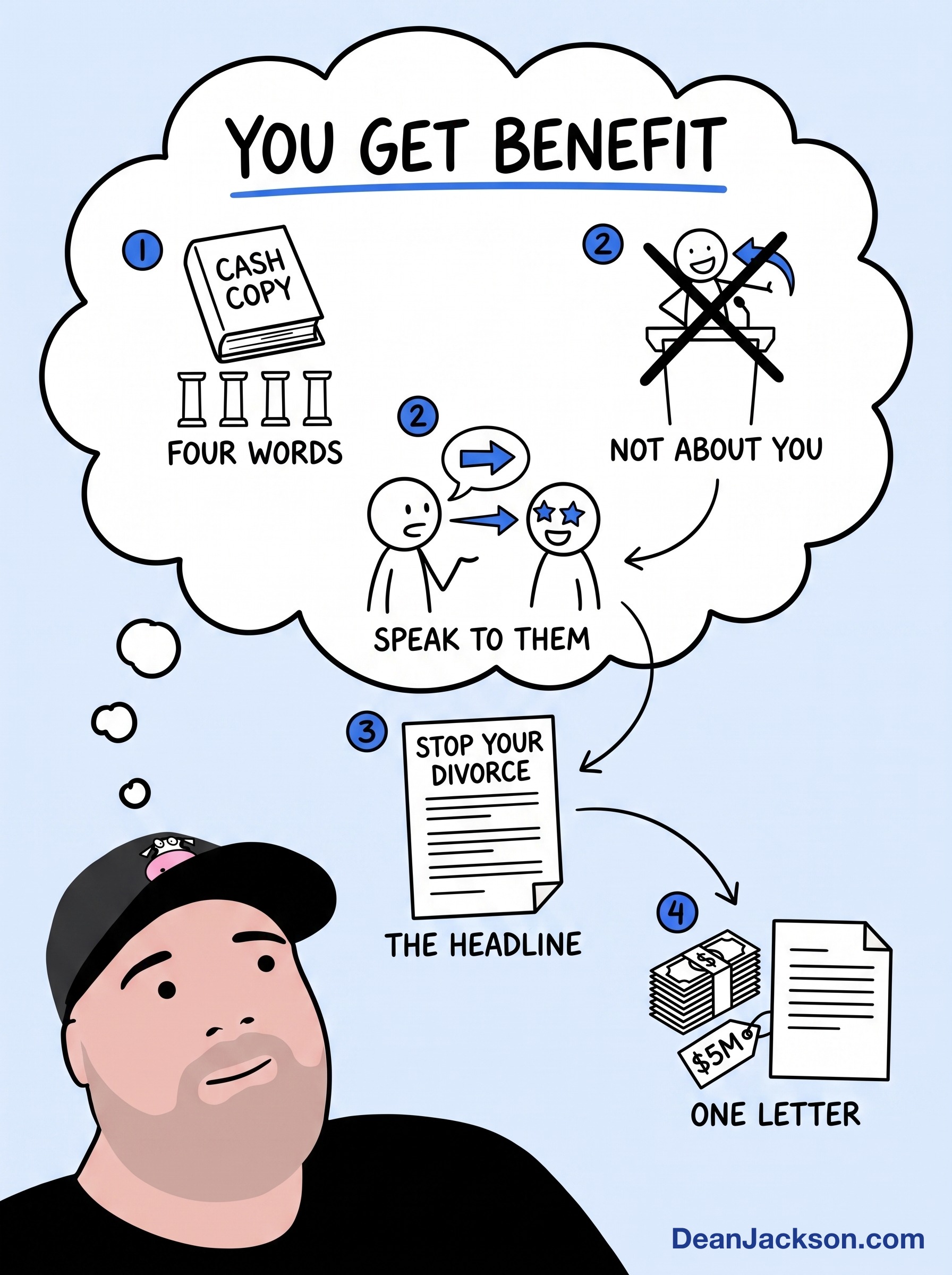
Everything worth knowing about copywriting fits under four words from Jeffrey Lant's Cash Copy: you get benefit now. If a word doesn't fit, cut it.
I learned four words from Jeffrey Lant that carry about 90% of what you need to write copy that works: you get benefit now. If any word you write doesn't sit under one of those pillars, you're on the wrong path.
The mistake almost everyone makes is thinking their prospect cares as much as they do about them and their product. Nobody cares that you're the leader or that you've spent your life at this. They care about what they get. I share the Stop Your Divorce letter that opens completely on the prospect's wants and has sold over $5 million from one sales letter I wrote in 1998.
I'll walk you through the exercise I run on any piece of copy: strip the adjectives and adverbs, look at the nouns and verbs, and ask if you're actually saying anything real. Then read it as your prospect and ask whether that's how they'd want to be introduced to your message.
I also give you the people worth studying: Jeffrey Lant's Cash Copy to start, plus Dan Kennedy, Jay Abraham, Gary Halbert, John Carlton, and Brian Keith Voiles. Nearly every dollar I've made in 30 years came from something I wrote or said.
Join me live on the next free 50-Minute Profit Finder call, Friday, October 9 at 1:00pm ET. Save your spot →
Transcript
Auto-generated transcript, provided as supporting material. It may contain errors, and speaker labels are occasionally mis-attributed.
I can sum up 90% of what you need to know to be a world-class copywriter in four words. And I learned these four words from Jeffrey Lant who I was introduced to by Jerry Ballinger. And this is what's so exciting about going through these journals is popping out and seeing the genesis of when certain things happen. cuz I know there's a a long uh trajectory of impact that learning what I learned from Jeffrey Lant has had.
So much so that Eban Pagan and I used to call each other up and just quote from Jeffrey Lance book cash copy. Now these the four words that Jeffrey talks about is everything about copywriting comes down to these four words. you get benefit. Now, if every other word that you write does not fit firmly under one of those pillars of you get benefit, now you're going down the wrong path.
And that's one of the tricks that I use now, like looking at people's copy, looking at the way people write things and you start to see that the focus of it is about them. And you start to see anytime an ad starts off, you know, we are the leaders in this or we know this or we've spent our whole life doing this. No one cares about that. In fact, in Jeffrey's book, Cash Copy, he has a beginning section, which is 23 egregious errors that copywriters make.
And that's what Eban and I would call up and and quote each other. And one of the errors is you think your prospect cares as much as you do about you and your product. That's the mistake. And then he goes on to describe it.
And we would read certain portions of this. If you can imagine Samuel Jackson in not Samuel Jackson um yeah is it Sam Jackson in Pulp Fiction. This scene where he's quoting the Bible. Well, we would call each other up and talk about Jeffrey's egregious error and he would say that, you know, of course you believe that your product is wonderful and that you are uh wonderful for having created it.
You may be the kind of person that people love, mothers love and dogs take kind to. But take your wonder silently, clandestinely, or gather with other such wonder workers in private and beat the collective drums of hubris and then get back to the one thing that matters, your prospect. And if you just think and then take that in that if everything you're writing is speaking about them and if I I think about the one of the greatest probably the first really masterful piece of copy that I wrote. I mean aside from the the guide to Halton Hills and all the things that I had done in real estate up to that point there it's not wasn't brilliant copy.
It was great uh it was great marketing framework understanding what people want they want to know about homes in another area that it's not about that I wrote masterful copy to get that copy was great but I wrote a letter and we'll hear about it in future journals. I wrote a uh book and a letter with a marriage counselor in Texas called Stop Your Divorce. And I really took this on this thing about uh thinking only about your prospects. com, still sells uh every month.
We've got people who are are going there and buying that book, but we've sold over $5 million worth of that book with one sales letter that hasn't changed since I wrote it in 1998. Now, the headline of that is and the opening of the letter follows completely this idea of you get benefit now. stop your divorce or lover's rejection, even if your situation seems hopeless and you're the only one who wants to stop it. And the letter starts out right all about them, not about not about Homer or McDonald.
It starts, of course, you want to stop your divorce. You jump right into and only about what your prospect wants. And so if you can think outwardly, think about communicating what it is that you're offering. This is why I rank these cornerstones in this order.
When you understand behavioral psychology and then you understand models of how you're going to apply these things, we're at the point now where we're activating it with how do you communicate it? I'm using the word copywriting, but it's really about communicating your message in a way that people will take action. That's that's really what you're doing is you're communicating your message in a way that takes a transformational action or gets people to to do something in their best interest. That's really if you come down to it that everything you're doing is for the benefit of other people that you're helping them.
You know, it's kind of that Zigg Ziggler idea of you can get anything you want in life if you help enough other people get what they want. And when you think behaviorally, behavioral psychology way, you realize that the most reliable thing that we know about humans is that we are wired to act in our self-interest, to seek our own self-preservation and our own advancement. And if you can get in alignment with that jetream of what people are already thinking about what they already want to do and you can communicate it in a way that is conversational and uh you know speaking only to them that's the you part of this and speaking about not what you've got not the features of your uh products not the things or the effort that you went into do it, but you think about what they're going to get in this. And one of the great exercises that I do when I'm looking at copy is I'll take it and I ask people, let's look at it and we'll take away all the adjectives and the adverbs and we'll look just at the nouns and the verbs.
What's happening here? how how much of your copy when people usually write flowery words or write things that sound copyesque, they're not saying anything real. They're not saying stop your divorce. It's completely uh it's a it's an amazing switch that you flip when you start thinking about it.
You know, one of my most popular books is a book called Get More Leads. How to choose the words that get you all the leads you want. Pretty amazing, right? But it's 100% focused on you get benefit now.
Um, so when you look at your ad copy, you look at the letters or messages or your website and you filter it through that lens, ask yourself those questions. Is this focused? If I'm looking at it from the point of view of my prospect, is this the way that they would want to be introduced to this message? You know, um, so that core book, Cash Copy by Jeffrey Lant is a great place to to start.
And of course I you know I look at my very first introduction to copywriting was uh was Dan Kennedy's uh book the ultimate sales letter that I discovered back in you know 1991 maybe or 1990 and uh you know his models of copywriting the way that he uh treats copywriting has been amazing and you can't go wrong looking at all of his uh collection. If I put like the Mount Rushmore of copywriting influences, I would put Dan Kennedy on that. I would put Jay Abraham on there. More J.
Abraham more from a uh models and a a strategy and a way of thinking. He's coming from that um you know outwardly focused always make it a win for your uh for your prospect. But Gary Halbert certainly John Carlton uh in 1996 I saw in you know jumping ahead to a couple of pages here I also got introduced to a gentleman called Brian Keith Voys and Brian was he's passed away a few years ago uh but he was an amazing copywriter. He had a wonderful course called Ad Magic.
And if you can uh find stuff online from uh Brian Keith Voys, he's amazing. Some of his uh the letters that he wrote as a learned copywriting as a magician doing uh things for uh doing birthday parties and that kind of stuff and put all of his things together in a wonderful course called Ad Magic. Um, but going down that path of copywriting will be the thing that will pay the most money. I would say almost every dollar that I have earned in the 30 plus years of of having discovered it has come from something that I've written or something that I've said.
And I count copy as just words that you're saying whether it's on uh through speaking them, through writing them, through presenting them. Um whatever it is, it's one of those four cornerstones of being an enduring marketer. And this is a good start for you.
Get BreakthroughDNA Free
Discover the 8 Profit Activators that can transform your business. Get the complete framework, free.