A 7-Step Checklist That Instantly Improves Any Ad, Postcard, or Mailer
Watch
Listen
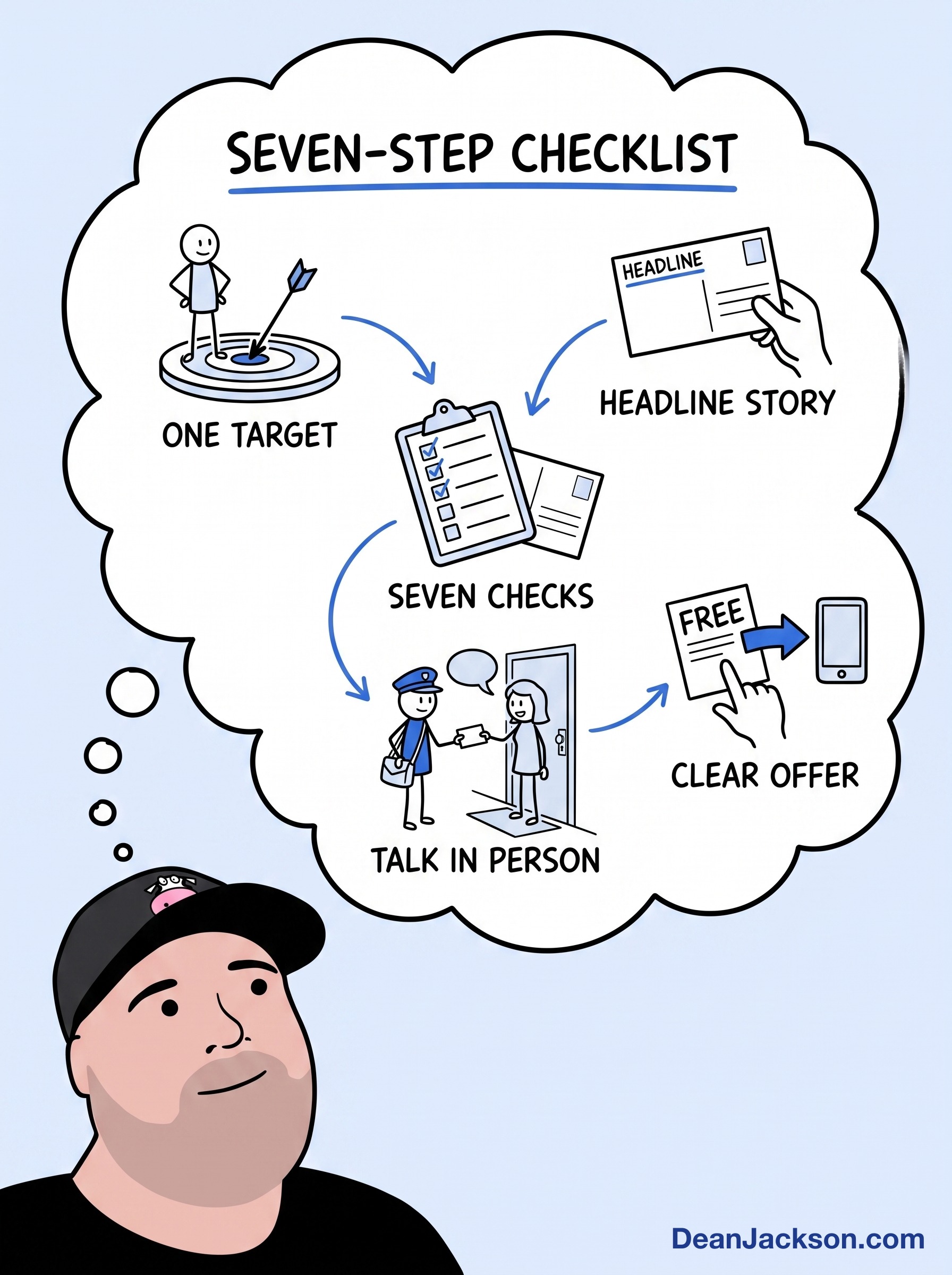
A seven-step checklist I've used for 30 years on any ad, postcard, or mailer, starting with one target market and a headline that tells the whole story.
Back in July 1996, Eben and I were touring the country doing real estate seminars, and I'd run an ad clinic where people submitted their ads and postcards. I came across the seven-step checklist I used, and it's just as durable today as it was pre-internet.
It starts with the target: have you selected a single market, so the right person instantly knows this is for them? Then does your headline tell the complete story on its own? Once you've got the right person and a headline that pulls them in, most of the job is done.
The rest of the checklist covers making it look like news instead of an ad, using conversational language, having a compelling offer, being crystal clear about the one action you want, and using words that let people get something instantly without talking to a salesperson.
I explain Broca's area, the part of the brain that filters out ads so you can ignore billboards and skip commercials, and why packaging your message as content sneaks past that filter. There's also the test I always come back to: if this postcard were you delivering the message in person at someone's door, would you actually pay to have it said that way?
Join me live on the next free 50-Minute Profit Finder call, Friday, October 9 at 1:00pm ET. Save your spot →
Transcript
Auto-generated transcript, provided as supporting material. It may contain errors, and speaker labels are occasionally mis-attributed.
This is going to be a good one. This is going to be a good one. Um, we're back in San Jose now. It's July of 1996 and I mentioned that we, you know, we've been going around the country doing these big real estate seminars with Joe Stump.
Eban Pagan and I would speak uh at the events and you know I liken it to being in a traveling Broadway show where you know you're doing the same performance uh every night minor modifications and this I I smiled when I came across this because this is a another piece of IP that is something that I probably gave this checklist hundreds of times over the next 15 years and it's still absolutely durable today. It's a sevenstep checklist for improving any ad, postcard, print ad. Remember these were things that at the time this is pre- internet but it absolutely applies to the uh to the internet too. But I'm going to share with you how we would evaluate the ads and the postcards that people would submit at the main events to be part of what we called the ad clinic which was a section on the thing.
So I would go through it and number one is have you selected a single target market? Now that I can tell by looking at the ad or looking at the postcard, who is this for? What visual cues are you using that or words in the beginning that are letting people know, letting me know that you know who you're trying to reach, that you have selected a single target market, not trying to be as broad as you possibly can. Instead of saying bluecollar business owners, that's very different than saying electricians or saying plumbers.
The only person that calling something bluear as an umbrella or entrepreneurs is that it helps you. It's more convenient for you to have an umbrella over people and think that you're casting a wider net. Same thing with geography. When you say the tri county area or the greater this area, all of those things are not as specific as southeast Winterh Haven or a particular neighborhood when you know by looking at it that this is for me.
And the first job that we have to do if you're creating any ad or creating a postcard, we have to get their eyeballs to look at this. And in that split second that you have their attention, they have to know, oh, what's this? This is for me. Now, once you have that, step two in our checklist is, does my headline tell the complete story?
Can you tell what this is about just by looking at the headline alone? Just by looking at the headline. So when we take a um when we take a postcard for instance mailing into a particular um neighborhood is we at the time one of the postcard examples that I would use is find out how much your river oaks home is worth for free over the phone. That was the headline of the postcard.
remember no internet yet, but that was the way that the whole thing is if you just saw the postcard, you'd see River Oaks and you live in River Oaks and then the headline would tell you the complete story. Find out how much your River Oaks home is worth for free over the phone. So now we're 80% of the job is done right now. We got in the right person.
They know it's for them. They've read the headline and they're either interested in that or they're not. And that's why we spend so much time getting the headline right. If you can get the language and the words of the headline to draw in your audience and give them this assurance that this is for you and that you're going to benefit by reading this.
Remember we talked about that you get benefit now and that's all 100% towards getting people's attention and getting them to read. Third step in the checklist is does it look like news or does it look like an ad? And the worst thing that we can do is make something look like an ad. When you show when you think about the psychology of getting and conveying a message, when people are reading a magazine, they're looking and they're reading the magazine or the newspaper not for the ads, they're reading it for the articles.
They're reading it for the information that's in there. So if you can make your uh ad look like information, look like valuable content, that is a big head start for you. There's actually a part of our brain called Broca's area that filters out things that are not important for you, things that you can ignore without consequence, and it draws the things that are important to you. It's what allows us to drive down the street and ignore all of the signs and all of the billboards and the ads and everything around us.
But when you see a red octagon with the word stop on it, you immediately notice that and you know that what to do. Imagine if you had to give every piece of information that comes in your ey line equal attention. You wouldn't be able to function. But that's what Broka's area does is it filters out stuff for us.
We see it when you're watching TV. When you're watching TV, you know when the commercials are coming. If you've got a DVR or you've got you're watching something with skippable ads, you can sense when the commercials are coming and then your brain as soon as it happens, you've got your thumb on the remote and skip skip as fast as you can through the ads to get back to the content. I would always laugh when The Apprentice with Donald Trump that was a that was an amazing example of it that when you're watching the show your Broca's area is Broca is kind of relaxing kick back.
Okay, this is the show. Go ahead and watch this. And then when the commercials come on Broka go, hey, we don't need this. Let's skip through.
But I always laughed because when you come back to the show, the assignment for the segment of the show is to create a new ad campaign for the new Crest Minty Fresh toothpaste, which gets right past Broca and into your brain because it's packaged as content that you don't even think about it as advertising because it's part of the content. It's the same way when you're doing print ads or postcards. Whatever you can do to make something look like news, you're going to be further ahead. Number four is, am I using conversational language?
Now, I used to talk about the postcards as an example. when you are delivering a postcard, one of the great uh that you know I look back at the Claude Hopkins or Robert Collier that the purpose of advertising is that it is salesmanship in print and what we're doing when we're sending a postcard is we're sending the card in lie of you. we're sending. Instead of you having to go and knock on every door and deliver a message, you can hire a unformed government employee to deliver the message to every person in your town or whatever whoever you've uh chosen it to.
And I would always say to people, imagine like put it through the test. If this postcard was actually you delivering the message in person, would you pay somebody to deliver this message on the doorstep of your ideal client? Would you, you know, I realtors were notorious for sending just listed or just sold postcards and that's it. That have a big picture of themselves and a sold sign and then the big words just listed and the phone number.
all of these things which when you put it through the sevenstep checklist here, you would find that you wouldn't hire somebody to go and knock on somebody's door when they answer the door, hold up your sold sign and say just sold, good night and go on to the next door. That's not what you would do at all. So I think about it that you know when you really think about what you the value that you have with the postal service of somebody delivering something right to exactly who you want it almost feels like we're making a mockery of the postal service. the guys that risked their lives on the Pony Express to deliver a message over the mountains to California for somebody and you imagine them showing up at the door and the message is delivered and it's just listed.
It's so amazingly ridiculous when you start to think about that. But I always think about the best way that you can do it is what would you say to somebody if you had their attention and you're standing there right at the doorstep or you're sitting there at the table with them as they're they come to your ad in the magazine. Okay. Number five is do I have a compelling offer?
Now, the purpose of the ad is to get them to take some action. So, we want people to leave their contact information. Our goal was to identify people who want to get something. I talked about my guide to Halton Hills.
I would run an ad that would show people a picture of the guide and they could go and or call and ask for leave their name and their mailing address and I'd send them a guide. But you have to have an offer in order for somebody to respond. Sometimes people put out stuff and just get their name out there, but the reality is that what you really want is it's more important to get your prospect's name in here. So, in order to do that, you've got to have a compelling offer for them and they've got to understand what it is.
Number six is, is it absolutely clear what I'm asking them to do? We can't just assume that people are going to know what they need to do to get something. And it's much more important for you to say to get a copy of the guide to Halton Hills, call this number and listen to this free recorded message. Or now in the modern uh world, you might say go to this URL or scan this QR code.
That's the thing. And number seven was, have I used the words freeed message? That was the primary thing that we were doing to get people to listen. com or scan this QR code.
We are making it crystal clear and using words that let people know they can get this and they're not going to have to talk to somebody right now. They can get it instantly. download your copy. Never say call and talk to somebody because that interprets as trained salespeople are standing by 24/7 to talk to you and we'll rush your autodebit commitment contract right to you.
We don't want to scare people off. people are not ready to make a commitment from an ad, but they're very interested in getting more information. So, there we go. Number one, have I is it have I selected a single target market?
Number two, does my headline tell the complete story? Number three, does it look like news, look like content, valuable information? Am I using conversational language? Five, do I have a compelling offer?
What is it that is going to compel somebody to leave their contact information to get it? Number six, is it absolutely clear what I'm asking them to do, what the exchange is? And number seven, have I used the words free recorded message or download now or scan this QR code directing everybody to this one action that we're going to measure the s the success of your ad by uh in the totality. So that's exciting.
That's fun. And I gave that performed that play, you know, hundreds of times over the next 15 years, but it's still as relevant today. And it's the actual mental model, the checklist that I use to look at ads and see where we can make an improvement on them. So, come back tomorrow.
We'll talk about more.
Get BreakthroughDNA Free
Discover the 8 Profit Activators that can transform your business. Get the complete framework, free.