How I talk my ADHD brain into doing the thing I'm procrastinating now
Watch
Listen
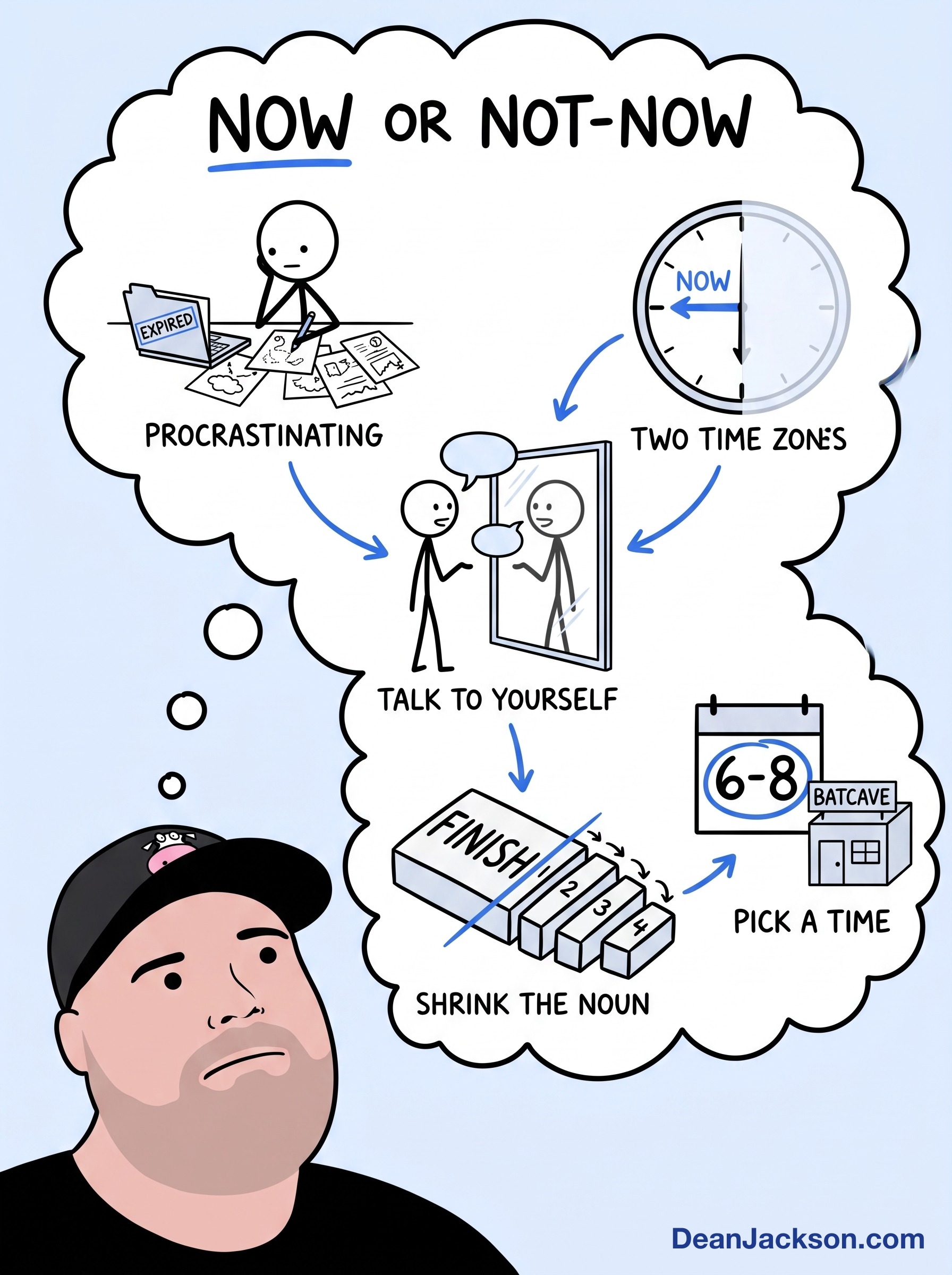
The trick I use to beat procrastination: write out a dialogue with yourself to break a vague task into specific steps, then pin down a real time and place.
Do you ever wonder who you're talking to when you talk to yourself? Some of my best conversations have happened in my own head, and going through my journals I found the first of many written-out dialogues where I play both parts to talk my ADHD brain into doing what I'm avoiding.
An ADHD brain only really has two time frames, now and not now. If something isn't due right now, it's a future Dean problem. And when you're procrastinating, you're usually procrastinating the noun of the task, the big thing like finish expired package that you can't take action on.
So the dialogue narrows me down. What would you actually have to do to finish it? I list the real steps, estimate how long each takes, figure out which part I'd enjoy most and which I could delegate, then nail down a specific time and place to do it.
The next morning I wrote that I was amazed how well it worked and was looking forward to doing it again. It stuck. This exercise on its own can help you take something you're stuck on right now and actually get it done.
Join me live on the next free 50-Minute Profit Finder call, Friday, October 9 at 1:00pm ET. Save your spot →
Transcript
Auto-generated transcript, provided as supporting material. It may contain errors, and speaker labels are occasionally mis-attributed.
Do you ever wonder who you're talking to when you're talking to yourself? It's so funny, but it's like there is somebody up there. There is somebody in there that you're talking to. I've noticed that in uh in many ways.
I've had a lot. Some of the best conversations I've had have been in my own mind. And when I look at all of the journals collectively, I think we're going to see that one of the most common things that shows up in here are written out dialogues, conversations with myself. And this is, I think, the first of those full-on dialogues that I came out with.
And what I realized that I had done is I kind of, and I do this a lot. But it's a way of tricking and not tricking, talking my ADHD brain into doing what I want to do or what I need to do, especially when I'm procrastinating something. Uh cuz that's been, you know, people uh you said people change but not much. And I think that that's absolutely true.
Like at my core, I didn't realize I was ADHD at this point, but I see all the things that I struggled with or all the things that were um you know that I'm writing about here. All the symptoms of having ADHD were there. I just hadn't been diagnosed yet. Um so on this particular journal, what I was trying I was avoiding a specific thing.
I was voiding we were writing this expired listing package that uh I was creating for our realtors and you know sometimes when you are doing the right thing your brain I don't know why tries to like makes everything else that you're supposed to be than what you're supposed to be doing more enjoyable. Steven Presfield wrote a great book called the war of art and it's that same kind of thing. He calls it the resistance that you have to uh face. So I find that looking back at it now, I know that one of the realities of an ADHD brain is that there are only two time frames.
Now and not now. And in my ADHD brain, if something's not due right now, if there's no immediate consequence for it, that's not now. That sounds like a future Dean problem. And uh but part of having a creative brain is that you can see, you can visualize and you know what you want to get done and in your mind it's already done.
And just the the hard work of actually putting the things together requires real time effort. You know, in order to fill four or six pages with your journal, you have to sit down in real time. What I've learned to discover is the the speed of reality, which is 60 minutes per hour. And your hand physically has to be writing out these words.
And that's true with whatever it is that you're uh that you're looking to do. So part of this what I learned and I've gotten better at this dialogue is I would literally have a conversation. I played both parts. So I would start out why do I procrastinate?
That was at the top of the page. That's the question. And I said well why do I not take action? And then I responded take action on what?
On anything on what specifically? On the expired program. So now I'm narrowing into what it is that I'm actually doing. Well, what action do you need to take?
I have the idea and the concept planned out, but I can't get myself to finish it. Well, what would you have to do to finish it? See how part of my brain knows that you can't do the whole thing? I I've learned now to describe that as usually when you're procrastinating something, you're procrastinating the noun of it.
And it's a very interesting thing because it's like the words that you use are you know write expired package that's the task that you give yourself which is or finish that's even better finish expired package on your to-do list. So you can't take action on that as a big thing. So part of the dialogue that really helps is narrowing myself down to getting the specific steps. Okay.
So I have to write the main letter. I have to write the offer form, design the certificate of completion, write the lift letter, and write the instruction form. And how long do you think it'll take? Four to six hours.
So getting learning how to estimate time is a is a big part of being able to manage um ADHD for me. I imagine for everybody in the same thing, right? But what part would you enjoy the most? Well, I guess the main letter, what part could you delegate?
See, there's an interesting thought of that. Is there any part of this that I could get rid of? Well, I get the certificate design and the instruction uh certificate and what would you do after the main letter, the offer form? Then what?
Then the lift letter. And would it be done then? Well, it would have to be cleaned up and final changes would have to be done, but it would be essentially done. What would you have to do then?
Then I'd have to do a version for advanced admission and for just expired uh members. So how long do you think it would take to write the main letter? This is the thing that was the enjoyable the main part one of the components of gone from finish expired package to identifying the main thing and that it would be two to three hours. And then I was asking when could you spend two hours uninterrupted on this?
Today probably when today right after I'm done visiting Tim and Darlene or this evening. What time for sure? So nailing myself down to a specific time. 6 till 8.
Where will you do it? In the Batcave. That was my office. I used to call my office the batcave up there.
Are you sure? Yes. Okay. So now that is the dialogue that I had with myself to identify what it actually was that I was procrastinating.
And if you're like me, you're procrastinating a lot of things at once. And it doesn't feel like procrastination because you've got lots of plans, lots of things. Let's just call this mountain of unfinished things that you want to do as things that if you're not doing them, you are de facto procrastinating them. But it doesn't you're you're it only feels like procrastination when somebody else is kind of expecting something or when you're doing when you're there's some consequence for not doing something.
And this exercise that I went through here got me to narrow down the specific component things if I was able to do it. What would it take? What would it look like to get this thing done? Identify the thing that I would actually enjoy the most of it.
And then nail down a time and a place that I would actually get this done. So the next morning in my journal I'm writing I was leaving that's why there was this deadline. I was flying out uh we were going to Cherry Hill, New Jersey for another uh main event. But it said so I wrote in my journal I'm amazed at how well the self dialogue worked on getting me to take action on the expired letter and I'm really looking forward to doing it again.
And then Eban and I had this whole conversation that, you know, he told me he was reading in creativity about these long dialogues that people would have with themselves on paper to work through things and figure things out. So now I had I know that it works because it got me to take action on something I probably let would have let sit and sit in my mind without taking action. So, I'm looking forward to spending some time with Eban this week, working out exactly what we need to do with this letter. This was a joint project we were working on and start planning out our module program and getting the book finished.
Yeah. Still, even though you slip back into the thing, getting the book finished, it's funny how that's the way that we uh that's the way that we think. So that's my first documented journal experience of having a dialogue with myself to get myself to take action on something. And I it's durable.
It it sticks. It's something that I do this again and again. A lot of my uh a lot of my conversations in my journals are specifically that walking myself through getting specific, picking a specific time for things. And I see now that this is the seed of something big that's going to come in I don't know how many journals away but a few journals away.
Just suffice it to say this exercise on its own can help you take something right now specifically that you're doing and help you get it to completion.
Get BreakthroughDNA Free
Discover the 8 Profit Activators that can transform your business. Get the complete framework, free.