I Almost Can't Believe I've Gotten Away With This Daily Schedule Over 30 Years
Watch
Listen
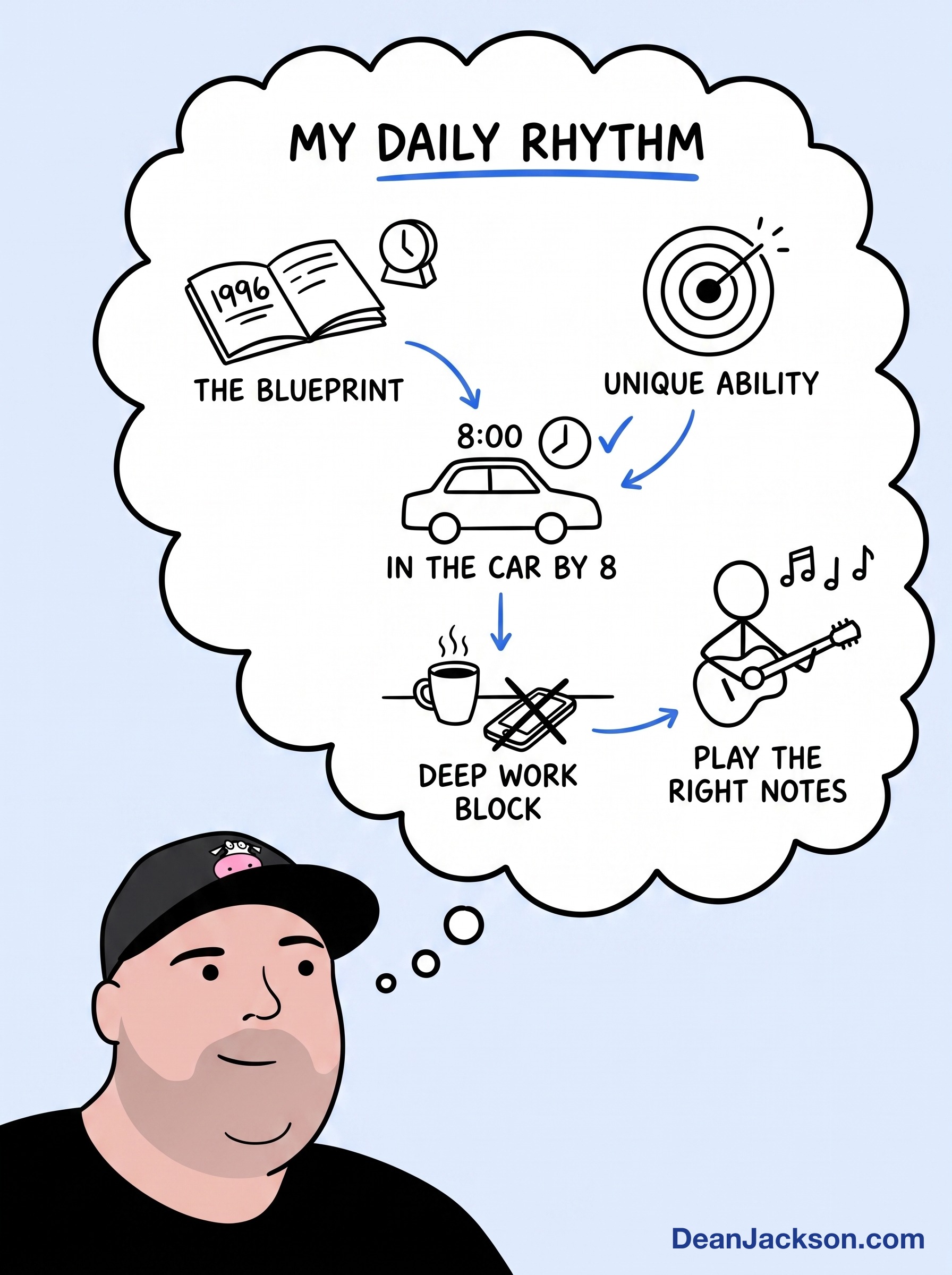
I found my daily schedule on page 31 of a 1996 journal, and thirty years later I'm still running the same rhythm. Same bands of time, same protected block.
This one starts on page 31 of journal number two. Back then I'd just picked up Dan Sullivan's How the Best Get Better and gotten hooked on two ideas. Unique ability, the thing at the core of what you do that energizes you and needs no amping up. And the entrepreneurial time system, three kinds of days: focus days spent in your unique ability, free days with nothing to do with work, and buffer days to prepare for both. I overlaid that lens onto a weekly schedule, and I kind of laugh now, because the schedule I sketched in 1996 is almost identical to the one I run today.
Here's the thing I keep coming back to. Time hasn't changed in 30 years. Same 24 hours, life still moves at 60 minutes an hour, and the only time we ever get to do anything is now. So I stopped trying to reinvent the rhythm and leaned into it. Bed at 11, up by 7:30, in the car by 8. My ADHD brain loves that deadline, it's almost magical how I never miss it. Same breakfast spot every morning, journal open, whatever pops out becomes the day's insight. Then straight across the street to the coffee shop, 9:30 to noon, no phone, no appointments, no interruptions. That's my unique ability time, writing, solving marketing puzzles, hatching evil schemes.
Early in real estate I played the game like Tetris. Time's moving, the blocks keep falling, and you're shifting and reacting and hoping it all fits. Now I treat it more like Guitar Hero. The notes still come at you, but they've been pre-arranged, so if you just play the right ones in the right slots, the day sounds ordered and purposeful. Appointments only land Tuesday, Wednesday, Thursday afternoons. Friday through Monday, nothing scheduled. Wrap by six, and the evening is just for living.
I'll be honest about where I still struggle. That 10-to-noon block is the hardest part for an ADHD brain. I've got the time, but choosing the one thing to work on out of everything I could do is the real fight. Ned Hallowell calls it VAST, too many open loops pulling at you. So it's still a work in progress after 30 years. I've got a new paradigm I've been chewing on from some conversations with Dan Sullivan, and I'll get into that tomorrow.
Join me live on the next free 50-Minute Profit Finder call, Friday, October 9 at 1:00pm ET. Save your spot →
Transcript
Auto-generated transcript, provided as supporting material. It may contain errors, and speaker labels are occasionally mis-attributed.
I almost can't believe I've gotten away with this daily schedule for over 30 years now. And I discovered it in my journal number two, my uh page 31. I, you know, at that point I mentioned in in journal number one, I got introduced to strategic coach. I went to the strategic coach offices to meet a friend and I picked up a copy of Dan's brand new at the time how the best get better little booklet and and cassette tape and he introduced the concept of unique ability in this which is the thing at the very core of what you do that is energizing and the thing that keeps you the most uh the most energized and excited.
The thing that you don't need any kind of amping up to do. It's the thing that you do naturally and comes the most to you. And then moving out from that, the things that you're you're excellent at and the things that you are um competent at and the things that you're incompetent at. And I I started looking through that lens combined with Dan's idea of the entrepreneurial time system which is spending three different types of days.
You have the uh focus days which are days where you're doing your you're in your unique ability. You're doing the things that are moving all of your your projects forward. and free days which are days where you're not doing anything to do with work related things and buffer days which are days where you are preparing for better focused days and more free days. And so that kind of lens that I started looking through, I started kind of overlaying that into a weekly schedule that to this day, like when I look back on this right now, I kind of laugh because I realize a couple of things.
Number one, time has not changed in 30 plus years. We still have the same 24 hours a day. Life still moves at the speed of reality, which is 60 minutes per hour. And the only time we can ever do anything is now.
And I look at every drop of ink that went on these pages in 30 years worth of journals was only ever done right in the moment, in the now. And it's kind of I mean it sounds a little philosophical but when you realize you know 30 years later I can look at this page and I can immediately be transported back to exactly what was going on in these moments. So I kind of treat this as you know u thankful entries in the in the permanent record so that I have this to uh to look back on. Now when I look at it, I started by, you know, I mentioned everything that I do is often in my journal, conversations with me or just, you know, getting my thoughts down on paper.
And I looked, you know, on page 30, I was outlining my ideal day. And I started thinking, you know, my ideal day be waking up and uh doing some exercise, having a shower, eating breakfast before doing 2 to 3 hours of uninterrupted work. And I look at when I set up this uh schedule here, you know, this block of time from 10 till noon has was reserved for unique ability time. And I look at it now like uh my schedule right now is almost identical to this like th this and I'm really embracing more the rhythm of it rather than trying to reinvent it or trying to experiment with new things.
I think when you resign or relax into the fact that this is just a reality. life moves at this speed and the only, you know, we were going to get another uh day tomorrow hopefully, but we do have today. And that setting up the structure for it really helps me have the highest opportunity likelihood of getting what I want to get done done. I was thinking about the difference between because I'm making the transition here from being a realtor being in real estate which for the first few years of my uh real estate career are really like I look at real estate like a Tetris game where you know if you think about you're a first person there's time is moving and the blocks are coming at you and you've just got to kind of shift and move things around and fit them in where you can and hopefully get as much uh as you can done, but you there's a little bit of being reactive and being out of control of it.
And if I think about it now, I'd look at it that the opportunity to treat the same thing more like Guitar Hero where the notes are coming at you, but they've been pre-arranged in a way that if you just play the right notes, you can play this song that you you have something that sounds ordered and uh and purposeful. And I think that that's really where this uh comes down to. So my basic daily thing and still I I look at it that my I I my natural bio rhythm for 30 plus years has been in bed at 11 awake you know 7 to 7:30 and we've been playing a game now really adding more structure to these things even though we don't need to. There's nobody requiring this of me, but we've been playing a game of that I have to be in the car putting the car into you pushing the I have a Tesla that does auto drive.
m. m. And for my ADHD brain, it's kind of that gamification of having a a deadline is something that is I don't know how it's magical in that I never miss. you know, it's like either 7:59 or very very occasionally it's 8:01 and we, you know, feel like we've missed the uh the boat.
m. I go to the same place for breakfast every morning. m. we shoot this video that this is the thing of I want to do this every day rather than negotiating when I'm going to do it or if I'm going to do it today.
I've really leaned into this idea that it's every day, bro. It's every day we go. There's no negotiation. I just know what we're going to do.
I don't have to think about I don't have to make stuff up. I just like while we're at breakfast, I just look through the journal and whatever pops out, the insights come, I'm just reporting what happened in in uh in 1996 and bringing it to update uh today. Now, as soon as we leave here, we go right across the street to this coffee shop where every morning 9:30 till noon, we're there at the coffee shop and I've got no phone and no interruptions and no appointments, nothing scheduled. That is time where I am doing my highest, you know, unique ability time.
That's the times where I'm writing things or I am uh hatching evil schemes or solving marketing uh puzzles. All of those things are where I do my uninterrupted best thinking. all of the afternoons is on Tuesday, Wednesday, Thursday are the only days that I have appointments where sometimes I have to zoom with other people or talk to clients or do a u do a lead conversion Zoom workshop or a lead generation Zoom workshop. Uh those things all happen between 1:00 and 5:00 on Tuesday, Wednesday, Thursday.
That's the only times that I uh book appointments. And then Friday, Saturday, Sunday, Monday, nothing. No time appointments on there. I treat Friday as a uh buffer day.
uh Monday as a a buffer day, but Tuesday, Wednesday, Thursday are the focus days that uh I get all the stuff done. We I wrap up by 6:00 and in the evening 6:00 till 11 is just time to live my life. I love to watch uh I love to watch Netflix uh stuff. I was joking here.
I was looking in 1996. The thing that, you know, we were doing is like prime time television was at its peak in in the '9s. You know, 1996, Thursday nights was mustsee TV that you had to watch. you know, Seinfeld and Shears, and those were the shows that were on the air at a specific time, and you had to be sitting in front of the couch to watch it.
Can you imagine? It seems so now that we've gotten a taste of streaming and the natural thing is that you can watch anything that's ever been recorded ever in the history of recorded television on any device you want at any time on demand. It almost seems undignified to have to be expected to be sitting on the couch at 9:00 at a specific night to watch the latest Seinfeld episode, but you had to do it because if you didn't, you would miss out. You'd be out on the whole water cooler uh conversation of what everybody was talking to.
So I am amazed by just the elegance of this pattern. If I were to look back at a a tapestry of the last 30 years, I've essentially I feel like I've gotten away with this for over 30 years. those bands of, you know, nothing before 10:00, 10:00 to 12:00 focused on the my stuff. And that block of time as an ADHD uh brain, that's the time that I struggle with the the most.
I often have the time, but I don't have the ability to choose the thing that I'm going to work on. got so many things. Ned Hollowwell calls that vast. You know, you've got this so many things that you can uh that you can do.
And I I joke about it. There was a Ron White, the comedian, talked one time about getting thrown out of a bar and he said, "I had the right to remain silent, but I didn't have the ability." And I feel like those things that those time zones, if I if I have 10:00 till 12:00 blocked off, if I could really get myself to take uh real action in those times, it'd be amazing. But I still to this day, 30 years later, struggle with getting myself to choose the thing that I'm I'm going to uh work on.
So, work in progress. And I've got some new uh paradigm that I'm kind of uh working with and I'll share that tomorrow. I'll talk about how I'm kind of looking at this uh time now through some conversations that I've had with Dan Sullivan. So tune in tomorrow and we'll talk about the most upto-date way of thinking about my schedule.
Get BreakthroughDNA Free
Discover the 8 Profit Activators that can transform your business. Get the complete framework, free.