I Predict These 7 Business Categories Will Survive & Thrive In The NEXT 30 Years
Watch
Listen
Page 20 of my 1996 journal listed the seven things people spend money on. Thirty years later, every one of them is still standing, and still wide open.
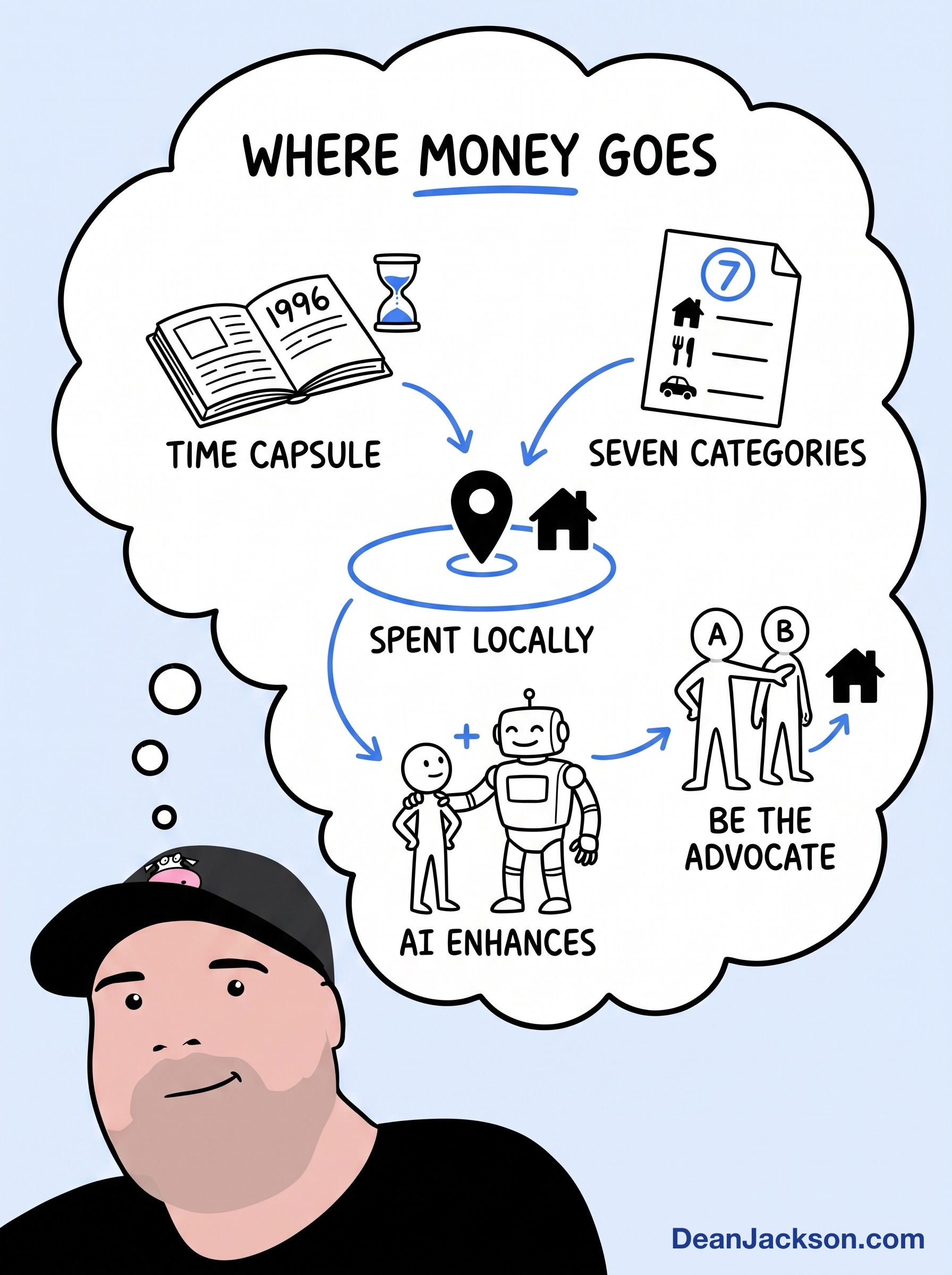
I found a little time capsule, page 20 of journal number two from 1996. Back then I was chewing on the idea of advocacy from The One to One Future and applying it to real estate. The realtor business is transactional. You sell someone a home and move on, even though 84% say they'd use that agent again and fewer than 25% actually do. The number one reason is they lost touch. That's a valuable relationship left on the table.
Looking back 30 years, I realized I was onto something with the things that don't change. I predict these seven categories survive the next 30 years. The context stays the same even if the content shifts. Home is the biggest line item, everything to do with the house. Food, because we're still 100% human and haven't merged with the robots yet. Cars and transportation. Kids, a whole economy on its own. Money, including debt, investing, and business owners spending to bring money in. Health, as the boomers and Gen X age into longevity. And me, the discretionary pleasure spending on travel, hobbies, and entertainment.
Everyone frames AI as disrupting things. I think the better question is how AI can enhance these seven. Pair it with the categories people already spend on and you're building on durable ground. Over 85% of the average household budget is spent within five or ten miles of home, which is why HVAC and home service companies keep thriving. That need isn't going anywhere.
Overlay advocacy on top of any of these and you've got a position. Instead of thinking about the one narrow spoke you provide, elevate out and become the person's advocate for the whole category. With realtors, that looks like being a home advocate for anything to do with their house. Take the one to one future and apply it to whatever category you're in, and you've set yourself up for the next 30 years.
Join me live on the next free 50-Minute Profit Finder call, Friday, October 9 at 1:00pm ET. Save your spot →
Transcript
Auto-generated transcript, provided as supporting material. It may contain errors, and speaker labels are occasionally mis-attributed.
Okay, I think I discovered a time capsule right here. This little snapshot of page 20 of journal number two from 1996. One of the things that I was thinking about was where do where do people spend money? Because I was, you know, thinking about marketing and that that's kind of this uh this world here.
I was really influenced by the onetoone future about that idea of advocacy and I was of course thinking about and applying that to how could real estate agents build an advocacy relationship with the people that they're serving. Because when you think about the real estate business, traditionally, the brokerage business is really a transactional business in that you help somebody buy a home and then they get in the home and then most of the time realtors will just move on and they'll look for somebody else. And even though on exit interview after exit interview, people are asked how the experience was with their realtor and 84% of them say they would definitely use that realtor again. But less than 25% of the people actually use the realtor that they used last time.
And the number one reason that they give for not is that they lost touch with them. And I think that's because there's very little incentive in the minds of the realtors to build a relationship that somebody who you just sold a house to is probably not going to buy another house for at least 5 6 7 10 years. So I get it that we're all very interested in the immediate thing. But I thought that is a a very valuable relationship with a consumer.
And it's funny because as I'm looking through this now, I I mentioned that the reason that all these uh consolidations now, Rocket Mortgage and all these real estate companies and insurance companies, they all as one analyst said are pursuing a firstparty relationship with a homeowner, which is the most valuable relationship in America. And as I was looking at this, looking back now from here from from uh 30 years ahead, 30 years in the future, I realized that I was really on to something with the things that are not going to change. And I predict that these seven things will be uh will survive 30 more years contextually. But the content under them might change.
So here's the seven things that I recognized of where people spend money. The first category is home. That's the largest line item on most people's budget is everything related to the home. And that means the house itself, the furnishing, maintaining the uh improving u all of the stuff, renovations, all the electronics, everything that goes into the home and household emergencies, things that might uh that come up to maintain that home.
I think that is a uh that that's really not going to change. we have enjoyed as a species living in homes and I don't think that that's going to change in the next 30 years. So if we hitch our wagon to that that's a pretty good durable industry. Um the next thing that people spend money on is food.
And you know we still are biologically human 100% so far. We merged with the robots yet and we require food every day and we enjoy eating and one of the biggest line items on people's budgets are their groceries or eating out in restaurants. And I have a client who owned uh restaurants. And one of the things that we discovered, he had a, you know, a list of 10,000 homes that were sort of the higherend homes in the uh in the city where his uh restaurants are.
And we calculated out that, you know, he does two servings a day. They're open for lunch and dinner. They're not open for breakfast. But of those 10,000 people, 10,000 households that represented, if you say two people per household on average, that represented 280,000 belly filling opportunities, BFOs, that's what we started calling it.
that when you think about that is like a constantly renewing opportunity to serve uh people. There's the food business is definitely changing. out our you see what's come along now where there's home food delivery services or meal prepped meals or things where they'll bring the food right to you and you know but the core category is food then the next is is cars and transportation if you take it as the the big thing but there's So much of our budget goes into owning and maintaining a car, the car itself, and the repairs on the car and insurance for the car and gas for the car and all of the things that that go um on that. Tires, detailing, that's certainly a big line item where people um spend money.
Another one is kids, children. If people are pursuing this children lifestyle, you know, if they have kids, that's going to require while the kids are not out earning money. That is a line item on people's budgets, which is, you know, they need clothes, they need books, they need uh all the activity, everything to do with kids. There's a whole economy just around kids.
Um, money is another category. If you think about debt service and credit cards and financial planning and investments and I would put business owners in the money category that people will spend money on their businesses to bring in money, treat that as an asset. Health is another category that we prefer to stay alive. We prefer to be healthy.
We are aging as a country. you start to see the baby boomers and the Gen X now are starting to uh to get older and there's a real shift towards longevity as a thing for uh where people spend and invest money in health things. Um and then the final category is me and that's you know the pleasure things whatever my discretionary things are that you like to do whether it's entertainment or hobbies or u you know travel going to the movies all those kind of things and when you think about where everybody talks about AI disrupting things and I think a better thought is how can AI I enhance things. How can you pair AI to really serve those seven things?
I I don't think that those are going to go away. Like what would you predict is going to change in the next 30 years around home? But you know, I think we're still gonna want to live in homes. We're still going to prefer climate control.
We're still going to need plumbing and electricity. Those things haven't changed. Maybe solar will become more of a thing of a source of power, but the general idea is we're still going to want to be housed. And somebody whether we move from a where we currently are right now as a homeowning society to a renting society somebody will own these homes and provide the uh the opportunity for shelter.
Um, and I don't think that any of these uh other things are fundamentally going to really change. What I what I found was that I think it was over 85% of the money that the average household the household budget is spent within five or 10 miles of where you are right now. So we think about the the you know opportunity in your local market there. That's why these companies you see HVAC companies and home service companies and things that are thriving now as the you know the population grows.
But the need for those things is uh you know un undisruptable. And I think that if we overlay this idea of advocacy on top of this, if we can help people get what they want in any of these uh these categories and really if you're in one of these categories, understanding which pillar of that consumption you you sit under and really thinking about how can I instead of just myopically thinking about the one little, you know, spoke in that that you provide, how can you elevate out? And that was where my mind was going with the realtors is what would it look like if the realtors were a home advocate for people that anything that you needed to do with your home that somebody was advocating for you. So I think you know taking the ideas of the one to one future and applying them to whatever category you're in is going to position you for success in the next 30 years.
Get BreakthroughDNA Free
Discover the 8 Profit Activators that can transform your business. Get the complete framework, free.