Inside My 1996 Content Factory vs Today
Watch
Listen
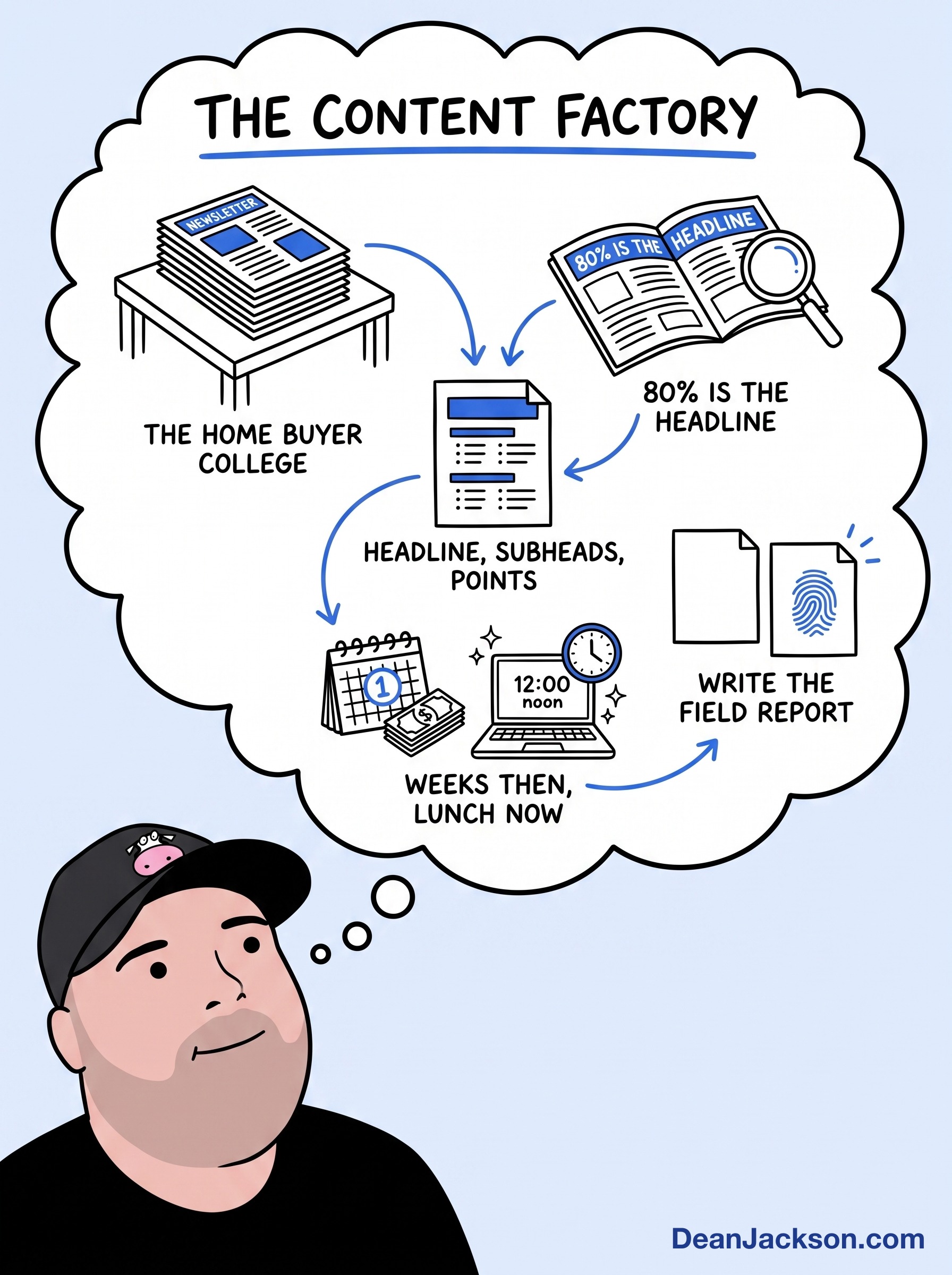
In 1996 it took $2,400 and weeks of work to build 24 marketing newsletters. Today that's done by lunchtime with AI, but the durable advantage hasn't changed.
I went digging through one of my big 1996 projects, the Home Buyer College. It was a correspondence course of newsletter reports we mailed as follow-up to everyone inquiring about buying a home, updated every two weeks when the new MLS catalog came out. It's hard to get back into the mindset that in 1996 your only ways to reach people were direct mail, print, the phone, or meeting in person. Radio and TV were cost-prohibitive for a small business. The Home Buyer College was the first real collection of IP I ever built, and we still use pieces of it to this day.
What struck me looking back was that I had a complete system for producing those five-to-eight page reports, and it's the exact same model I follow now. Step one, and 80% of the whole game, is the headline. Eben Pagan and I were headline hunters at all times, pulling cues from Cosmo, the home magazines, the National Enquirer, trading made-up headlines like improv theater for marketing nerds. Step two, list eight to ten subheads, the major points in short form. Step three, drop three to five talking points under each subhead. Step four, expand each one like act one, two, three. Step five, write the lead and the closing paragraph. Done right, the report is a work of art you can grasp just by reading the subheads.
Here's the part that gets me. Back then, creating that content meant interviewing an expert for twenty minutes, mailing the tape off to be transcribed at a dollar a minute, then paying a writer a hundred bucks to turn it into a finished report. Call it a $2,400 investment for twenty-four newsletters. That same work could be done by lunchtime today with Claude or ChatGPT. We don't realize what a gift that is.
But I'd separate the content into two kinds. A book report just compiles what's already known about a topic, and AI is perfect for that. A field report is your own unique approach, the thing that differentiates you from what already populates the large language models. That's where you need to focus. The tools and the distribution have completely changed between 1996 and 2026, but our desire for information, paired with your ability to create your own perspective on it, is the durable advantage that lasts.
Transcript
Auto-generated transcript, provided as supporting material. It may contain errors, and speaker labels are occasionally mis-attributed.
Good morning. I am going to give you a deep dive into state-of-the-art of a content creating factory circa 1996. I was looking through one of the the big projects. The big project that I was working on in 1996 at this period was the home buyer college which I mentioned and that was a series of newsletter reports that we could send as followup to people who were inquiring about buying homes.
Remember our the guide to Halton Hills or Toronto and beyond? We would be generating all these buyer leads and then every two weeks when the new MLS catalog came out, we would send them physical newsletter updates of all of the new listings that came on along with an insert of a newsletter. And I called this collection the home buyer college. It was essentially like a correspondence course.
And as I was looking at the the looking back, and it's hard to like get into the mindset that things didn't exist back in 1996, like the only way that you could communicate with people was either, you know, I looked at the the options that we had to get in front of people. You could use direct mail. You could use print in newspapers or magazines or home uh magazines. You could call them on the phone or you get together with them in person.
And you know, radio and TV that was out of the question for a small uh a small business. Like nobody was doing that at the time because it was so cost prohibitive. But I, you know, I mentioned creating IP and this idea of the home buyer college was the first sort of um, you know, collection of IP that I was able to create and we still use it to this day. I mean, a lot of these things.
So I was looking here that I had a complete process, a system for creating these five, six, eight page uh reports. And of course the most important part of it was number one start with the headline. And so we would come up with compelling headlines and that's where you know we would get cues from Cosmo magazine and women's uh home magazines and um the National Inquirer all these things we were Eban Pagan and I were were just headline hunters at all times looking for things. It was kind of made us giddy to get the Cosmo magazine and then we would just brainstorm.
It was like improv theater for marketing nerds. We get the thing and then we would just trade off making up up headlines. And so part of them I remember like the home buyer college headlines. Some of them were, you know, how much it really costs to buy a bigger home or um how to buy a home with zero down payment even if you can afford to pay cash.
All these things were coming up with the compelling headline of understanding what people would want. And for me, that's the exciting part. And that's 80% of the success of anything is the headline. But once you got the headline of this, then step two was to think of eight to 10 subheads or major points that would give you the solution in point form.
So we're not just starting to write the headline and then start to just from beginning to end write the whole report. We were writing just eight to 10 things. I always think about like if you're just had to express this in uh in short form, well, you got to know about this, this, this, this, and this. And when you get those eight kind of big pieces there, then step three was to underneath those subheads, write three to five talking points or questions or comments that come to mind underneath each of those eight uh things.
And then we just proceed down the list of the subheads. So now you've got each of those subheads with three kind of talking points underneath it and then go back to the subheads. And then all you have to do is just kind of expand on each of those three. It's kind of like if you think about the subhead, you think about the the three things as like act one, act two, act three within the uh underneath that subhead.
And then you just go back on and create and fill it out. Then when it was done, step five was to write the lead paragraph and the closing paragraph. So you would lead into it and then you would lead out of it. And then at the end, the report should be five to eight pages long and be a work of art.
And I I say that because remember I talked about the idea of design is presenting things in a way that makes it um easy to read, bolded, underlined, uh you know, italicized for emphasis, marked up or whatever the thing with some illustration on it. It should be interesting to read and people could get the whole point by reading the the subheads. And so I look at that that system is that's really the same model that we follow now. You know, 30 years later, I think about how quick and easy it is to create this kind of content.
Like literally, you could brainstorm. I I well I've done this. We just recently had a uh situation where we wrote uh you know short book like 16page uh little PDF book about a topic called smells that sell and we did another one on the air fried carnivore and so you can come up with ideas and then now with claude or chat GPT or any of the AI things. You just say, "Hey, write me a 16page booklet about this, about smells that sell."
And it'll go and research, find out the things, create it all, and it happens instantly. We would either have to create this content or my favorite way to do it would be to find an expert and just interview them for you know we would do a 20 minute interview with an expert and ask them those questions. Then we could take that tape recording that we had of the conversation and get it transcribed. And at at that time it cost a dollar per minute of recorded content to get that transcribed.
And I had to physically send the tape to uh someone who would then listen like as a court reporter type thing. type in the uh thing and you'd get back a word doc with the uh with the actual transcript and edit that in. And I got to where, you know, uh I would be able to come up with the um headlines and then we had a I had a writer that I could outsource the uh actual creation with. I would come up with the headline, interview the the uh the expert and then from the transcript onto the the thing that was all outsourced uh with somebody else.
And I, you know, you look at the cost of it to create one of those things was an investment in both the my time to do that then getting the transcript for you know a dollar per minute. So, let's say $30 for a 30 minute interview. And then I paid a writer $100 to create these uh to turn it into these finished uh these finished reports. So, a $2,400 investment to create 24 of these home buyer college u newsletters.
And that could be done by lunchtime today with with AI. You know, we realize what a gift we have of being able to create this content. And I think about what type of content you can create though is I think it falls into two categories. It's either a book report where you're just taking a topic and compiling all the known information about something or drawing from what's already known and just conveying uh the information about the topic which is perfect for AI.
But there's a different type of report that I call a field report. And that is something with a unique approach to something. Somebody who has something that's different than what is populating the large language models. Something that you as an expert probably have that differentiates you from what something AI could create.
And that's where we really need to focus is creating the content that is your own unique perspective on something. But AI, man, as a tool for um creating this, it would have been handy in 1996. And the a the things that we have now available as distribution. You know, you think about all the ways that you can get information out to people.
Um, it's a whole different world. It's a whole different world in 2026 compared to 1996. But our desire for information and your ability to create it is really what's uh that's the durable advantage that you'll be able to have.
Get BreakthroughDNA Free
Discover the 8 Profit Activators that can transform your business. Get the complete framework, free.