How to Turn Your Advertising From a Slot Machine to a Vending Machine
Watch
Listen

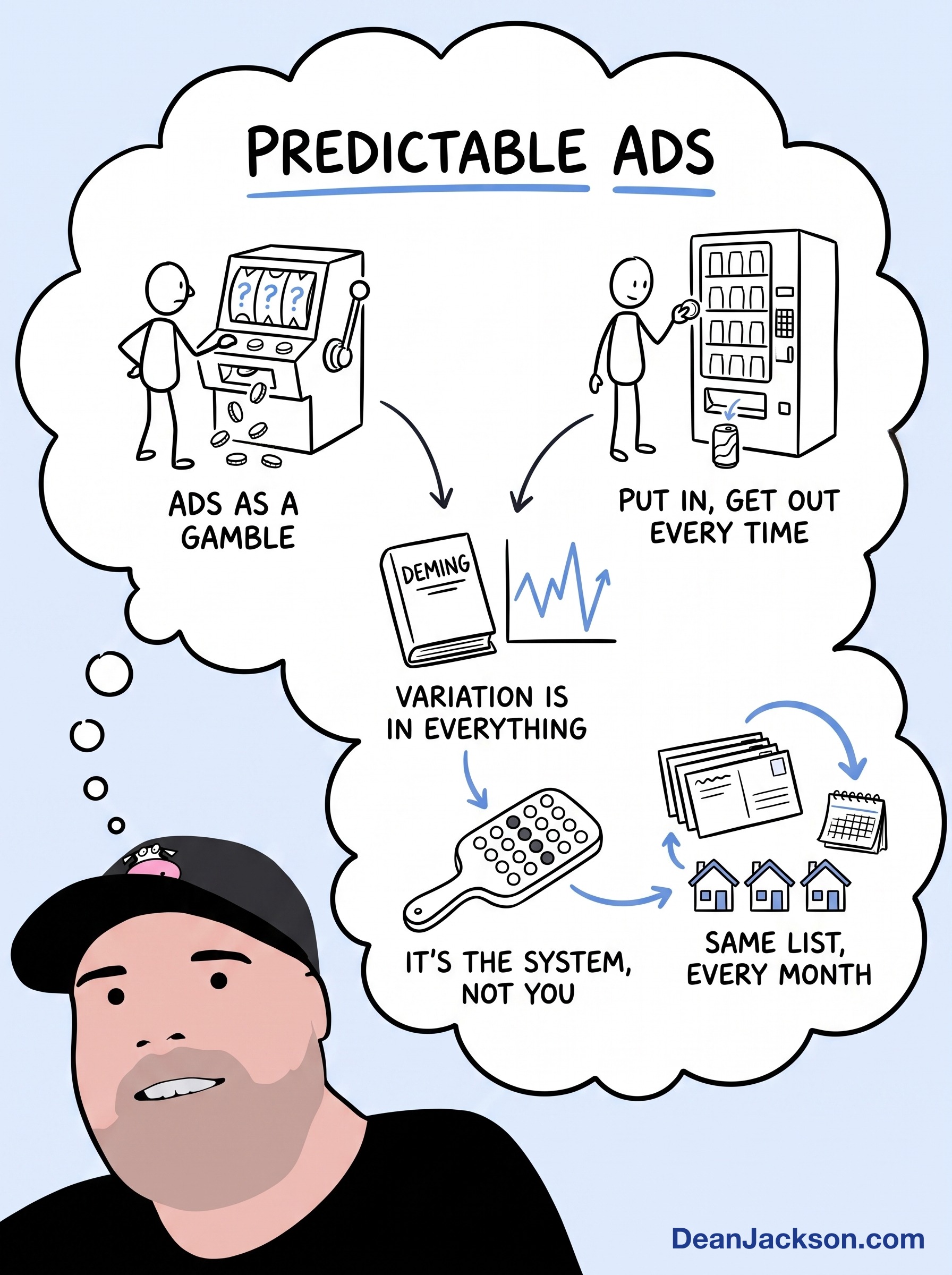
Deming taught me in 1996 that variation is in everything. Drive it out, and your advertising behaves like a vending machine instead of a slot machine.
This one starts in Nashville in October of 1996, on my first lap around the country. My friend Mike Hardwick, founder of Churchill Mortgage, the only mortgage company Dave Ramsey has recommended for years, took Eben and me out for dinner and a high school football game, then said he was taking us for a treat. We came over a hill and Mike said, boys, the hot light is on. We had no idea what it meant, but it sounded good. It was my first Krispy Kreme, a whole dozen hot off the line with chocolate milk between us, and it's still one of my favorite Nashville memories. A nice reminder of what long-term relationships are worth.
That same fall I got introduced to the work of W. Edwards Deming, the man who went to Japan after the war and helped turn them into the highest-quality manufacturers in the world. His principles of profound knowledge have shaped how I think ever since, and the first one that grabbed me was simple: variation is in everything. Once you see that, the goal becomes obvious. Drive out the variation and make things stable and predictable. That's all we really want from our marketing. I've come to describe it as wanting your advertising to be a vending machine instead of a slot machine.
The worst thing you can do is confuse an unstable system for a verdict. Someone mails one postcard, gets nothing, and decides postcards don't work. Or they mail a different thing to a different list the next month and draw the same conclusion. Improvement only comes from a place of stability. So I started asking what's stable in real estate. Here in Winter Haven there are about 2,100 lakefront homes, and roughly four to five percent of them sell every year, so 90 to 100 of those owners will move in the next twelve months. The stable play is mailing to those same 2,100 people every month, not blasting 2,000 random postcards wherever you're emotionally led that week.
Deming proved this with his red bead experiment. Teams would dip a paddle into a bin of white beads salted with red ones, the red beads standing in for defects, and record each day's count. They chanted no red beads, no red beads, and nothing improved. They rewarded the best worker and docked the worst, and the next round the star came out worst. It was never the person, it was the variation baked into the system. Pair that with Michael Gerber's idea of building something to be duplicated 5,000 times, and you see it: duplicate identically and you get predictable results, start tinkering and you invite the variation back in. That was the beginning of my scientific advertising approach, choosing predictable results over the emotional pull of I like red or that's our branding.
Transcript
Auto-generated transcript, provided as supporting material. It may contain errors, and speaker labels are occasionally mis-attributed.
Good morning. They say you never forget your first time. And that's true. We got a first coming up right here.
This is fun because as we're winging through these journals, I'm making my first lap around the country to see all these new places that I'd never been. And one of those was Nashville, Tennessee. In October of 1996, we went and we did a main event, big real estate seminar in Nashville. And I got to hang out with a friend that I had met just a couple of months earlier, Mr.
Mike Hardwick. And Mike is the founder of Churchill Mortgage, you know, big mortgage company who uh built in collaboration with Dave Ramsey. It's the only mortgage company that Dave Ramsey recommends and has been for years. Well, Dave and uh Mike started out together.
Mike was the one that was kind of the the sponsor of the very first Dave Ramsey show and they've built an amazing relationship. So that one of those things as a sidebar kind of shows you the value of long-term relationships and when you meet people and Mike has become one of my closest relationships. I've had amazing experiences all over the world uh with Mike. And this particular time we were flying, we came into Nashville for a main event.
Eban and I were both uh there and Mike took us out for dinner. We we went to a football game. It was the fall, so we went to a high school football game. We went to Macaroni Grill.
And after dinner, Mike tells us, he says, "I'm going to take you for a treat." And we, you know, we had never been to Crispy Cream. This was before the big Crispy Cream craze. They were mostly in the in the South.
So, Eban and I were both very excited. And we get in Mike's big, you know, white Mercedes sedan and we're driving through town and we come up over the hill. I'll never forget the words because Mike looks at He goes, "Boys, the hot light is on." And we were giddy because we didn't even have any idea of what that meant, but it sounded like that was a good thing.
So, we pulled in and we had I had my first crispy cream dough. We ate a whole dozen crispy cream donuts, hot off the line between us with chocolate milk. And it's one of my like favorite memories of ever being in Nashville. It's such a vivid uh such a vivid memory.
And so Mike Mike Mike, thank you for uh that memory. It's it was fantastic. Now, at that same time in that fall, one of the things that I got introduced to was the work of W. Edwards Deming.
And Deming, if you don't know, was the guy who went over to Japan after the war and helped them rebuild and turned them into the in the 80s the most uh quality uh manufacturers in the world at the time. and he created all these principles around um what he called Deming's principles of profound knowledge. And I see as I'm looking through the journals here, how impactful that's been on me just understanding these principlebased things of how these uh how to look at things from a scientific perspective. So, what I I wrote down a few of these and one of the things I first learned is that variation is in everything.
And so, we look at it and we start to see that everything is variable. I I was really applying this to advertising outcomes like the the two go hand inand J. Abraham is a big uh Deming um uh student and practitioner. So when you understand that variation is in everything, you can start to identify it.
And of course the goal is to drive out variation and make something stable and predictable. That's what we really want from our marketing is we want certainty about things. And it's uh you know, I've evolved this into what we're looking for. We want our advertising to be a vending machine versus a slot machine.
And a lot of this is rooted in the things that I learned about uh about Deming here. So when he uh when we're looking at things there are there's a difference between a stable system and an unstable system. So a stable system is that some of the variables you you've driven out the variables and you have some constants. So what the worst thing that can happen is that people will take an idea, they'll put a postcard together, they'll mail out the postcard and they didn't get any response and then they come to the conclusion that postcards don't work.
or they do something. They mail one postcard this month and then they mail a completely different thing to a whole another list next month and they don't get the same result or they do get the same result of nothing and they think, "Oh, again, postcards don't work." Or they'll run a print ad and get no response or print ads don't work. But they've got to realize that when you drive out variation in something, you can improve a system, but it has to come from a place of stability.
So I really started applying that to um to real estate in terms of thinking about what is stable around real estate. Like if we look at if we want to get listings, find people who want to sell their house and have them hire us to do it, then the stability comes in knowing that if we take a particular category of homes, let's say we take lakefront homes like we do right here in Winter Haven, we know that over the last three years, every year among the 2,2100 lakefront homes in Winterhaven that roughly four to 5% of them will sell every year. So that is a stable system. That means that out of those 2100 that there will be 90 or 100 people that will sell their house in the next 12 months.
If that is fixed and we stay there, those 2100 people, our what would be stable is mailing something to those 2100 people every month instead of just randomly mailing out 2,000 postcards to wherever uh you're emotionally led to do. And it's a very interesting um thing that you see why people do the things that they do when it comes to advertising. They kind of are chasing their emotional things. They maybe there was a sale of a particular type of home and then you decide, oh, I'm going to run over here and chase that type of home.
uh but all the wins come from identifying a stable system and applying a uh something that you can create that's predictable. So that was the basis of everything that we've done with our uh our getting listings program. Um it's it's very interesting because one of the things that Deming would do with he mostly worked with manufacturing processes and they would uh he would do these workshops with uh with companies and he would have all of the the management teams. Management theory was a big thing in the 80s and 90s of how do we drive quality?
How do we drive uh um results? And one of the things that they would do to prove this everything is related to the system um approach is they would do what he called the experiment on red beads and he would they would have these tubs filled with red and white beads and the red beads would represent defects in the system. So most of the beads are white, but there are red beads in the system. And then they would go around, they would build teams of five people, four production plus a a manager, and they would test the basic management theories of the day.
And one of those was goals and exhortations. If everybody's aligned with the goal and the goal is no defects, as long as everybody's clear on our objective, that should be fine. So, they would take the uh they would have a paddle that was like a Chinese checkers paddle with you dip it in and the all the beads would kind of line up on the um on the board and then they would record the day's production. That was what happened when you uh loaded up your paddle and you'd count how many red beads.
But while it was going on, they got everybody around the bin say chanting, "No red beads, no red beads." And then they'd write it down and they would see that as they did more rounds, there was no production improvement. Nothing was changing except the people's attitudes. they weren't making a change in the actual system.
And then they decided to test carrot and stick goals, you know, punishment and reward. So they did the same thing. They didn't change anything about the ratio of beads in the bin. And they would take the paddle, but now they were going to record and the bottom person who got the worst production was going to be punished or docked and the one who got the best production was going to be praised and rewarded.
So they would go and you would do it and dip it up and mark down the things. And Josh got the the best result. He got the lowest number of defects. So everybody was, "Yay, Josh.
Be more like Josh. Everybody should do what Josh does." And then the next round, Josh would have the same approach. He would dip in his paddle and come out.
And the next time he would be the worst. And it so you realize it was nothing that Josh was doing. It was all the variation that was inherent in the system. So this sounds a little bit like h how that gets applied is that when you try and drive out u the variation in things when I create a system the reason if we take Michael Gerber's concept of designing something that's going to be duplicated 5,000 times then when you duplicate something identically you're going to get very similar results and it's where you start changing things that you end up with all of the variation.
So I look at this as a the very beginning of where my mind started thinking in terms of scientific advertising and not getting caught up in the emotional thing of well I like red or I prefer blue or these are our logos or these are our uh you know this is our branding. All of that stuff is sort of emotional and not looking at driving successful predictable results every time. So that's been the that was kind of the beginning of the scientific advertising approach rooted in Deming. And as we evolve here, I'll show you some of the the outcomes, the systems that we were able to create using this kind of model.
Get BreakthroughDNA Free
Discover the 8 Profit Activators that can transform your business. Get the complete framework, free.