How I Get Ideas From My Head, to My Journal, to the World
Watch
Listen
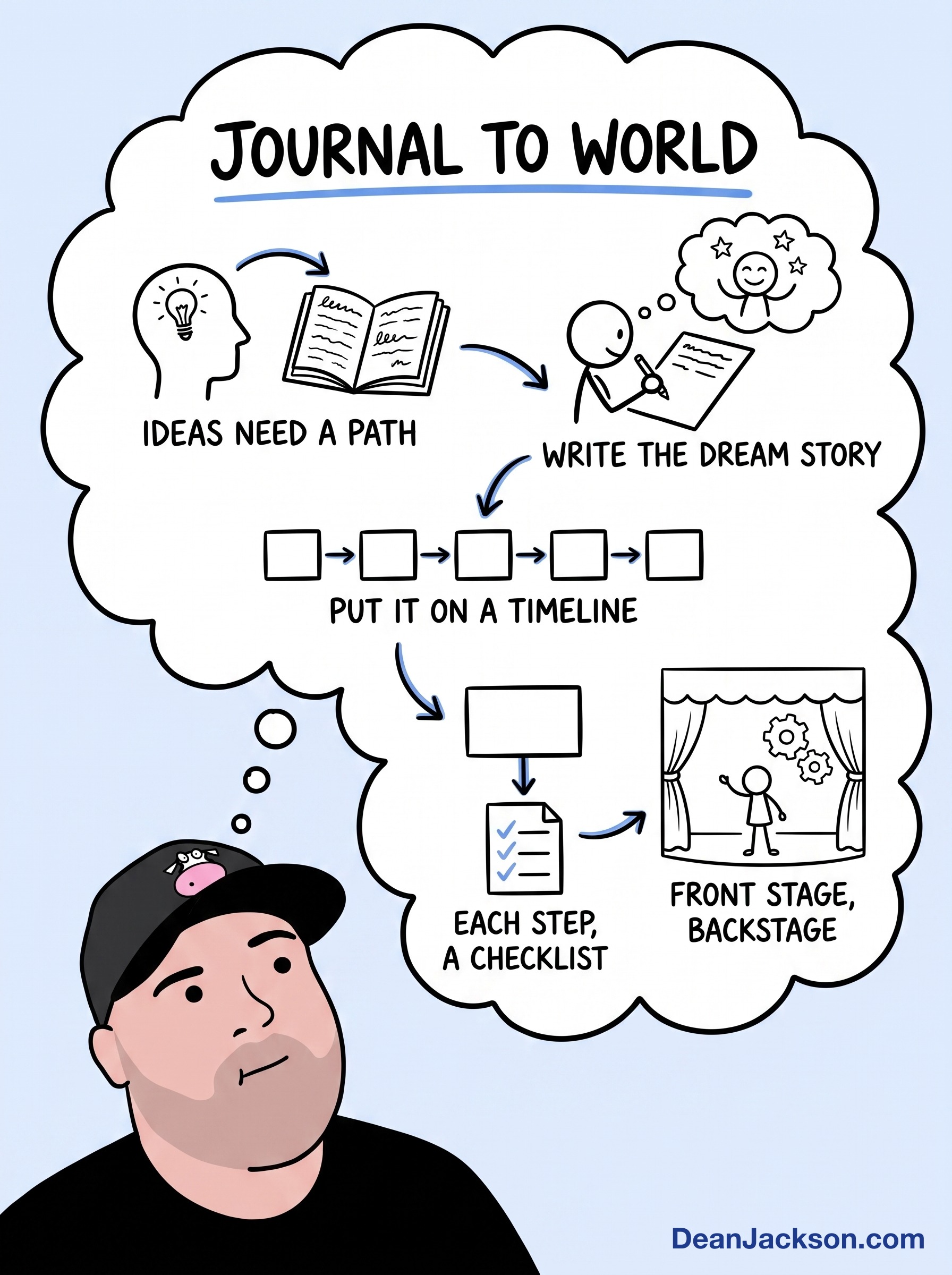
Journal number three, and a pattern is emerging: two tools I use to take an idea from a page in my journal and walk it, box by box, into the real world.
Good morning. We're in journal number three now.
And a question keeps coming up... once you start journaling, how do you get all these ideas out of your internal world and into the real one?
Flipping back through, I can see the organizing model I've been using all along. Two tools, and your brain is really good at both.
The first is to tell the story of what's going to happen... narratively.
We used to do this at the big real estate main events. We called them ultimate scenarios. Relaxing music on, a few minutes to fill a page, writing from the perspective of your ideal customer who's just gone through the experience of working with you.
"I'm John Jones, and I just finished selling my house with Dean Jackson. From the moment we called him, the entire experience was amazing."
Get into real detail. Let yourself write it in the most glowing, wow-experience way you can imagine. People would rave about this exercise... because when we write words like that, we can't help but visualize.
The second tool is to take that scenario and lay it out as a timeline.
That's why my journals are full of these blocks moving across the page. Each box is a benchmark, something that needs to happen. Get a lead. Set up the 800 number voicemail. Take the leads off.
And here's the trick... right underneath each box is the perfect place for your mind to ask, well, what needs to happen to make THAT happen? You start thinking in checklists. Call sheets. A lead intake form. A letter for the people who didn't leave a phone number.
That's exactly how we built the Guide to Halton Hills.
And it's the beginning of what became the client experience timeline. Everything above the line is what your clients see and experience. Everything below the line is the systems, checklists and responsibilities that support it... what Dan Sullivan would call front of stage and backstage.
Thirty years later this is just instinct now. See the idea as a timeline, break it into component parts... which, for my ADHD brain especially, beats staring at the whole thing every time.
Try it out. I think it'll help you get your ideas from your journal into the world.
Transcript
Auto-generated transcript, provided as supporting material. It may contain errors, and speaker labels are occasionally mis-attributed.
Good morning. Okay. One of the things that you'll notice when you start journaling and you start creating ideas in your journal is that you're going to be faced with, how do I get these things from my journal, my ideas, all the things that I'm creating in this internal world, out into the real world? And I'm seeing now as I'm moving through.
We're in journal number three. I'm starting to see a lot of a kind of organizing model that I would use. I would use these storyboards or these blocks to take through a process in a timeline. So two things that I would do that our brain's really good at is, number one, I would use the journal to narratively tell a story of what was actually going to happen.
We used to do these at the big real estate seminars at the main events, and we would call them ultimate scenarios where we would have people and we'd put on some nice relaxing music and we would say would give people a few minutes and to fill a page. But to write a story from the perspective of your ideal customer who's just gone through the experience of working with you, and have them describe it in the most glowing, wow experience type of way that you could imagine. So I'm John Jones, and I just finished selling my house with Dean Jackson. And from the moment that we called him, the entire experience was amazing.
The first thing is, before he even got there, he sent us a booklet and a package that outlined the process. It showed us what was going on. I mean, you just get into real detail and let yourself get into that mindset of writing from the perspective of the person who's ultimately going to experience it. And you're going to be amazed at how creative you are.
We never, ever, I mean, people would rave about this particular exercise that they would do at the main events to outline and visualize what your ideal experience is for people going through your business. And then we would have people read them. And it's pretty amazing when you start seeing it, when you start hearing. And whenever we write words like that in a story, we can't help but visualize.
So you visualize the process. Now, the next step in getting all of this from that hypothetical scenario, that created scenario that you did, is to create it in a timeline model. That's why all of these things that you'll see in my journals are really. They're timeline oriented from beginning and they're moving across the page.
And what we're putting in each of the boxes is a benchmark of something that Needs to happen. So I'm trying to organize the guide to your local area system. So this would be similar. This would be exactly what we were doing in Halton Hills, the guide to Halton Hills.
So it would start the moment that we get a lead. So that's the first box. Get a lead. Then the second one is the 800 number voicemail.
So it had to have the voicemail set up on there, take leads off the 800 number. And what we would do is when you put on the timeline where the steps that have to happen, when you identify what that is right underneath, it is the perfect place for your mind to think, well, what needs to happen in order to do that? You start thinking in terms of checklists. You start thinking in terms of, well, what do we need to do to make that happen?
So when I say take leads off the 800 number, because remember, all of the leads that we're getting are voicemail because there's no Internet for people to go and fill out a form. But in order for that, that brainstorm underneath, it led that we need call sheets. So I created a sheet that was like a lead intake form that you could put the name of the person. You take all the information off the voicemail, and then you schedule the initial call, and then you get the phone number.
And if they didn't, if they left their address, we would call 4, 1, 1, which was information to get the phone numbers. All of this stuff we would have. If they didn't leave a phone number, we'd have a letter that you could send to people. So you start immediately directing and containing your systems, thinking into, in a way that helps create your.
Makes your visualization reality. And my journal, you know, I was looking through this one particularly. There's so many of these blocks. I just got to thinking that way.
And I still do this in terms of how to get myself sequentially organized on what needs to happen in order to make something make something real. And this is the. It's cool because this is the evolution that turned into creating and thinking about what we call the client experience timeline. And there's two parts to it.
Everything above the line are the things that your clients actually experience and see and. And have evidence of. And then below the line are all the things that happen systematically in systems, checklists, responsibilities, org charts, who does what to make sure that we're supporting that vision. So you think of it as what Dan Sullivan would call front of stage and backstage.
In order for the play to be happening on the front stage, there's a whole support system of things that have to happen in order for that experience to take place for your clients. And it's good to see, like, really the beginnings of how I've formalized this, because 30 years later, this is ingrained in me that it's a natural tendency. The first thing I do just instinctively is to visualize something as a timeline and help, especially for me, with my ADHD brain, instead of looking at the whole thing, breaking it down into the component parts, that makes it so much easier to get my ideas from my journal into the world. So try it out.
I think that will help you organize yourself.
Get BreakthroughDNA Free
Discover the 8 Profit Activators that can transform your business. Get the complete framework, free.