Your Relationships Are Worth More Than Your Marketing
Watch
Listen
A November 1996 page from the day Eben and I interviewed the authors of The One to One Future... and eight ideas from that book still run everything I do.
Good morning.
Here's a question that stopped me this morning.
How much money would you have right now... if you still had a relationship with every client who's ever paid you?
All of them still active. Still collaborating. Still getting value from you.
That's a whole different way to look at a business.
I found the page where this started for me. November 1996. Eben Pagan and I interviewing Don Peppers and Martha Rogers, the authors of The One to One Future.
You know how we got that interview? I called them up and asked. That was it.
Most people are more accessible than you'd think... when you come at it with what's in it for them.
I'd been living inside that book for six months, and it quietly rewired how I see a business. It's where the Before Unit, During Unit and After Unit really came from... especially the After Unit, where you nurture lifetime relationships and orchestrate referrals.
Eight ideas from that book stuck with me. Here they are, 30 years later.
Shift from market share to share of customer. Stop asking how many new people you can chase, and start asking how much of one person's lifetime you get to serve.
Collaborate with your customers. This is how we put realtors, mortgage brokers and home inspectors on the same team, all serving the same client.
Differentiate your customers. A first-time buyer is not the person looking for a horse farm. The closer people feel you were custom-designed for them, the better it goes for you.
Economies of scope, not scale. Deeper relationships with fewer people beats shallow contact with more... because you're not forever refreshing what you already have.
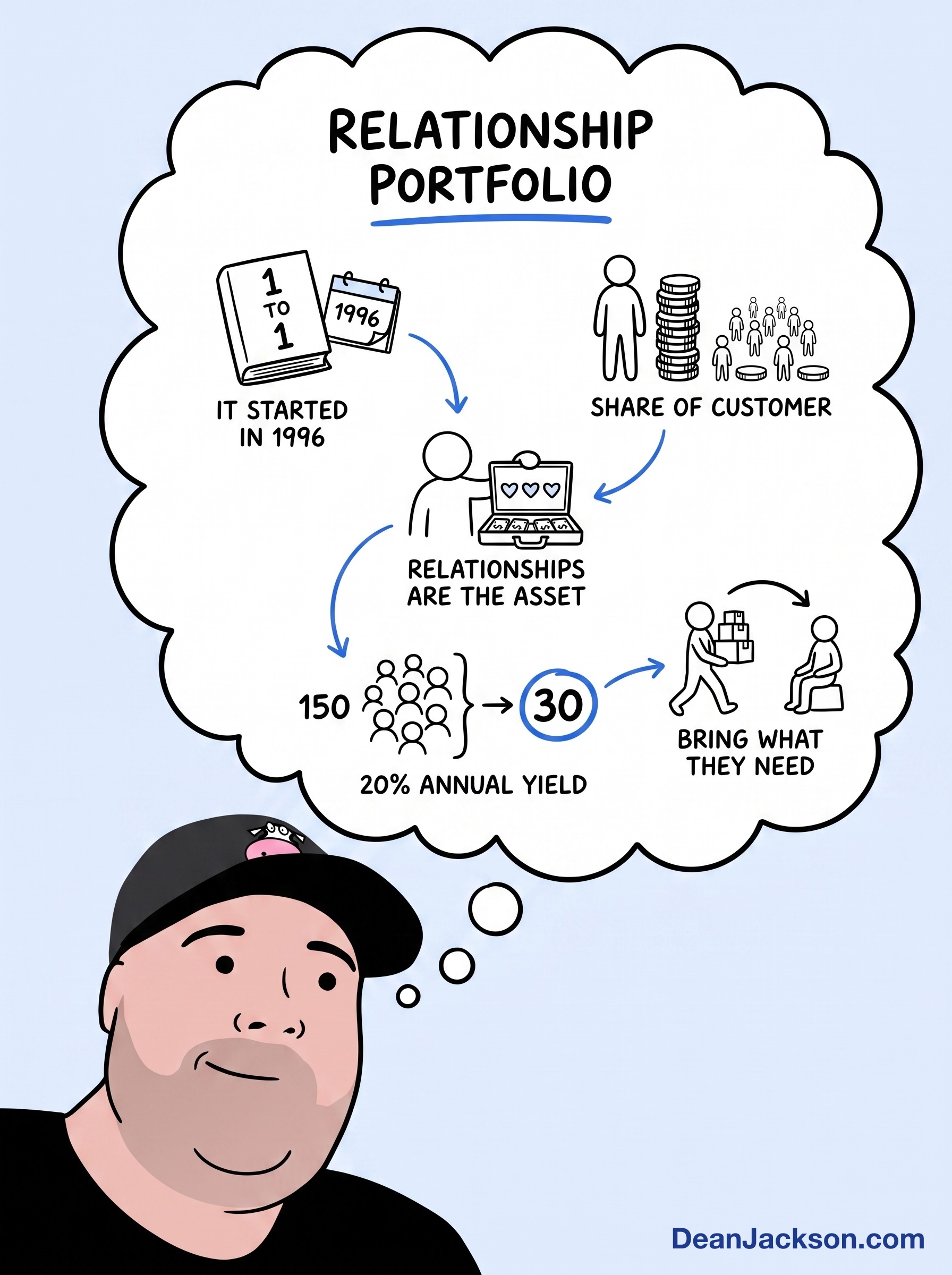
Manage your customers like an asset. This is your relationship portfolio. Take your top 150 relationships and manage them for a 20% annual yield. That's 30 transactions.
And 20% isn't hard when you really look at it. It just means one person, one time in five years, does one more deal with you or sends you one referral. That's it. That changes everything.
Engage your customers in dialogue, not broadcast. In 1996 that meant mail, and money. Today, with email and social, we've never had it better.
Take products to customers, not customers to products. Once you have the relationship, the only question left is... what else do they need? That's why I bring people GoGo, books, postcards. The relationship is the valuable part.
And make money protecting your customers' privacy. When you hold the relationships, people don't have to go hunt around for who to trust. You bring the right things to them.
Eight ideas. One thread running through all of them.
Your relationships are the asset. The marketing just fills the portfolio.
Read The One to One Future if you never have. I'm still drawing from it 30 years later.
Transcript
Auto-generated transcript, provided as supporting material. It may contain errors, and speaker labels are occasionally mis-attributed.
Good morning. How much money do you think you would have if you still had a relationship with every client that's ever paid you money? That they're still an ongoing client of yours. You still have a relationship with you.
You're still adding value. You're still collaborating with them. That would be a pretty amazing outcome. And uh when I was reading the one to one future, it's been we're in November now.
Started this in April again that was one of the first books. So 6 months I've been really studying and uh and diving into the ideas of the onetoone future. And I've mentioned how impactful that's been because it made me realize the value of ongoing relationships with people. Well, here we are in November of 1996 and Eban Pagan and I were doing on this day an interview with the authors Don Peppers and Martha Rogers.
And you know how we got that interview? I called them up and asked them. I called them up. And it's so funny that you know I talk a lot about selfappointment is that a lot of times people go, "Oh, how'd you ever get to do that?"
Well, I you know what? Most people are very um accessible. Let's call it that. But I'll tell you what, on a sidebar, what I get a lot personally is there's so many people I get pitches all the time for people who say, "Let me be a guest on your podcast.
Here's what I can bring to your audience." And probably for every 20 of those I get I maybe get one inter one request of somebody saying can you come on my podcast and it's a very interesting dynamic is that you know if you start if you just reach out to people but you take this mindset of what's in it for them that often people are very friendly and accessible. So that's how we got them. And here's some things that I uh got some of the the main concepts that I wanted to explore in talking with them about the book.
And number one is the shift from thinking of market share to share of customer. And the whole dynamic changes when as marketers are in business, people are always more interested in getting new and more clients. They want to get new new new now and now. New people who want to do something now.
But making that shift from share of uh from market share to share of customer is a very interesting thing that helps you. brings into life what would be what's the lifetime value calculation of somebody. This was fundamental in this whole development of the before unit, the during unit and the after unit because the cornerstone of the after unit is building nurturing lifetime relationships with people and orchestrating referrals. So that first shift is what are the things that you could do on an ongoing basis?
How could you continue to add value to the people that you're serving now? And what would that look like if you could imagine an ongoing relationship with them? You know when you start thinking so many of the things this led this was the beginning of leading to you'll see a few years from now that we created money-making websites for realtors of thinking about how can we build a lifetime relationship. And by the way, 26 years later, we still have several of the people who were clients in 2026 that are still customers today.
Um, number two is collaborate with your customers. And that again is that shift from um away from acquisition and more to retention and starting to think about how can you collaborate with your customers to together get both of what you want. So, how we applied this in in by referral only when we were working with the realtors is what if we could show the realtors how to collaborate with mortgage brokers, with loan officers and form that team. And that became a collaborative effort that we were able to introduce realtors to us through lenders who were looking for realtors to collaborate.
And we introduced to us through realtors who were out hoping to build a foundation of collaboration among themselves. that a mortgage broker and a real estate agent together could both serve the same client. And we did that same thing with now home inspectors. And uh you start thinking about this share of customer in the context of a real estate transaction.
And there's so much more than just helping somebody buy and sell the home and moving into their role as home owners. Now number three was to differentiate your customers. And that became really clear on the um that became one of the things of selecting a single target market and understanding that differentiating your customers is really moving towards that onetoone future where if you know that this particular person is a firsttime buyer that's very different than somebody who's looking for a horse farm or somebody who's looking for a condo or u you know building a new home. any of those things.
When you start looking that differentiating gives you an advantage in that the closer you feel that people feel that you are exactly what they need, that this was customd designed for them, the better off it's going to be for you. So differentiating your customers allows you to speak directly to their individual need. Number four is economies of scope, not economies of scale. And that's an interesting thing when you start looking at especially the information that you have about your clients.
If you take that there are 10,000 households in a uh you know in a nice small town or however many households there are in a neighborhood. Having somebody's address and having the fact that they live there, that's a scale of information. But when you think about what is the depth, the scope of the information that you have is how many of those 10,000 people are feeling like you are an advocate for them for everything to do with living in their home. And that's it's a really interesting way of thinking about it that is having deeper relationships with fewer people gives you more long-term opportunity than having short-term relationships with more people cuz you have to continually keep refreshing that.
So that was a big um shift for us. Number five is manage your customers, not just your products or services. And that was an interesting thing that we, you know, developed this idea of imagining your relationships as a valuable asset. To this day, this is the way we think about this.
And you may have heard me talk about your relationship portfolio. thinking about these relationships as a valuable asset that you are managing for an annual yield. And that's a really one of the metrics that we use is just that return on relationship in your after unit. How much value are you adding to the people that already know you, like you, and trust you?
measurable in the terms of that return on relationship. When we look at it for realtors, we say take your top 150 relationships and imagine what would happen if you were managing that relationship portfolio for a 20% annual yield. That would mean that you should be able to do 30 transactions from that group of 150 people. And we see that all the time.
There are lots of people who u get to that level and higher. But it doesn't come without an orchestrated effort. It doesn't come without first making that shift that you value the relationship. And by the way, 20% isn't that hard when you look at it.
That what that means is that if you took one person that you have a relationship with now if you were to invest in that relationship, manage it like a valuable asset, do you think that that person one time in 5 years would do one more transaction with you or refer one person? That's what a 20% annual yield is. is one time in five years and that changes everything when you really understand that and the value of it. Number six, engage your customers in dialogue.
So it's a different thing to just broadcast things to people as opposed to engaging in a dialogue. Now, in 1996, it was much more difficult to do these kind of things because the only way that you could really communicate with people was through mail, right? You had to spend money to do this. Now, with social media, with your with email, the actual execution of the one:1 playbook is we're we've never had it better.
We've never had it better than u doing that right now. Number seven is take products to customers not customers to products. Now that comes when you think about the relationship that you have with somebody with a home owner or for me with a business owner. When you think about it's not just that they do the one thing that you do with them is what else are they going to need?
What else would be valuable to them? So when you look at it, what other things could you introduce to people that give them an advantage? I I talked about how we did the giftgiver postcards or I you're going to see some of the great ways that we uh implemented that. But when I look at how I've been able to um do that in my own businesses, I know that if I teach people about doing email marketing, about doing lead generation, about running postcards, that they're going to need postcards.
They're going to need books. They're going to need all of these things. And I've been able to bring go- go clients to people so that they've got a CRM, you've got an email broadcast, you've got landing pages, the capabilities that people are going to need to execute the things that I talk about, 90minute books as a way of helping people write the books that they need to generate the leads that are going to be um there. my relationship with prospects plus for mailing postcards, anything that people need and integrating that into go- go clients.
When you start thinking about how can you bring products to customers, the relationship is the most valuable part that you have. And then number eight is make money protecting your customers privacy. If you look at that, you have the relationship with people instead of them having to go out and vet people and search for people and find the services that they're going to need. What if you know that collectively you have a portfolio of relationships who are all going to need to get their carpets cleaned or to get their u their roof done over the course of uh a year.
And you start now working with other businesses to introduce those things to them without them having to go and getounded by other people. whole different world. So, I'm glad that I found this part of my journal here and I can't recommend it enough that you read the one to one future because I'm still drawing from u drawing from those ideas 30 years later.
Get BreakthroughDNA Free
Discover the 8 Profit Activators that can transform your business. Get the complete framework, free.