The Most Underrated Day in Your Week
Watch
Listen

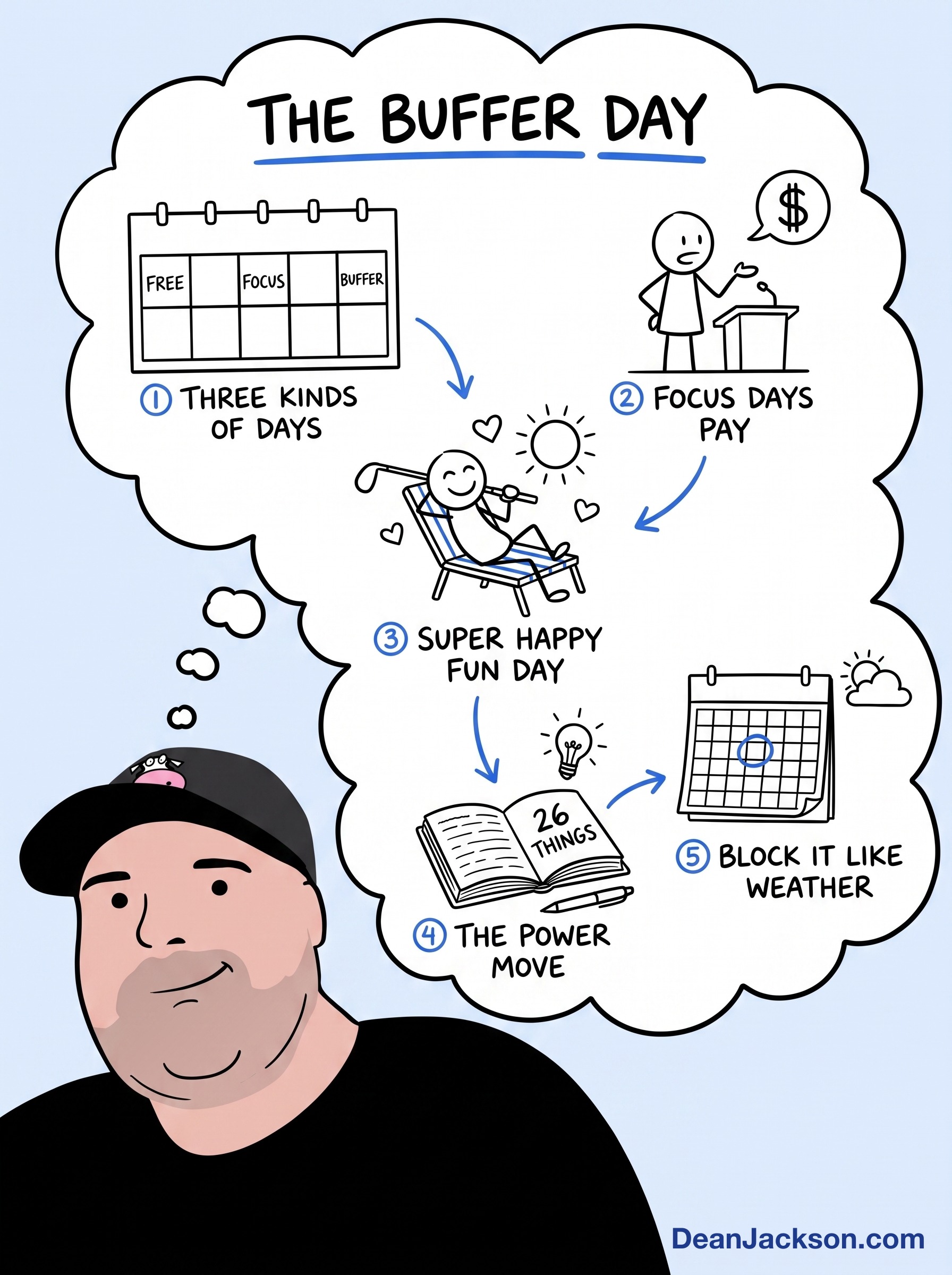
Dan Sullivan gave me free days, focus days and buffer days in 1996. Thirty years on, it's the buffer day, the one everybody wastes, that's the power move.
Good morning.
The last week of November, 1996. My very first Strategic Coach workshop in Toronto.
That's the day Dan Sullivan started me on a 30-year habit he calls thinking about your thinking.
I'm looking back at the notes I took in that first room. An industrial part of the city, beautiful old brick buildings, lofty loft spaces. Everything about it was built to make you think bigger.
And on day one, Dan laid out something I still run my whole life by. He calls it the entrepreneurial time system.
The idea is that an entrepreneur's time works like an athlete's or an entertainer's. You've got game days, practice days and off days.
Dan renames them. Focus days, free days and buffer days.
Focus days are easy to picture. They're the days you do the money-getting thing. Workshops, clients, coaching, whatever you actually get paid for.
Free days are the ones most people get wrong. Dan means a full 24 hours completely disconnected from work. Not slipping out at lunch for a movie and feeling like you got away with something. The day off is the whole point of the day.
Mine evolved into what I call super happy fun days. You orchestrate the whole thing, start to finish, filled with the stuff you love. Breakfast at your favorite place. A round of golf with a good friend. Lunch at the club. A movie. Dinner. A spa. All in one day.
But a day like that doesn't happen by accident. And that's where the underrated one comes in.
The buffer day.
I used to treat buffer days as the junk drawer of the week. The in-between. Catch up, do whatever's left over, whatever needs doing.
I had it backwards. The buffer day is the power move.
A buffer day is where you proactively plan and set up your focus days and your free days so they actually land. It's where the thinking about your thinking happens.
That's why I spend so much time in my journals. I'm sitting on a buffer day, drawing out the things I'll do on my focus days and lining up the things I want on my free days.
One thing I love to do is make a list of 26 things that bring me joy. There's no magic to 26. It's just the number of lines on a page in my journal.
Put a constraint on it and your brain gets to work. It does what you ask it to do.
Now that list is a menu. On a buffer day you pick from it, put it on the calendar, and enroll the people you want there with you. That gives everybody something to look forward to.
If you want an on-ramp to all this, don't try to build your perfect week this week.
Treat your calendar like the weather forecast.
You're a storm of activity moving through the days. You know exactly what today and tomorrow hold, same as a meteorologist knows the next couple of days cold.
But go out 14 days and it opens up. Pick three Tuesdays from now and it's easy to drop a beacon in there. A super happy fun day. A real buffer day. Once it's on the calendar, everything else works around it.
My friend Taki Moore calls it spanxing your calendar. Squeeze all your focus days into Tuesday, Wednesday and Thursday, and let the rest breathe.
I got a funny email from Rick the other day. "Dean, are you saying you can teach me to make fat stacks by hanging out at a pub drinking coffee like you?"
I laughed, because... yes. That's exactly what I do.
Every idea I've had and every dollar I've made in 30 years went through my brain, down my pen, onto a page in my journal, before it ever went out into the world.
So here's your nudge for today.
Stop treating the buffer day like a throwaway.
Give it a job. Use it to plan the days that actually matter... and watch how much better the rest of your week gets.
Transcript
Auto-generated transcript, provided as supporting material. It may contain errors, and speaker labels are occasionally mis-attributed.
Good morning. The last week in November 1996, that was the first time that I went to my very first strategic coach workshop in Toronto. And I was introduced and started my 30-year journey of what Dan Sullivan calls thinking about your thinking. And I've looking back I'm think I'm writing down some of the my notes from being in strategic coach for the first time.
And first of all just from an impression standpoint when I walk in the building it's an industrial area with you know beautiful old brick buildings lofty kind of spaces. Everything about the strategic coach environment was inspiring. It's a It was a a really amazing place and it still is to this day. They're in the same space.
They've just expanded, of course, the footprint, but as I look back over it now, I've mentioned the Mount Rushmore of influential people and Dan Sullivan is right up there. you know 30 years now of uh of guidance and this was day one and the one of the concepts that we explored I learned this uh because the first thing that I got from strategic coach was Dan's program how the best get better and on day one in the actual strategic coach program one of the things that we talked about was what Dan calls the entrepreneurial time system. And I realized how pivotal some of these concepts that we're talking about, how durable those things are. Like as an entrepreneur, this is just as relevant and important today as it was 30 years ago.
And so basically Dan looked at the entrepreneurial time as being self-directed a lot like entertainers and athletes in that they have game days and they have practice days and they have off days and that if we take that kind of approach to being an entrepreneur Dan would call them free days, focus days and buffer days And what I learned, you know, I I always talk about my schedule and my zones and what I that was planted in 1996 by looking at the cadence of your week is unchanging. You know, I've said lots of times that life moves at the speed of reality, which is 60 minutes per hour. And there's one uh seven days in a week, 30 days serve 31 in a month. And that perpetual rhythm is something that if you embrace it, you and fit your approach to u navigating that time, not about managing it, but navigating your way through that time is going to create the best outcomes.
And I I think that the big impact for me, the thing that I've evolved to, what free days became, it it's really interesting that Dan talks about these days as a 24-hour period, not just taking some time off in the middle of the day to slip out and, you know, go to a movie or go to lunch with a friend or slip out and play golf. It's not something that you try and get away with. It's something that you It's the purpose. It's the whole purpose of the day.
And you know, Dan, when they look at it, you know, they take over 155 uh free days, maybe, yeah, I think 150 plus free days where they're completely disconnected from the uh from anything work related. And once you have your first experience of that, it's it's really interesting because we're so used to blending um everything. And my approach to free days sort of evolved to what I started calling super happy fun days where you plan for a complete free day where the whole thing is about doing all of the things that you that you like. Focus days are kind of easy to imagine because they're the days that you're doing the thing that is the money creation or money generation thing.
If you're doing workshops or you're with clients or you're u coaching people or whatever it is that you get paid to do those days, those focus days are the days that you're actually doing the money getting activity in your business. and buffer days. I used to think about buffer days as just the in between space, the time where I'm not really work I don't I'm not working on uh focus activities. I'm not going to take the whole day off, but a buffer day.
And originally, I kind of thought of it as just a catchall day that I'll catch up or I'll do whatever needs to be done or I'll just kind of do what I want on those buffer days. But what I've realized and evolved to is that I see that the buffer days are the power move here. the buffer days. If you think about it not as a just a throwaway day, but you think about it as a day where you're proactively planning and supporting yourself to have better and more productive free day or focus days and more and more enjoyable free days.
And that kind of pro-activity of taking that buffer day has been a uh has been a big thing. And that's where a lot of this thinking about your thinking comes into play where you're planning things where that's why I spend so much time in my journals is thinking through and creating the things that will ultimately be the activities that I do on my focus days and identifying what are the things that you want to do on your free days. I always love like as we go through my journals. One of the things and I think I see it coming up is what are I just would make a list you know 26 things that bring me joy and the reason there's no magic to 26 but 26 the number of lines that happen to be on the page in my journal.
So I always love to put a constraint on something and your brain does what you ask it to do. So, I came up with 26 things that bring me joy. And I would just list all of them uh down there. And it's really when you go through and you start to look at this as a menu, as a menu of things to on your buffer days, organize, place on the calendar, and enroll other people.
If there's people that you love to spend time with, having something where you know that this is what we're uh this is what we're going to do gives both of you something to look forward to. And elevating the uh the level of what you do on those days. Like I when I elevated my free days to super happy fun days. Just imagine a day where you orchestrate it from beginning to end filled with all the things that you really love.
Breakfast at your favorite place, playing around a golf with a really good friend, having lunch at the country club, going to a movie, going for dinner, going to a spa. Imagine having all of that in one day. That's pretty fun. But it doesn't happen randomly.
It happens because you use some buffer time to plan and organize it. One thing that I will say about trying to plan these things is that it it's very difficult if you're trying to do it this week. If you're trying to say, I'm gonna have free days, focus days, buffer days this week. The thing that is the uh best on-ramp to it is to treat your calendar like the weather forecast.
If you think about it, you are this storm of activity making your way through your calendar. and all of the time for today and tomorrow. And you have a really good idea of what's happening over the next 2 or 3 days, just like the meteorologists have a really good idea of what's going to happen weatherwise in the next 2 or 3 days. But as you go out 14 days or more, if you pick three Tuesdays from now, it's much easier for you to block that off to put that as a, you know, beacon in your calendar that that's going to be a super happy fun day or that's going to be a real proactive buffer day.
When you put it in the calendar, now you can work around it. And I found for me setting up these ideas of having a zone where I know which days are roughly going to follow that thing. I love my friend Taki Moore calls spansing your calendar. If you take your calendar and you just like the Spanx tightener body shaping things, if you spanx your calendar so that everything focuswise fits into Tuesday, Wednesday, Thursday, that's what I've done is setting up that approach there.
And I think that this kind of free day, focus day, buffer day approach can have a big impact uh on you. I got a funny email the other day from Rick. It says, "Dean, question. Are you saying you can teach me to make fat stacks by hanging out at a pub drinking coffee like you?"
And I laughed to myself because I was thinking, you know, yes, I I can do that. That's what I do. is the funny thing. What I really realized is that every idea that I've had, every dollar that I've made over the last 30 years has gone through my brain, through my pen onto a piece of paper in my journal before it went out into the real world.
And if I can turn people on to that activity as a driver for what to do, what to think about, what to ask yourself to draw out, what the next most valuable action is for you, and how to find the most profitable things that you can install in your business. I'm all for it. m. I'm going to do for the first time a 50inute profitfinder workshop and you're going to join me live on Zoom and we're going to go through a 50inute exercise.
Bring your pen. Bring a notebook or piece of paper. And I'm going to guide you through a thinking process that will help you identify where the lowest hanging fruit is in your business and maybe some fruit that you didn't even know was there. But I'm going to show you where to look for it.
So, it's free. It's for you. m. this Friday.
Just watch. Go to What did we call the website, Josh? >> 50inut profitfinder. m.
Get BreakthroughDNA Free
Discover the 8 Profit Activators that can transform your business. Get the complete framework, free.