9 Reasons “Time Management” Fails Your Entrepreneurial ADHD Brain
Watch
Listen

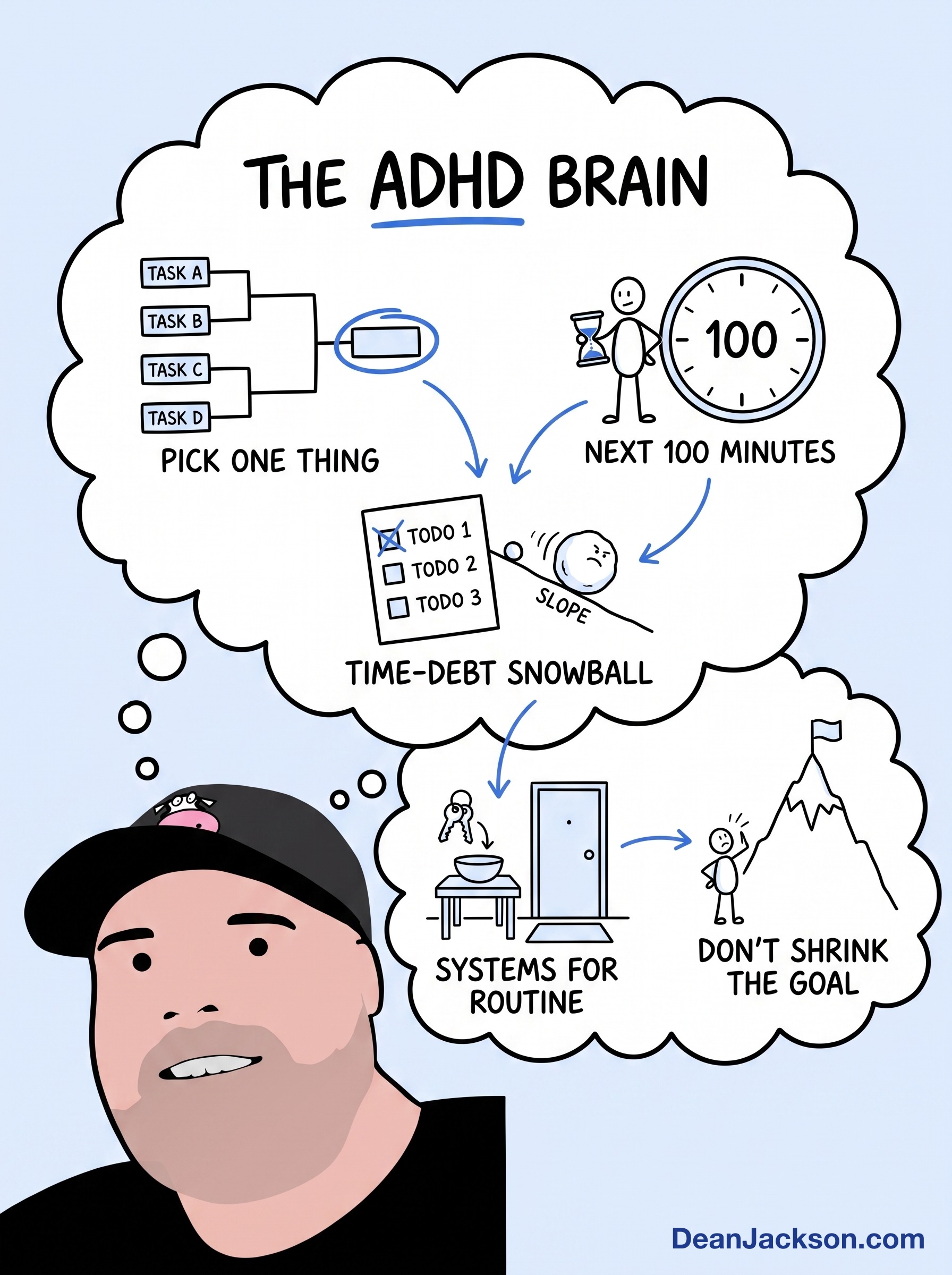
Nine reasons time management never works, especially for the entrepreneurial ADHD brain. All nine on one page of journal three, and they still explain my week.
Good morning.
We're almost halfway through journal number three.
And I keep noticing the same thing on these pages... my undiagnosed ADHD, rearing its head, trying to work out why I can't seem to be a normal boy.
The question sitting underneath all of it. Why doesn't time management ever actually work?
I found nine reasons. So here they are.
One. We don't know what we want. My decider is broken. Every option feels equally possible, all at once, and I freeze on choosing one. So I run elimination tournaments... eight things in a bracket like the NCAA, played off against each other until one is left standing. Then I can finally focus.
Two. We don't put first things first. I drift to whatever's newest and most interesting, not the thing I already know matters. Nothing moves for me until it becomes a deadline. I love them and hate them at the same time.
Three. We focus on the wrong time frame. Time moves at the speed of reality... 60 minutes an hour, no matter how fast my head insists it's already done. The only actionable time frame is today. A thousand waking minutes. And really, the next 100. I run the day in ten-minute blocks, and you'd be amazed what fits in one of them.
Four. We don't leverage our time. Jay Conrad Levinson's 90-minute hour. If something takes 30 minutes and you can do something else alongside it, you've stretched the hour. Go for the walk and listen to the podcast. Stack it, batch it, multiply it.
Five. We don't allow ourselves to be supported. Michael Gerber's point. As we grow we cling to the things we think only we can do. The real move is to look at your pile and ask... is there anything here somebody else could do for me?
Six. We don't have systems for the routine. If you keep hitting the same snag again and again, that's time debt piling up. So I put a garbage can right outside the car door in the garage, and the junk on the passenger seat never makes it into the house. A bowl by the front door for the keys I always lost. Little systems, made easy.
Seven. We are in time debt. All the things you've been putting off weigh on you exactly like financial debt. So make the list. What do I owe, and to whom? Then run a time-debt snowball, Dave Ramsey style... knock off the fastest one first, feel the progress, keep going.
Eight. We don't have the energy. Procrastinating is exhausting. A block on the calendar is worthless if you're too drained to use it. That's why I've become what Brian Johnson calls a professional sleeper.
Nine. We are afraid. Afraid to set the big goal. Afraid of what taking action might mean. Afraid of failing. So we quietly shrink the whole thing down.
Here's a side note that surprised me. Almost everything I feel real pressure about involves somebody else. Someone's waiting, someone's expecting it. I never seem to feel that pressure just from myself.
And that's the fun of a journal. Nine reasons, sitting on one page of book number three, still explaining my whole week 30 years later.
I got a funny email from Rick the other day. "Dean, are you saying you can teach me to make fat stacks by hanging out at a pub drinking coffee like you?"
I laughed. Because... yes. That's exactly what I do.
Every idea I've had, every dollar I've made in 30 years, went through my brain, down my pen, onto a page in my journal, before it ever went out into the world.
So here's your nudge for today.
Take the thing you keep putting off... and just ask what happens if you don't touch it in the next 100 minutes.
That one question tells you what actually matters.
Transcript
Auto-generated transcript, provided as supporting material. It may contain errors, and speaker labels are occasionally mis-attributed.
Good morning. m. You know what that means? Time for the simultaneous sip.
Thank you, Scott Adams. Okay, I'm noticing in my journals so far, we are almost halfway through journal number three, and I'm noticing a pattern. [snorts] I'm noticing that my undiagnosed ADHD is rearing its head. trying to figure things out about why I can't seem to be a normal boy.
And I start thinking about why time management doesn't work. And I'm starting to see now I could title this nine reasons time management doesn't work, especially if you have ADHD. And I came up with these nine things that looking back at them are very helpful. I actually wrote a uh I wrote a little book about this back then, but here we go.
So, number one is we don't know what we want. And for me, what I've discovered now about my ADHD is an executive function uh issue is the real thing. And so I've learned that I see all the options possible as being possible right now. And they all carry equal weight and I have a hard time prioritizing and selecting.
My decider is broken and and so I see like feels like everything needs to be done. In my mind, it's already done, but I can't I have a hard time narrowing myself to what I want. So, I end up finding a lot of times where I'm sitting in a spot where I have the time to do something. I have the the great everything I need, but I can't get myself to decide and choose this one over this one over this one.
it doesn't feel like sequencing things is really uh troublesome. So I started using elimination tournaments where I would set up like six things or eight things in a bracket like the NCAA tournament or a tennis tournament and I would play them off against each other to find the one thing so that then I could focus on that thing. And that led into number two is we don't put first things first. And so I would tend to work on the thing that's most interesting to me or novel or new.
I don't know why I just have an unending energy and appetite to work on new things rather than the thing that is now making something that I already know is a priority. I already know that it maybe uh I really want to get it done, but not until it moves to the point of I need to get it done. Do does that stimulate my brain into action. So deadlines are a are a real thing.
I love them and hate them at the same time. Number three is we focus on the wrong time frame. So, I tend to realize, this is where I you've heard me say a lot, that time moves at the speed of reality. And that I found is absolutely true.
That's a physical thing that we're moving through at 60 mph. My brain as a creative can shapeshift. It can get things done quickly in my mind. I see what actually needs to be done.
But you still actually have to do the work in real time. And that seems like the snail's pace for me. But focusing on everything that I want to get done in the week or in the month or the quarter or the year is the wrong time frame. The only time frame that is actionable at the very most is today.
So the the thousand minutes that we get today of waking time and more realistically the most actionable time is the 100 minutes. The next 100 minutes is the immediately actionable future. And try it out for yourself. like you still have hope that you can get a lot done today, but if you narrow the focus to what can I do in the next 100 minutes or what could be done in 10 minutes, I tend to use 10minute blocks of currency.
And so I take my thousand minutes as I have a 100red 10minute blocks and you'd be surprised what you can actually get done in one little 10-minute uh 10-minute thing. But there there's a lot to this of focusing on what you can do. One of the things when I do the elimination tournaments too, one of the things that you'll find is that I look at I try and get myself in this comfort zone of what actually has to be done today. And that's an important word when I'm thinking, especially if you're an ADHD brinksman like I am, like the last minute of things is if it's not due until, you know, midnight, well, there's that's not now.
m. in the morning, there's still plenty of time. And I don't know, it's a funny thing, but that's a um you know, these little games kind of help. So if you look and see of the things that are worrying you or the things that are you feel pressure or you're procrastinating is just kind of look at it and say to yourself what what happens if I don't do anything in the next 100 minutes or in the next thousand men like if I didn't do anything on this today and that gives you a sense of the things that have priorities and by the way as a side note Almost everything that you feel or I feel I can't speak for your brain but for my brain everything that I feel that pressure with is because it involves somebody else.
So it's always a sense of that person is expecting this or I'm going to they're waiting for this and that's uh I don't know I never feel that kind of pressure from myself. It's always on behalf of uh of other people. So number four is we don't leverage our time. I read a great book years ago called the 90minute hour by Jay Conrad Levenson and I I found it fascinating because he was talking about the great efficiencies of stacking things that you can do while you're doing something else.
If something takes 30 minutes, but you can do something else while you're doing it, you can create a 90minute hour. For instance, you want to listen to this podcast or you want to have this conversation and you want to go for a 30 minute walk, you can go for a walk and listen to the podcast. And that's a that helps you leverage and get more things done in that time u that you're looking for. So I really started looking for all the leverage, the things that you could stack or batch or do things that multiply the amount of time that you're able to spend.
5 speed. So, not everything is appropriate to kind of take that approach because there's a lot to be said for taking your time to read and understand and think about a book that you want to listen to. It's not just about jamming it into your ear holes so that you get the the information in the most efficient way. Number five is we don't allow ourselves to be supported.
And Michael Gerber talks a lot about this that part of the thing as entrepreneurs when we reach um a growth phase we we often have a hard time letting go of things of doing things that are um that we think we could do. But the real thing is looking through your stuff and realizing is there anything that anybody else could do for me? letting go and being supported in things is a uh is a big piece of making time management work especially for ADHD or I'm going to even call it entrepreneurial brain because I think it's mostly people that have uh that are entrepreneurs deal with the same things whether you have ADHD or not. Um number six, we don't have systems for the routine.
So, there's a really interesting thing that if we're constantly reinventing something that if you notice that you're running into an issue again and again, there's a real kind of time debt that you're uh setting yourself up for that you're going to have to do something again. I would constantly look at my environment and look at things that are that I end up having to do again and again. Something even simple things like I would notice, okay, there would be a lot of uh trash or papers or mail or things that would end up in my car on the passenger seat and I wouldn't take wouldn't do them right away. But then I had this idea of putting a garbage can right outside the door to my car in my garage so that it is super easy that when I pull into the garage, I take whatever was there, I put it in the garbage and off I go.
And that's kind of a it's a really interesting thing, but you start looking for how can I systemize things to make it easy. I would constantly lose my keys. So, I got a bowl to put in the front entrance of my house where the uh there's a there are drawers uh in the front. And in the bowl is just where I would throw my keys.
Now, I don't even need a key. It's all on my phone. But that's a good thing. Uh looking systemizing things.
Number seven is we are in time debt. And that's a really interesting thing when you look at things that you've been procrastinating, things that you have to do, things that need to be done that you've been putting off and putting off. I look at that as time debt. And psychologically, it weighs on you in the same way that being in financial debt weighs on you.
you can't kind of make good uh plans for the future knowing that you've got to clean up whatever time debt you're in. So, great exercise is to make a list of treating it like what do I have to do? What do I owe people right now? What am I in time debt for?
and making a list like that and starting almost like what Dave Ramsey would call your a time debt snowball where you start with the thing that you could knock off the list the fastest and then get that progress and and keep going and eliminate that time debt. Number eight is we don't have the energy. Is that sometimes, you know, it's draining sometimes when you've got all these things to do and you're not making any progress. Not making progress and procrastinating on things is exhausting sometimes.
And when you have a block of time blocked on your calendar to do something, it's important that you have the energy to do it. that you have the energy to do the things that you need. So that's why I love Brian Johnson talks about the shift to being a professional sleeper because sleep I think is a wonderful thing that helps you make the most of the thousand minutes that you're available or the 110minute blocks that you have in a day. And the number nine reason that time management almost never works is we are afraid.
And I really Eban Pagan and I would talk about this that I think that part of this when I say that is that we're afraid to set big goals. You're afraid to take action on something. You're afraid of what that might mean. And so we limit ourselves.
Afraid of failure, afraid of what are you afraid of in a situation that is blocking you from doing it. So there we go. That's a fun uh page, a fun find in journal number three. And hopefully those things will help you understand your entrepreneurial ADHD brain.
I got a funny email the other day from Rick. It says, "Dean, question. Are you saying you can teach me to make fat stacks by hanging out at a pub drinking coffee like you?" And I laughed to myself because I was thinking, you know, yes, I I can do that.
That's what I do. is the funny thing. What I really realized is that every idea that I've had, every dollar that I've made over the last 30 years has gone through my brain, through my pen onto a piece of paper in my journal before it went out into the real world. And if I can turn people on to that activity as a driver for what to do, what to think about, what to ask yourself to draw out, what the next most valuable action is for you, and how to find the most profitable things that you can install in your business.
I'm all for it. m. I'm going to do for the first time a 50inute profitfinder workshop and you're going to join me live on Zoom and we're going to go through a 50inute exercise. Bring your pen.
Bring a notebook or piece of paper. And I'm going to guide you through a thinking process that will help you identify where the lowest hanging fruit is in your business and maybe some fruit that you didn't even know was there. But I'm going to show you where to look for it. So, it's free.
It's for you. m. this Friday. Just watch.
Go to What did we call the website, Josh? >> 50inut profitfinder. m.
Get BreakthroughDNA Free
Discover the 8 Profit Activators that can transform your business. Get the complete framework, free.