Good Marketing Never Gets Old (Proof Inside)
Watch
Listen
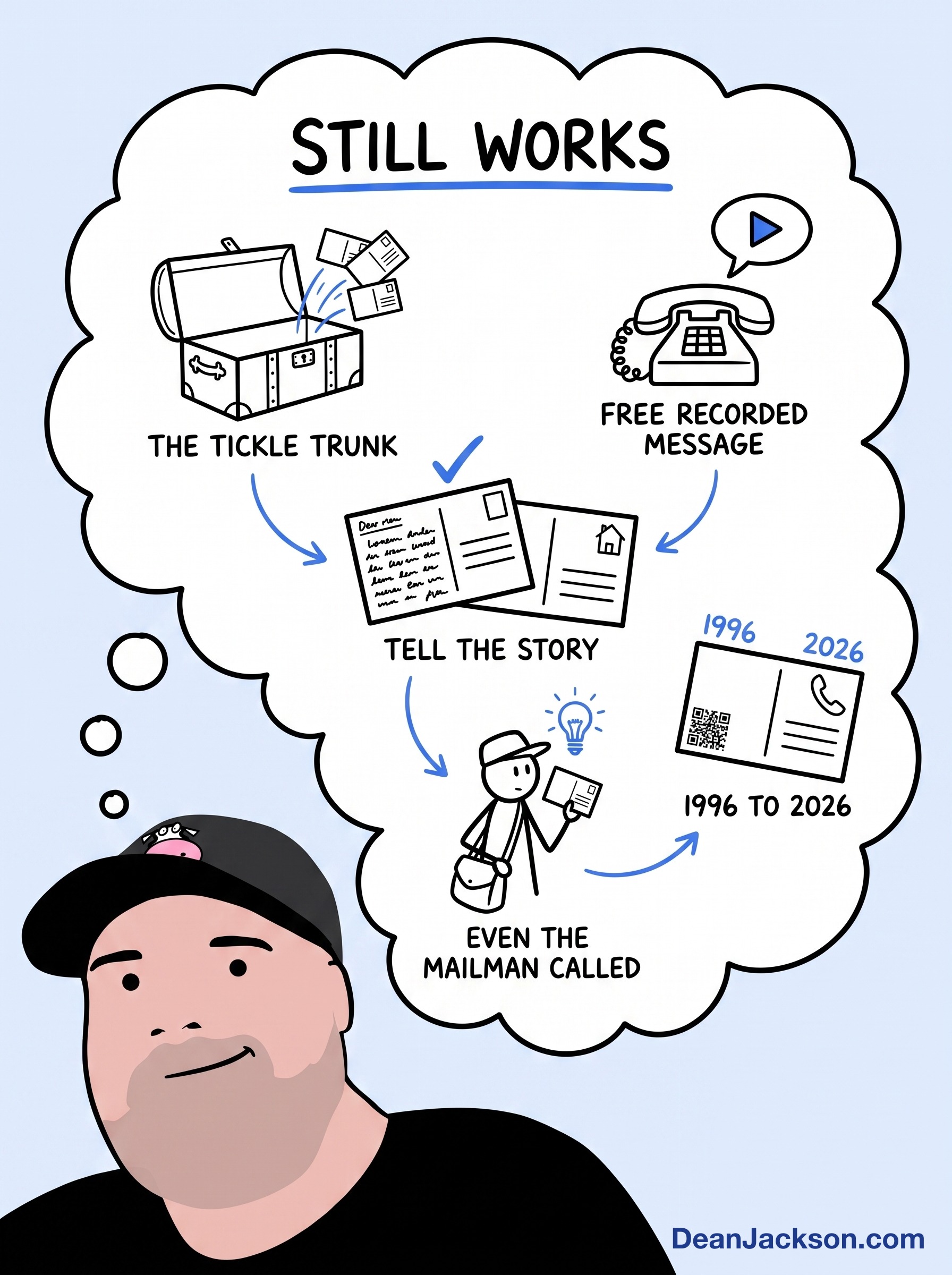
Straight out of my tickle trunk: the 1996 postcards and free recorded messages still pulling in 2026, and why the constraints made the copy so good.
Good morning.
I brought some props with me today.
I called it my tickle trunk, the way you say something you assume everybody knows... and I was today years old when I found out not everybody grew up with Mr. Dressup. My Canadian friends will know exactly what I mean.
I keep red archival boxes. Dozens of them. Every project I've done over my whole career, sitting in those boxes.
And this morning I've been in journal number three again. We're at the end of 1996, moving into 1997.
I'd talked in an earlier video about recorded messages... those three magic words, free recorded message. And somebody left a comment saying, oh yeah, those were the good old days. They used to send 20,000 postcards a week with nothing but a call to action to hear a 90-second message.
Here's what I thought when I read that.
These are the good old days.
Because looking back at what we had to work with, the thing that made it all so good was the constraint. Constraints force your creativity.
Print or direct mail. That was the entire menu.
I found the original guide to Winter Haven in the box. Same logo as the guide to Halton Hills I'd made a couple of years earlier, the one that became Toronto and Beyond. Eleven by seventeen, folded down to letter size. A little letter inside from a very young Julie Matthews, circa 1996.
We even put a price legend in it so I wouldn't have to reinvent the whole guide every time the market moved. Just shift the categories.
And every bit of it was laid out by hand. Pasted-up photographs. This is right before real desktop publishing. Getting one of those printed and out into the world was an effort.
But every single one of them pointed at the same thing. Call and listen to a free recorded message.
That was the lowest friction way for somebody to get information without feeling like they had to talk to a real person. And it took the burden off you having to be sitting there to answer the phone every time.
Then came the postcards.
Any time Julie got a new listing, that was an opportunity. We'd mail the neighborhood around that home.
And we didn't send a picture of the house. We told the story.
Do you know what your neighbors at 365 East Thelma Street did last night? It may come as a surprise to you, but they've been plotting for a long time.
Then the whole thing unfolds. They've decided to sell. They listed with Julie because they saw how fast she'd been selling homes around there. Three bedrooms, two baths, pool, almost 3,000 square feet, a family room that measures 30 by 30. Sits on a double lot running all the way from Thelma to Echo, deeded separately, you could build another home on it.
If you know anyone thinking of buying in East Lake Alfred, be sure to tell them about this one.
And the PS. If you're going to sell your own home in the next six months, Julie has a special report called How to Sell Your House for Top Dollar Fast. Call 1-800 whatever, 24 hours, for a free recorded message.
Run that card through the seven-step checklist. Single target market? Yes, the neighbors of that listing. Headline that draws you in? You know what it's about from the first line. Conversational language? It reads like news, not like an ad.
The just sold cards worked the same way. Your neighbor Mrs. O'Brien got exactly what she deserved... and it could happen to you next.
Then we tell you what she deserved. A buyer for her beautiful home, less than 90 days after she put it on the market.
Here's the test I'd use on any of it.
Would you hire somebody to stand at that person's doorstep and say out loud what you've put on your postcard?
You'd never. Most realtors are mailing a big photo of the property, the words JUST SOLD, a logo, a name, and call Julie and start packing.
But a story is a very compelling thing to find in your mailbox.
My favorite proof of that. One of the first times we mailed those cards, Julie got a call from the mailman who'd been delivering them. He'd read one, written the number down, and called her because he wanted her to sell his house.
He and his new girlfriend both had homes to sell, and they bought one together. Three transactions. From the guy carrying the mail.
And none of this is nostalgia, that's the part I want you to hear.
These are still the same postcards we use. To this day. The message is still as relevant as it was in 1996.
We did it for the Mosquito Authority. Your neighbors the Valentes got exactly what they deserved... and it could happen to you next. Then the story about the Valentes getting their yard treated and having a mosquito-free backyard. On the back, the offer. Absolutely positively no mosquitoes in your yard, guaranteed. Period.
And people still call the recorded message.
So do recorded messages still work today? Absolutely.
Do postcards still work today? Absolutely.
They're at the core of any message you want to put in front of a very specific group of people.
The only thing that's really changed in 30 years is that now we can put a QR code on the card next to those same words. More ways for somebody to respond. Same message doing the work.
So here's your nudge for today.
Take the last thing you mailed or emailed to your people, and read it out loud at an imaginary doorstep.
If you'd be embarrassed to say it... go and write the story version instead.
Transcript
Auto-generated transcript, provided as supporting material. It may contain errors, and speaker labels are occasionally mis-attributed.
Good morning. And as much as I hate the phrase I was today years old, I was today years old when I learned that not everybody grew up with Mr. Dress Up as a television personality. I was saying to Josh today, I brought some props here and I called this my tickle trunk.
And the, you know, I grew up in Toronto, so my Canadian friends will all completely understand when I talk about Mr. Dressup as a uh I think he had this u it was a wonderful Canadian child show that we all grew up with. And he had this thing that he called his tickle trunk. And I've said that those words.
I say it to people like everybody knows what a tickle trunk is. But I turns out not everybody knows about Mr. Dress up. But what I'm going to share with you today is stuff exactly from my tickle trunk of wonders.
I keep these red archival boxes. I have dozens of these boxes of all of the projects as an archive of everything that I've done over my entire career here. And as I was looking through, you know, we're in journal number three. It's coming up on the end of 1996.
We're moving into 1997. And I was talking in an earlier video about the using recorded messages and using those words, free recorded message. And when I look back on it, somebody posted a comment about, "Oh yeah, those were the good old days." They were talking about how they used to send 20,000 postcards a week with just a call to action to call a recorded message for a 90-second recorded message.
And I thought to myself, you know, these are the good old days. Like I I look back at it now and I think part of what was so amazing was that having constraints forces your creativity. So, I'm going to show you some of the ways that we used the postcards and the recorded messages over the um you know, as it evolved cuz remember back then this is all that was available. I found this.
This is one of the original guide to Winter Haven. And this is identical to the one even the same logo that I had with the guide to Halton Hills that I made in uh that was the genesis of of Toronto and beyond. And in this little, you know, 11 by 17 pages that fold into uh, you know, 8 1/2 by 11s. On the inside, we'd have a little letter from, look at this, a young Julie Matthews here, circa 1996.
And we'd have some uh legend of what the prices were. So, we I thought ahead that I didn't have to reinvent the guide every uh year whenever prices change. So we would put a legend of what the prices were and then we would have the uh the category the price legend price range B so that you could as the market went up or down we could adjust them there. But I when I look back at this every how difficult it was, how much of a um how much of an effort it took to create something like this and get this ready for the world.
I mean, these required doing all this uh, you know, individual layout, pasting up these pictures cuz this is really right before the age of true kind of desktop publishing, you know, but getting these printed, that's the the guide that we would use and everybody that would call to get it would call and listen to a free recorded message. And when I was talking about my checklist for uh ads, the big thing that we used was that free recorded message because it was the least friction way for somebody to get information without feeling like they're going to have to call and talk to a real person. And it took the burden off of you having to be available to answer the phone every time um someone called. So everything that we did used these free recorded messages.
And when I look back at our options, everything was about how can we get people to call and listen to this recorded message. And so the things that we had at our disposal then were print or direct mail. So, we could run print ads using that sevenstep checklist that I talked about in a previous video, and we could do postcards and go directly to the people that we know might be candidates for what we're doing. So, this I always I love to have this.
This is if this is like the uh Smithsonian of of all of my marketing uh stuff. This is the genesis. This is like one of the uh originals. One of the things that we did using these postcards was whenever Julie would get a new listing or any realtor would get a new listing, we looked as an opportunity to send just listed cards where we would mail around the neighborhoods of those uh of that home.
And here's the the story. We would tell the story. You could put this through the sevenstep checklist of have we selected a single target market? We got the neighbors of the uh things.
Do we have a headline that draws people in? You can tell what this is about just by the headline. We're using conversational language. It looks like news.
And so we would tell the story, do you know what your neighbors at 365 East Thelma Street did last night? It may come as a surprise to you, but they've been plotting for a long time. Your neighbors at 365 East Thelma Street have decided to sell their home and they listed it with Julie Matthews of Brokers Realy. They called Julie because they saw how quickly she had been selling homes in their neighborhood.
Now that they've made the decision to sell, they need your help to do it. The house is a three-bedroom, two bath pool pool home with almost 3,000 ft of living area, including a family room that measures 30 by 30. The unique thing about this house is that it sits on a double lot that goes all the way from Thelma to Echo. The extra lot is deed separately and be can be used to build another home.
If you know anyone who's thinking of buying a home in the East Lake Alfred area, be sure to tell them about this special home on East Thelma. If you're PS or we had the thing, if you're going to sell your home in the next 6 months, Julie has prepared a special report called How to Sell Your House for Top Dollar Fast that she'd like to offer to you or anyone you know for a free copy of this handbook for home sellers. Just call 1 800 for a 24 hours for a free recorded message. In the meantime, your neighbors would appreciate it if you kept your eyes and ears open for a buyer for their home.
So, this was the model of postcard number one that we did of the these. Now, there have been thousands of these postcards sent out. To this day, the are still the same postcard that we use. The message is still as relevant and we still use the words free recorded message except now in 2026 we have the opportunity to use a QR code that can go directly to a website.
com or whatever the address of the property is. We have more ways that people can respond to something. But at this point, we're using these magic words of free recorded message. And then we had the same thing for just sold postcards.
Instead of remember using conversational language, I would ask, would you hire somebody to go and deliver the message that you're putting on the postcard at their doorstep in person? And you would never. Most realtors are just sending a card with a big picture of the property and then just sold and then their logo and their name. You know, call Julie and start packing or whatever the things are.
But this story is a very compelling thing to get in your mailbox. So the just solds say your neighbor Mrs. O'Brien got exactly what she deserved and it could happen to you next. And then we just tell the story about what happened to Miss O'Brien.
You may remember less than 90 days ago, your neighbor put her house on the market. Well, she got what she deserved a buyer for her beautiful home. And again, we tell a little bit about it. Free recorded message.
And we would send these out around every listing. And here's the funniest thing is one of the first times that we sent these out, Julie got a call from the mailman who was delivering the postcards in the neighborhood. He had seen them. He wrote down the phone number and he called Julie because he wanted her to come and sell his house.
And he had a new girlfriend at that time. They bought a house. She had a house to sell and they bought a house together and that was all transactions because the mailman saw these postcards and called Julie. So I think that when we look back on it the core things stay the core things stay and I think we get a little bit distracted.
You know, even a modernday thing like we've adopted this model for we did this for the mosquito authority where we sent out your neighbors, the Valentes got exactly what they deserved and it could happen to you next and we tell the story about the Valentes having the mosquito authority come and treat their yard and they got a mosquito-free backyard. And then here's on the back, we had the offer for absolutely positively no mosquitoes in your yard, guaranteed. Period. But we also had people just call the recorded message.
So, do recorded messages still work today? Absolutely, they work. Do postcards still work today? Absolutely, they still work.
They're at the core of any message that you want to deliver to a very specific group of people. So, I'm excited to uh have my little tickle trunk here and uh there's lots to share. I got probably three or four videos to share things from uh from the tickle trunk. So, stay tuned.
I got a funny email the other day from Rick. It says, Dean, question. are you saying you can teach me to make fat stacks by hanging out at a pub drinking coffee like you? And I laughed to myself because I was thinking, you know, yes, I I can do that.
That's what I do. is the funny thing. What I really realized is that every idea that I've had, every dollar that I've made over the last 30 years has gone through my brain, through my pen onto a piece of paper in my journal before it went out into the real world. And if I can turn people on to that activity as a driver for what to do, what to think about, what to ask yourself to draw out, what the next most valuable action is for you, and how to find the most profitable things that you can install in your business.
I'm all for it. So this Friday at 100 pm I'm going to do for the first time a 50inute profitfinder workshop and you're going to join me live on Zoom and we're going to go through a 50inute exercise. Bring your pen. Bring a notebook or piece of paper.
And I'm going to guide you through a thinking process that will help you identify where the lowest hanging fruit is in your business and maybe some fruit that you didn't even know was there. But I'm going to show you where to look for it. So, it's free. It's for you.
m. this Friday. Just watch. Go to What did we call the website, Josh?
>> 50inut profitfinder. m.
Get BreakthroughDNA Free
Discover the 8 Profit Activators that can transform your business. Get the complete framework, free.