How to Know What To Do When Something Goes Wrong With a Customer
Watch
Listen
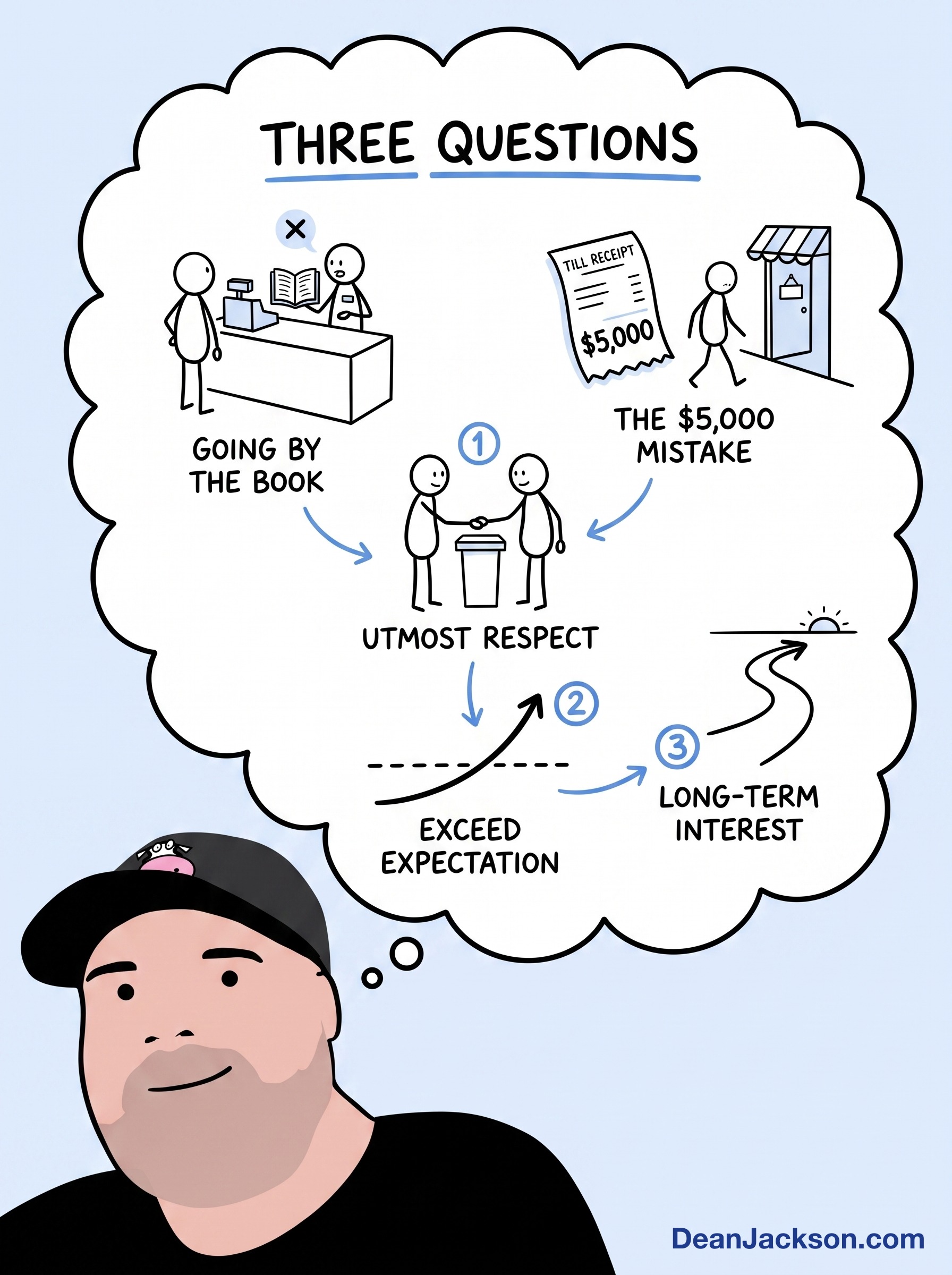
Three questions Steve Kross gave me thirty years ago for when something goes wrong with a customer, and the $5,000 mistake a KFC cashier made unknowingly.
Good morning.
If you're growing your business, you're going to involve other people.
And once other people are involved... things are going to go wrong sometimes.
The real question is whether everybody already knows what to do when they do.
I was looking through journal number three this morning and found a page from Steve Kross.
Steve was a Century 21 broker in New Jersey. Ran a very successful office. He'd come and speak at the big seminars I was doing around the country with Joe Stumpf.
A gentleman in every way. And full of wisdom about how to handle the business.
He used to tell a story about a Kentucky Fried Chicken.
An older gentleman had been coming in every week for a long time. Same order every time.
Then one day the counter is busy, the cashier is brand new, and what this man always got was a little outside the way things are normally done.
So the new employee goes by the book. Says no.
And has no idea he just made a $5,000 mistake. Because alienating your best customer is never a small thing... it just never shows up on the receipt.
That's why Steve had three questions. If everybody in the organization is aligned around them, everybody knows what matters in the moment.
Question one. From the customer's point of view, am I treating this customer with the utmost respect?
Not taking a hard line. Not flexing authority. Not because I said so, or that's not how we do it here.
Question two. Am I exceeding the customer's expectation?
When somebody comes to you with a complaint, they're already carrying an expectation of how this is going to go. Usually not a good one.
And if you lean into it, you're feeding exactly the thing they were braced for. The divide grows... in front of them, and in front of everybody else who's watching.
Question three. Is what I'm doing in the best long-term interest of the customer?
Sometimes that means making a concession you didn't have to make.
And sometimes it means letting a customer go. That can be the long-term interest too.
They say people might not remember what you said, but they remember how you made them feel.
I've passed this page a few times now in journal three. And every time, I remember how it felt to come at things that way. Resolving instead of defending.
The other use for the three questions is afterward.
Somebody on your team has been through a conflict. Sit down together and walk the checklist. Did we treat them with the utmost respect? Did we exceed what they expected? Was it in their long-term best interest?
That's how a team ends up with one unified way of handling things, instead of three people handling it three different ways.
So here's your nudge for today.
Take the last time something went wrong with one of your customers... and run it back through the three questions.
You'll know pretty quickly whether you handled it, or just survived it.
Transcript
Auto-generated transcript, provided as supporting material. It may contain errors, and speaker labels are occasionally mis-attributed.
Good morning. Listen, if you're growing your business and you're going to start involving other people, there's going to be times when things don't go right. And when everybody is aligned and knows exactly what to do in those situations from a culture standpoint or from a philosophical standpoint, that's going to be the best scenario for you. And as I'm looking through my journal, one of the things that I was very fortunate in going traveling around the country with Ab and doing the big seminars with Joe Stumpf, is I got to meet amazing business leaders that we'd have come and speak at the events.
I've mentioned Mike Hardwick from Churchill Mortgage. And another one of those gentlemen that used to come to the main events was a gentleman called Steve Kross. And Steve was a Century 21 real estate broker in New Jersey. Owned a very successful office there.
And he was just a really super I don't What's the right word? He was a gentleman in every way. And I I just I really got to know him and enjoyed spending time with him. But hearing his wisdom, he had a very wisdom approach to the way that he would uh that he would handle the business.
And he used to talk about three questions to structure your behavior, mostly in in conflict situations. Now, it's been 30 years since I'm I mean I get the exact uh elements of the story, but here's the direction of it that you know, uh he would paint the scenario that a uh it would at a Kentucky Fried Chicken uh restaurant, an older gentleman came in and he had been coming in every week for a long time and always got his this particular order and one day when he came in the restaurant or the cashier was very busy and new and didn't know who this gentleman was and what he normally got was outside of the scope of what was normally going on there and this new employee kind of was going by the book in denying not being able to do this and without realizing that the mistake that he was making was probably a $5,000 impact mistake because alienating people that are that are your best customers can be a huge impact downstream. And so he outlined these three questions that if everybody on the team if everybody in the organization is aligned in this, it helps align with what's the most important in any situation. So question number one was from the customer's point of view am I treating the customer with the utmost respect?
So that's first one is not to take a hard line or not to be flex authority or not to you know, because I said so or that's not the way we do it or any of those things is always think from the customer's point of view am I treating the customer with the utmost respect? Number two is am I exceeding the customer's expectation? When people come and voice a complaint or they voice a problem or an issue or anything that's going on. They have some expectation.
Maybe if they've had an experience with the company or with customer service in general, they may be thinking and not have positive expectation for it. And when you lean into it, that oppositional dynamic is exactly feeding what they were thinking was going to happen and it builds this divide between you and ultimately that customer. And by the way, everybody around who's seeing what observing what's happening. And then question number three is what I'm doing in the best long-term interest of the customer?
And so that's a really interesting thing where sometimes it does make sense if to make concessions in certain situations where it's in the long-term best interest of the company. And there's also times where letting a customer go is also in the best long-term interest of the company. And I it's so funny because you know how when they often say people they might not remember what you say, but they remember how you made them feel. And I was remember as I was looking back on this page in my journal and I've passed it a few times in journal number three here.
Then I always remember fondly that the way that that made me feel of of knowing coming from a a place of avoiding that conflict and resolving it more importantly in in any situation. So, short, but I think those three things are uh can be very impactful from the customer's point of view. Am I treating the customer with the utmost respect? Am I exceeding the customer's expectations?
And is what I'm doing in the best long-term interest of the company? And often that's a great way to review what happened in situations. If somebody is uh has been through a conflict on the other side of it with somebody on your team, to go through that checklist and see did we handle this in the best possible in the best possible way? So, you're going to have conflict if you're growing your business.
You're going to have other people having a unified way to attract or to uh treat those situations is going to be a very helpful thing. I got a funny email the other day from Rick. It says, "Dean, question. Are you saying you can teach me to make fat stacks by hanging out at a pub drinking coffee like you?"
And I laughed to myself because I was thinking, you know, yes, I I can do that. That's what I do. Is the funny thing, what I really realized is that every idea that I've had, every dollar that I've made over the last 30 years has gone through my brain, through my pen, onto a piece of paper in my journal before it went out into the real world. And if I can turn people onto that activity as a driver for what to do, what to think about, what to ask yourself to draw out what the next most valuable action is for you, and how to find the most profitable things that you can install in your business, I'm all for it.
m. I'm going to do for the first time a 50-minute profit finder workshop and you're going to join me live on Zoom and we're going to go through a 50-minute exercise. Bring your pen, bring a notebook or piece of paper and I'm going to guide you through a thinking process that will help you identify where the lowest hanging fruit is in your business and maybe some fruit that you didn't even know was there, but I'm going to show you where to look for it. So, it's free.
It's for you. m. this Friday. Just watch.
Go to What did we call the website, Josh? >> 50-minute profit finder. com and I'll get you all the details and hopefully you can join us then. m.
Get BreakthroughDNA Free
Discover the 8 Profit Activators that can transform your business. Get the complete framework, free.