Think Big. Start Small. Keep Going.
Watch
Listen
January 1997, journal four, a page listing every business under one category... plus what I'd tell my thirty-years-ago self about finishing just one of them.
Good morning. This is the big day.
January 1997. Winter Haven, Florida. Journal number four, and the page where I move to Florida full time.
And here's something I wish I'd known thirty years ago.
Back then I was a kid in a candy store. So many possible businesses. So many markets. I always loved finding the edges of a thing... where are the boundaries, how big could this get.
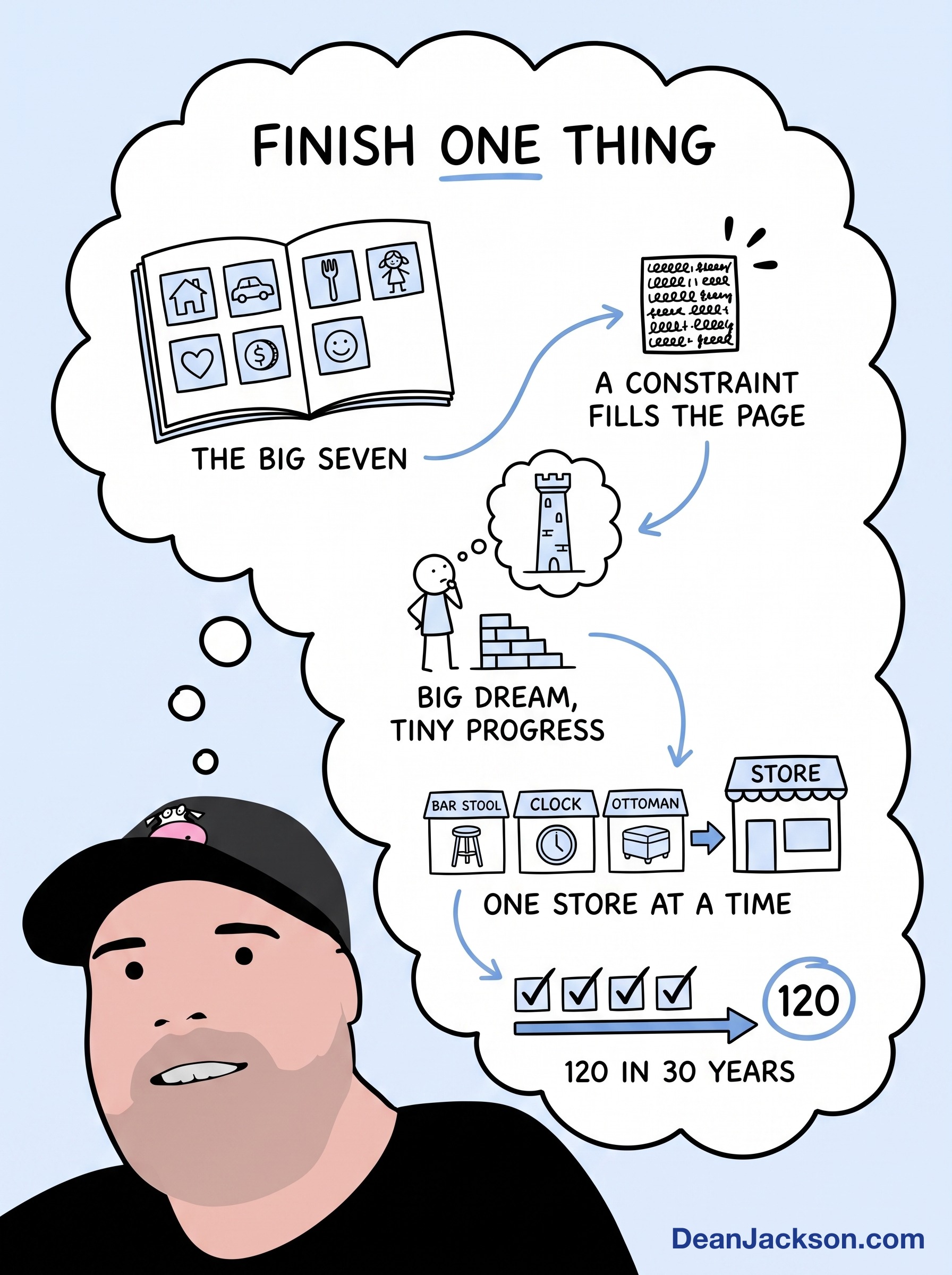
I'd already worked out that there are only seven major things people spend money on.
Home. Cars. Food. Kids. Health. Money. Me.
Everything anybody spends money on fits into one of those seven.
So in the journal I gave myself a page per category, and filled it.
Under home alone: buying a home, renting one, the mortgage, the home inspection, furniture and accessories, electronics, painting the house, paint and wallpaper, carpet, carpet cleaning, garage doors...
That's the thing about a constraint. Put one on a brain that generates a lot of ideas, and it goes and finds everything that fills that bucket.
My ADHD brain loved it. Like a puppy in a field of fresh snow. Everywhere you run, it's untouched.
Then overlay all of it with the one-to-one future. Because the centerpiece of all seven of those is one person. One household. One relationship.
Infinite possibilities.
But here's the part I got wrong.
I spent a lot of time thinking about how big something could be... and a lot less time completing one of them.
Because time moves at the speed of reality. 60 minutes per hour.
Every word on that page had to come through my pencil one word at a time. I can't instantly finish anything.
Now think about Wayfair.
Before Wayfair was Wayfair, they didn't build Wayfair.
They built one complete e-commerce brand that sold bar stools. Only bar stools. Site, infrastructure, all of it, up and running.
Then grandfather clocks. Then ottomans. Then speaker racks. Every category with enough in it to be a big thing on its own.
270 individually profitable brands. Then they rolled them all up and... tada. Wayfair, with everything already built out.
That's the advice I'd give thirty-year-old me.
Instead of thinking about the vastness, think about the depth.
Take one. Build it all the way out. Let it run. Then take the next one.
From the base up, not from the top down.
Because I'd been living in the future for so long, imagining the whole finished thing, that working in the present felt slow. Almost like living in the past.
But your brain doesn't really care what it's working on... as long as it's clear on what it's working on. You get to innovate and imagine inside the one thing you're focused on right now.
So picture where I'd be if I'd taken one of them and built it all the way out. Then another one the next quarter. For thirty years.
That's 120 of them. Done.
That's a very different world.
And here's your nudge for today.
Take one of the things you've been imagining in full... and build it all the way to done.
Transcript
Auto-generated transcript, provided as supporting material. It may contain errors, and speaker labels are occasionally mis-attributed.
Good morning. This is the big day. 1997 January, Winter Haven, Florida. This is the big transition.
This is the time I moved now full-time to Florida. And here's something that I wish I knew 30 years ago. I was right about the I I've spent so much time thinking about marketing and thinking about markets and potential businesses. I was like a kid in a candy store that you know there's so many possibilities of things that I could do and I always love to like get the boundaries like test where are the edges of something.
Let's get the whole universe here. And I mentioned in an earlier journal that I've discovered and realized that there were only seven major things that people spend money on. They spend money on their home, on their cars, on food, on kids, on health, on money, and on me. And every of everything that people spend money on fits into one of those seven categories.
And I was looking through the uh you know I was going through and each page you know I put a whole page where I would just list all the possible businesses that we could help underneath the home category. And we were just having breakfast with some friends from Australia today and we're talking about AI and you know home service how what things that are changing and things that are not going to change. And as I looked through this list, just in the home category, all the money, the business opportunities, the the marketing opportunities specifically under the home category, people, you know, I made just made this exhaustive list of things. people, they buy a home or they rent a home or they get a mortgage, uh, home inspection, furniture and accessories, electronics, painting the house, paint and wallpaper, carpet, garage doors, carpet cleaning, all you know, you can imagine that when you set a constraint for yourself, and this is often what I would do in my journals is you when you have a brain that is capable of coming up with a lot of ideas.
When you put a little constraint on it, you now find all the content that fills that particular contextual bucket. And it's it's fun. And I don't know, maybe because it was like um you know, my ADHD brain just like you know, like a puppy running through a freshly snowed field where you just everywhere you go, it's fresh new snow. And that's the way that my mind would work.
And you could instantly see possibilities. Now I'm using these big seven as a as a um illustration of it because the intersection of where do people spend money and the onetoone future because what the the nexus the be the the centerpiece of all of these seven ways that people spend money all relate to one person to one relationship one household And that to me when I overlaid all of that with the onetoone future became infinite possibilities especially when I layer on top of that all the things that I know about marketing now what I know now is ra I spent a lot of time and a lot of energy thinking about how big something could be like all of the possibilities My brain works like an improv theater. Yes. And and and this and and and and until you run out and exhaust all of the things within a category.
And again, we can shapeshift and we can imagine all of these things completely finished, but the reality is is getting something applied, getting something done in the real world takes real time. And time moves at the speed of reality, 60 minutes per hour. You can only, you know, every word that I wrote here, I had to write one word at a time through my pencil. I can't instantly complete all of these uh tasks.
So, I spent a lot of time thinking about what the possibilities for something could be and less time working on completing one of them. And I caught myself the other day that if I could give this advice to myself 30 years ago, I'd be in a completely different situation. I was explaining to somebody cuz I can identify it in other people when they're thinking about I could do this, I could do this, I could do this. com.
com is this huge juggernaut of selling homegoods online. But the real story about how Wayfair became Wayfair was that they started out before they ever combined everything. com and build out a complete website a complete e-commerce brand that only sold bar stools. Then they did the same thing with grandfather clocks and then ottomans and speaker racks and every category that had enough that it could be a big thing on its own.
They individually went to work, set them all up, set up the infrastructure, got them to the point where they're completely built out and they're completely running. Then at the end of that they had 270 super profitable individual brands rolled them up and tada wayfair is there with already everything built out. So I thought to myself if I could take rather than seeing this model built out in every market in the country with the uh you know advocates using the onetoone future language it's a big lifetime uh project but if I could go back and look at this Taking one of these and building it out and then letting that one run is taking them to completion and building from the base up rather than spending all my time thinking from the top down. Because I would find that because I've spent so much time living in the future and ideiating and imagining a future that I could see completely to me and maybe it's just my ADHD brain, but to me working in the present felt super slow and like living in the past in a way.
it was there was not not the same energy as going the uh going that path. But now I'm also finding that now because your brain doesn't My brain hopefully I'm speaking for everybody that your brain really doesn't care what it's working on as [clears throat] long as it's clear on what it's working on and you can innovate and ideulate within the thing that you're currently uh focused on. So I imagine where we would be today, 30 years later from uh when I was having these thoughts, if I had just taken one of them and built them all the way out and then continued to layer and maybe one per quarter, building those out over 30 years, that'd be 120 of these that were uh done. That's a a very different uh it's a very different world.
So that's a insight. That's a big insight. I'm going to start seeing these uh recurring themes um coming up. I recognize it now.
But that would be my advice is imagine what instead of vastness thinking about depth of what you could do taking one of them and getting it all the way to completion. I got a funny email the other day from Rick. It says, "Dean, question. Are you saying you can teach me to make fat stacks by hanging out at a pub drinking coffee like you?"
And I laughed to myself because I was thinking, you know, yes, I I can do that. That's what I do. is the funny thing. What I really realized is that every idea that I've had, every dollar that I've made over the last 30 years has gone through my brain, through my pen onto a piece of paper in my journal before it went out into the real world.
And if I can turn people on to that activity as a driver for what to do, what to think about, what to ask yourself to draw out, what the next most valuable action is for you, and how to find the most profitable things that you can install in your business. I'm all for it. So this Friday at 100 pm I'm going to do for the first time a 50inute profitfinder workshop and you're going to join me live on Zoom and we're going to go through a 50inute exercise. Bring your pen.
Bring a notebook or piece of paper. And I'm going to guide you through a thinking process that will help you identify where the lowest hanging fruit is in your business and maybe some fruit that you didn't even know was there. But I'm going to show you where to look for it. So, it's free.
It's for you. m. this Friday. Just watch.
Go to What did we call the website, Josh? >> 50inut profitfinder. m.
Get BreakthroughDNA Free
Discover the 8 Profit Activators that can transform your business. Get the complete framework, free.