9 Journal Prompts for Thinking Through Anything
Watch
Listen
People keep asking what I do in my journal. Here are the nine prompts, off a page from 1997, that turn a blank notebook into where your ideas start.
Good morning.
1997, journal number four. By now I'm becoming a professional journaler. I'm really getting into this.
And since I started doing these videos, people keep asking me the same question. What do you actually do in your journal?
Turns out thirty-year-old me already answered it. There's a page in here where I made a list of the things to journal about.
So let's tally them up.
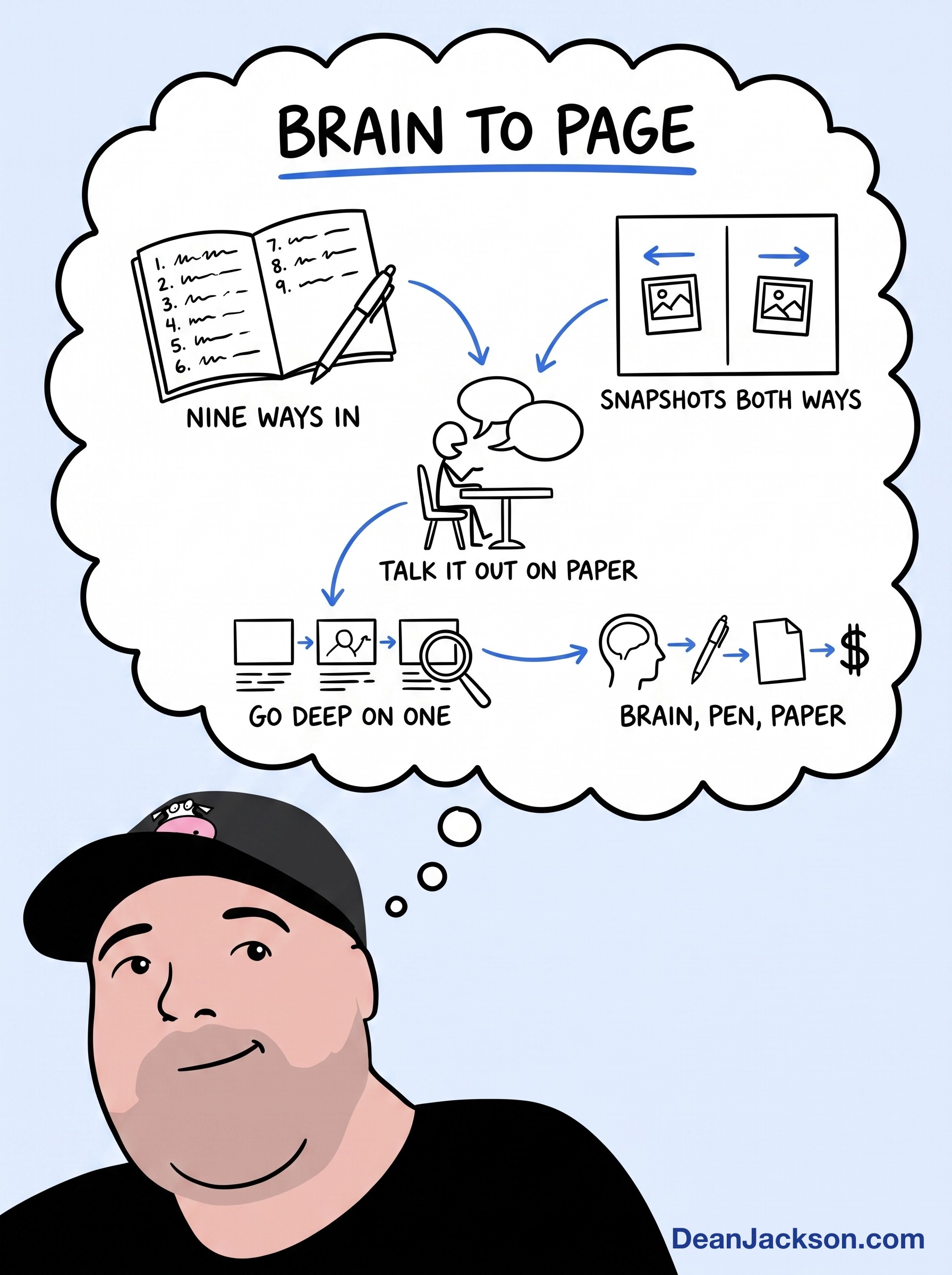
One. Snapshots of life, as it's happening.
That first journal is full of places I'd never been. Palm Springs. I read those descriptions now and I'm immediately back there. You're anchored to the moment.
This journal opens with the drive down to Florida. January. My friend Steve and I left in the most horrible snowstorm, a complete whiteout, 20-car pileups the whole way. We only got as far as Windsor the first night.
I'd forgotten all of it. It's right there on the page.
Not in a dear diary way... well, kind of in a dear diary way. Just the observations you make and the feelings you're feeling.
Thirty years from now, you're going to be thankful you took the time.
Two. Snapshots of the future.
Ultimate scenarios. Writing out a vignette of what it's going to look like when it's done.
My friend Cameron Herold calls it a vivid vision.
What's the picture on the cover of the puzzle box you're trying to put together?
Because the clearer you are on that, the more specific your mind gets about how to make it happen.
Three. Conversations with myself.
Most of the bulk pages in these journals are full dialogues. Me working something out on paper.
And it's the gift you get to enjoy twice. Once while you're doing it. Again thirty years later, when you get to see the way you were thinking.
Four. Mind maps, flowcharts, storyboards.
Visual planning.
I don't want to give it away yet, but there's a very special page coming in this journal. The very beginning of the 8 Profit Activators.
That came out of storyboarding. Flowcharting the process, spotting the benchmarks, then putting some creative thinking against them.
Five. Things that drive me crazy.
I love these one-question pages. Ask the question, then list 5 or 10 or more.
Then pay attention to what keeps recurring. And on your buffer days, come back to the list and ask what you could do to get rid of some of it.
Six. What do I want?
A future shopping list.
A Porsche 911 keeps presencing on mine around this time. Spoiler alert.
And you can point that question anywhere. What do I want in this situation? What do I want for my life? What do I want for my days?
Seven. How can I...
Fill in the blank.
Whenever you pose a question to your mind, you're immediately drawn to fill that vacuum with an answer.
You're querying your brain.
This is 1997, remember. We always referred to our brain as a search engine, and we didn't even know what a search engine was yet.
Eight. The idea machine.
Take one specific segment of the storyboard and get deep. Just ideas around that one piece.
Looking at the home buyer timeline, one of the questions I asked was, how could I create an opportunity for somebody to refer us before the end of the transaction?
Well... think about what's actually going on. Somebody moves into a new house, and for the next 30, 60, 90 days it's the first topic of conversation with everybody they know.
We got a new house. You have to come and see it. We're living over there now. We just moved.
Every conversation they're having is about this new vector in their life.
That's a great time for people to refer.
Nine. Things I've learned.
I read a lot. I've always read a lot. And I'm constantly processing it in the journal so I can distill the best parts of it.
Writing it out by hand reinforces it. And it lets me collide what I'm reading with everything else I'm reading.
The one-to-one future, crossed with the seven things people spend money on, crossed with real estate agents. That combination turned into something really valuable.
People also ask when to journal. It doesn't really matter. It just has to be an integrated habit.
I do it almost every morning. I've got a great environment for it. And I feel lost if I don't have my journal to keep writing things in.
I got a funny email from Rick the other day. Dean, question. Are you saying you can teach me to make fat stacks by hanging out at a pub drinking coffee like you?
And I laughed to myself, because... yes. That's exactly what I do.
Here's what I really realized though.
Every idea I've ever had, and every dollar I've made over the last 30 years, went through my brain, through my pen, onto a piece of paper in my journal, before it ever went out into the real world.
So here's your nudge for today.
Pick one of the nine. Put it at the top of a blank page.
And just start.
Transcript
Auto-generated transcript, provided as supporting material. It may contain errors, and speaker labels are occasionally mis-attributed.
Good morning. Okay, so 1997 journal number four. By now, I'm becoming a professional journaler. I mean, I'm I'm really getting into this.
And uh I've had people ask me since I've been doing these videos like, "What do you do in your journal?" And so I'm going to share because I happen to make a list of things to journal in one of the pages in journal number four and we'll tally them up at the end. So here's a list of x number of things that you can do. Um one of the things that I find very useful reflecting on them now is these snapshots of life of the interesting things that were happening to me.
Um, you know, in the first journal I was sharing a lot about because it was the first time that I'd been to a lot of places like going to Salelo and going to Palm Springs and seeing these things and reading these vivid kind of descriptions bring me immediately back there. So, you're anchored to those moments. I I mentioned that this journal is the beginning of 1997 and that was my transition to Florida. I was moving down now to Florida full-time and we drove down my friend Steve Hansinger and I drove and I'd forgotten about this but going through I was describing it was January when we left and it was like the most horrible snowstorm like it was complete white out.
There were 20 car pileups on the way and we left and the we only got to Windsor the first night, but I was count recounting this whole thing um of what was uh what was happening. And it was just so great to be able to document that journey going to Knoxville and Savannah, Georgia. and I can relive those moments in a way that if I thought about them, I might be able to do it. But looking back at it from 30 years, you're going to be thankful that you took the time to just kind of snapshot and not in a like dear diary way, uh, but in kind of in a dear diary way of looking and just kind of making the observations that you make and the feelings that you're feeling, especially if they're like peak experiences or outlier experiences or sometimes negative negative experiences, things that you want to kind of just get your your thoughts out there.
So that's the way number one is the snapshot of life that as it's happening. Number two is creating snapshots of the future. And I've talked about the ultimate scenarios of imagining just going forward and drawing, writing out a vignette of what it's going to look like. What what is the what is the cover on the box of the puzzle that you're trying to put together?
What's that going to look like? What's your vision? My friend Cameron Herald talks about your idea of creating a vivid vision. And the more clear you are on what something is going to look like when it's completed, the more um specific your mind gets in coming up with ideas on how to make those things happen.
So creating those snapshots and ultimate scenarios for the future are fantastic. Number three is conversations with myself. And I've found like a lot of this journal and a lot of the the bulk pages that are happening in these journals now are full dialogues with myself as I'm working things out. And it's very helpful because again you get now looking back it's the gift that you get to enjoy twice.
You get to enjoy it as you're doing it but it's also a gift when you're looking back at it. Like I can say looking back from 30 years to now is a uh it's really great to be able to see the way I was thinking and the things that I was um rolling over in my mind. Number four is creating mind maps or flowcharts or story boards visual planning of things. I don't want to give it away, but the um there's a very special page in this journal where we've got the um the very beginning of the eight profit activator.
So, I'm going to save that for later. But that came from storyboarding, flowcharting the um the process recognizing benchmarks so that you can put some creative thinking to how to make those things um happen. Another uh one of my number four four way is four or five things that drive me crazy. I like these one question pages where you just ask a question and then list five or 10 or more things like one of them one of those great questions is things that drive me crazy.
And so if I started, I would pay attention to things that were recurring um things that consistently um come up and then I would wait I would look on buffer days and look to see how could I make my how could I make those things better? What could I do to um get rid of uh some of those things? Number next is what do I want? That's a great thing if you just make a list.
I remember so in writing here and I'll share some of these with you, but I would write down things that what I want as like a future shopping list. So, this is you're starting to see these things creeping up like a Porsche 911 keeps presencing in the things and spoiler alert, it's coming up very soon here as I'm moving down to Florida. But that was a thing that started on the journal of what do I want? And you can define that any way.
What do I want in this situation? Or what do I want for my life? What do I want for my days? Another question that I ask is how can I and then ask that question whatever it is how can I and fill in the blanks and whenever you pose a question to your mind you're immediately drawn to fill that vacuum by getting an answer it's like querying your your mind here right and this was you know pre Google I keep thinking 1997 we always refer to our brain as a search engine and but we didn't even know what what was a search engine in 1997 right so looking back I see the the journey of just asking a question that can be um that can direct your mind into coming up with answers then I call this idea the an idea machine.
And I mentioned it where I would take specific things, take a specific segment of a story board and really get deep into creating ideas around that specific segment of the um of the idea. Like when we look at when I look at the uh timeline story boards of the home buyer experience, one of the things, one of the questions that I would ask is coming up with ideas of how could I create an opportunity where people refer somebody to us before the end of the transaction. And that leads to the thinking of well what's going on? Well, when somebody is buying a house, the as soon as they move in the next 30, 60, 90 days, it's going to be the first topic of conversation with everybody that they know.
Oh, we got a new house. Oh, you got to come and see the house. Oh, we bought a house. Oh, we're living over in there.
We just moved. all of the conversations that they're having are going to be about this new uh new vector change in their life that they bought this new house and when those conversations come up that's a great time for people to refer. So I was thinking about all of those um ideas there and then the next thing is things I've learned. So when I look at this, I would keep I read a lot and I still read a lot all the time and I'm constantly processing what I'm learning in my journals so that I can distill the best parts of what I'm learning, but I'm also reinforcing it by writing it out by hand and I'm comparing it to the other things that I'm also reading like when I was talking about the the intersection of the one to one future and the seven veins of consumption the seven things that people spend money on and the real estate agents that combination becomes a really valuable thing.
So there is some number of things that you can either start with or add to your journaling sessions. And oh one thing that people often ask is well when do you journal and you know it doesn't matter really when it's just an integrated habit. I like I journal almost every morning is the thing that I'm doing. I've got a great environment for doing it and I'm constantly um I'm constantly I feel lost if I don't have my journal to continue to write things.
So, uh I think getting in the habit will be a great gift for you. I got a funny email the other day from Rick. It says, Dean, question. are you saying you can teach me to make fat stacks by hanging out at a pub drinking coffee like you?
And I laughed to myself because I was thinking, you know, yes, I I can do that. That's what I do. is the funny thing. What I really realized is that every idea that I've had, every dollar that I've made over the last 30 years has gone through my brain, through my pen onto a piece of paper in my journal before it went out into the real world.
And if I can turn people on to that activity as a driver for what to do, what to think about, what to ask yourself to draw out, what the next most valuable action is for you, and how to find the most profitable things that you can install in your business. I'm all for it. m. I'm going to do for the first time a 50inute profitfinder workshop and you're going to join me live on Zoom and we're going to go through a 50inute exercise.
Bring your pen. Bring a notebook or piece of paper. And I'm going to guide you through a thinking process that will help you identify where the lowest hanging fruit is in your business and maybe some fruit that you didn't even know was there. But I'm going to show you where to look for it.
So, it's free. It's for you. m. this Friday.
Just watch. Go to What did we call the website, Josh? >> 50inut profitfinder. m.
Get BreakthroughDNA Free
Discover the 8 Profit Activators that can transform your business. Get the complete framework, free.