How to Get Referrals While You're Still Doing the Work
Watch
Listen
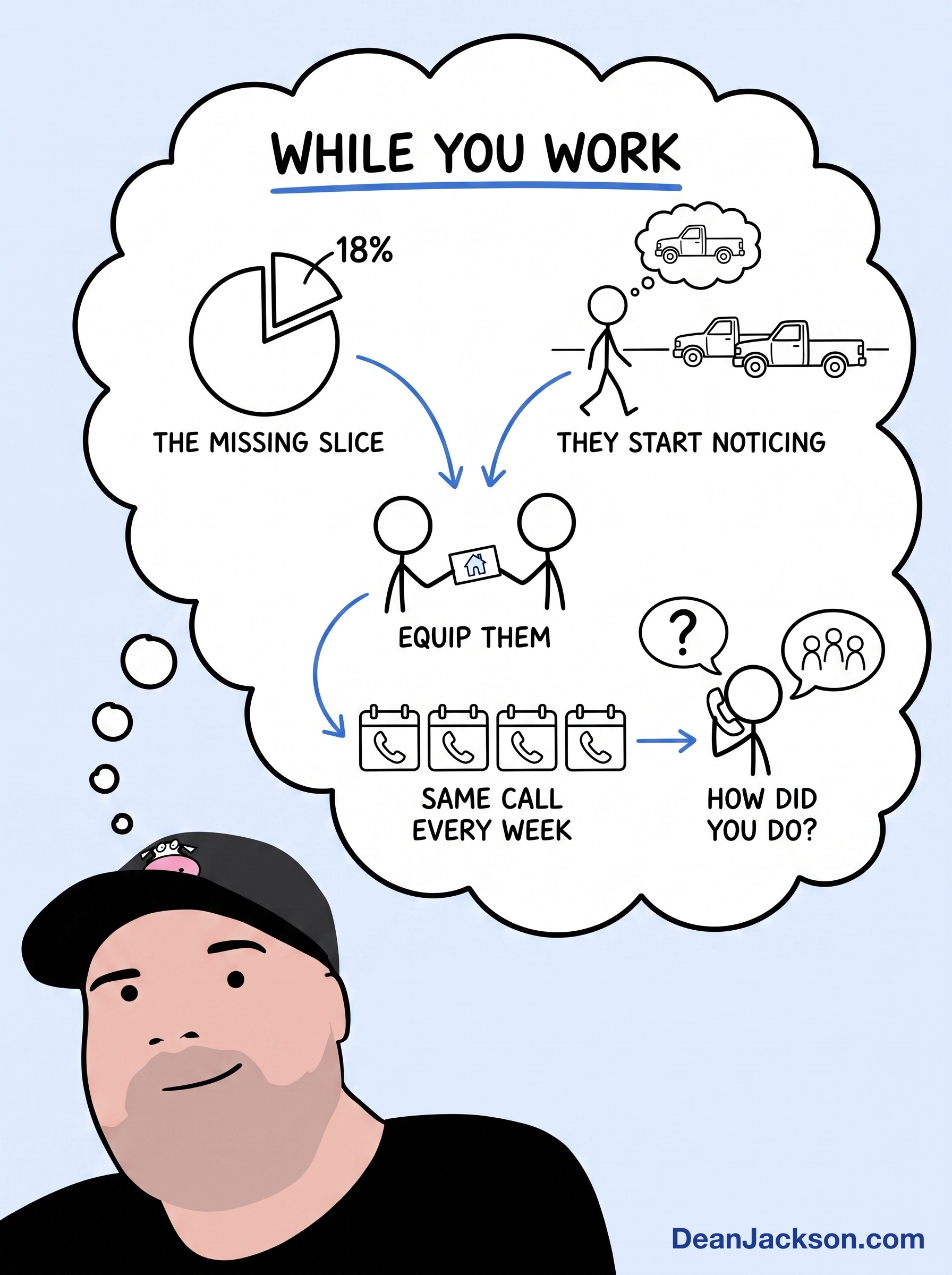
A 1997 page on turning one listing into more than one transaction: the weekly seller call, the one question at the end, and why customers notice for you.
Good morning from Honeycomb.
January 1997. Journal number four. And the heading at the top of today's page is: here's how to get referrals from your listings every single week until they sell.
Thirty-year-old me was pretty pleased with that headline.
But this is the page where something bigger started. The beginning of thinking about the people you're already working with as multipliers.
We call it your multiplier index now. Back then it was just a question... how do I turn this one listing into more than one transaction?
Here's the setup.
Every year the National Association of Realtors surveyed home buyers and sellers on where the buyer came from. Signs. Ad calls. There was no internet yet, remember.
And one slice of that pie chart was direct or indirect referral. Someone who knows someone who knows someone.
18%.
Almost a fifth of the market, and most agents were doing nothing about it. Put it in the MLS, stick a sign in the yard, maybe run an ad. Then wait.
So we built the whole thing around that missing 18%.
It starts at the listing appointment. You show the sellers where buyers actually come from, you show them that slice, and then you ask them for one commitment.
Keep your eyes and ears open for anybody buying or selling a home while we've got your house on the market.
Then you explain why that's going to be easier than they think.
The reticular activator. The part of your brain that notices what's relevant to you right now.
It's why pregnant women see pregnant women everywhere. It's why the day you drive home a new red pickup truck, everybody else got a new red pickup truck today, too.
The sign goes up in the yard, and suddenly they're hearing real estate conversations they'd have walked right past a week ago.
You don't have to convince anybody of this. They already know it's true.
Then you equip them.
We gave every seller little business cards with a picture of their house on them and a recorded message number to call. Property flyers to hand out at work. Little flyers for the lunchroom board.
And by the way... all of our other sellers are out doing the same thing for you.
Now here's the core of it.
We called every seller, every single week, at the same time. Which is just good business. They want to know what's happening.
But the call had a structure, and the structure never changed.
We had six showings this week.
Here's what the agents told me their buyers said.
Here's what sold this week.
Because we framed every listing as a horse race. If somebody's in the market for a house like yours, there are 5, 10, 20 viable options. That's your field. We identify it on day one so you know exactly who you're running against.
Here are the new listings. New competitors just entered your race.
Here's what's coming up. Three showings arranged, an ad in Homes and Land, classified ads running, and this many people called the recorded message.
And we got a referral from the Smiths, another one of our sellers, so I sent them information on your house.
Every week. Same order.
Then you ask one question.
How did you do this week?
And then shut up.
The first time, it's awkward. What do you mean, how did I do?
Well... who did you hear about? Any conversations this week?
But I guarantee you the next time you ask it, they're ready. Oh, John from my office, his brother's looking, I gave him one of the cards.
That's it. That's the whole system.
I wonder how many referrals that generated across the thousands of agents who used it. What I wonder more is how many of them ever actually ran it.
Because it only clicks once you see what's really going on in the transactional period.
While you're building somebody's deck, decks are all they talk about. The neighbors notice. The crew out front gets noticed. They're showing the renderings at work.
Somebody buys a new car and for the next 90 days it's the first thing out of their mouth.
Your customers are having those conversations right now. Whether or not you've given them anything to do with them.
So here's your nudge for today.
Open your journal and ask yourself... how could I create a referral opportunity while somebody is still doing business with me?
And if you can make it self-serving for them, even better.
Transcript
Auto-generated transcript, provided as supporting material. It may contain errors, and speaker labels are occasionally mis-attributed.
All right, good morning from Honeycomb. Get fully caffeinated because today is going to be a good one. Okay, we are January 1997 and everything that I'm doing is thinking about I wake up every day thinking about how can I improve the real estate business of all of our members all over the country, but I get to do that through one realtor locally in Winter Haven. So I was saying, you know, I you've heard me mention working with Julie Matthews and part of this is using having what Michael Gerber would call your franchise prototype.
One of the big things that has been shaping my thinking here is creating a business that you're going to duplicate 5,000 times. So, I'm always looking at the micro uh steps along the way and going deep on those things, putting out the story boards. And one of the story boards that we have is when somebody lists their home with you, you are in the that the story board of get that home sold once it's on the market. And I laughed because to the heading on today's journal page is here's how to get referrals from your listings every single week until they sell.
Great headline. I love that whole idea. But this was the genesis, the beginning of thinking about the opportunities as multipliers. What we would call now your listing multiplier index and what we call with all the other businesses that we work with is your multiplier index.
How can you turn the current people that you're working with right now into even more uh in even more business? So, we orchestrated a full system and I'll explain the real estate system to you so that you can see what parts of this might apply to you. It was a great thing. The the National Association of Realtors, NR, every year they would do a survey of home buyers and sellers and they would show the source of where buyers came from.
And there was always you know signs was one, ad calls was another. Uh there was no internet at this point. So it wasn't like internet which would be most of the things now. Um is one of the uh the pie one of the pie pieces in that pie chart was something that was called direct or indirect referral.
And that was 18% of the time homes were sold by direct or indirect referral, which means someone who knows someone who knows someone, right? That that kind of thing. So when our objective was to turn this listing into multiple transactions while getting it sold, we would set the stage at the beginning by letting the sellers know where buyers come from and how we're addressing all of those uh things. So, we're laying out the marketing plan and then we're showing this little 18% part that what most realtors do is they put it in the MLS and they put a sign in the yard and maybe they advertise it, but they're missing out on almost 20% of the opportunities about by not orchestrating direct or indirect referrals.
So explaining that to the sellers and saying to them, we would have this language. I might be a little rusty on the language uh now, but essentially saying that one of the advantages that we have is I'm going to ask you to make a a commitment, the same commitment that all of our sellers make is to keep your eyes and ears open for people who are buying or selling homes in the period while we have your house on the market. And then we would explain the concept of what's called the reticular activator. And the reticular activator is the part of your brain that notices things that are relevant to you.
It's the reason why pregnant women see other pregnant women. And if you just got your new red pickup truck today, you notice that everybody else got their new red pickup truck today because it's relevant. and that's what's on your mind. So, as soon as people put their house on the market, there's it elevates the conversations and the things that they notice about people who are in the process of buying or selling a home.
And so, when you present that and you share that idea with a seller, they're it's of course they're going to buy into that because it's exactly what happens. As soon as that for sale sign went up, you're going to notice that all everybody else is moving, too. And what we do is equip the sellers with a way to give people information about their house. We're enrolling them, equipping them with everything they would need to give to somebody who they hear is going to be uh is talking about real estate.
So, we would give people these little business cards that had a picture of their house on it and the recorded message about their house so that they could get information about that house. Cuz remember, there's no um there's no internet for people to go to to get what we have now as an instant openhouse, but we'd equip them with all of the things. We would give them the uh property flyers about their house so that they could hand them to people at work. We would give them little flyers to put up in the lunchroom to put wherever to help spread the word that your house is for sale.
And by the way, all of our other listings are doing the same thing. So, we set the stage that way. But then here's the the real core of it is we would call sellers every single week at the same time with an update. And that's just good business.
They want to be updated. They want to know what's going on. But we would structure the call in the same way. So I would call and say, "Hi Josh, it's Dean.
I just wanted to keep you up to date on what's been uh on our progress." And then we would just go through sequentially. We had six showings this week and this is the uh I talked with all the agents because they want to know the house is being shown. They want to know what the feedback is from the agents.
So we'd say I talked with the agents and this is what they said. So we're providing the feedback that the market is telling us what it is. Then we give updates on what's happened. This is what sold this week.
Whenever we would list a house, we would put we would frame it as a horse race that we're looking to get our house sold before all of the other competitors in the field. that if you look at it, there's a handful of homes that are if somebody's in the market for a house like yours, there are 5 10 20 homes that are viable options like yours. So to understand to narrow the field that if you have a townhouse in this complex that first of all any other town houses just like yours in the complex any other town houses in the market that's your competitive field and we identify that and isolate it for people right at the very beginning in the same way that somebody now looking at horse farms that's not in that's not a competitor of yours. So, we look at it and say, "This is what sold this week."
We update the board in terms of this is the ones remember this one over here just sold. And we get the the price on that. Then we say, "These are the new listings. These are the new competitors that have entered the field in your race."
Right? So, we've got the the structure now where we're going, These are the shows we had. This is what the agents said that their buyers have said. This is what sold this week, what's changed in the market.
These are the new listings that have come on the market. This is what's coming up on the uh in the next week here. We've got three showings arranged. We've got an ad coming out in the Homes and Land magazine.
We've got classified ads being run this week. We've got the um um info box uh flyer there. This is how many people called and listened to the recorded message. All of the activity there.
And then if we're saying if any of the other sellers, we got a referral from the Smiths that are looking for a house in the whatever their price range is. So I sent them information on your house. And this is where the collaborative effort of all of your sellers who are looking, they're tuned in, their reticular activators are on high alert and they're noticing people who are talking about selling. Maybe somebody is looking for a townhouse just like yours and they are able to uh to keep that open.
And here's how we harvest that. We go through all of those things and then we just ask a question. How did you do this week? And then shut up.
How did you do this week? And the first time you ask it, it's super awkward because you don't know. They might, what do you mean, how did you do? Oh, well, who did you hear that is thinking about selling?
How did any conversations that you had? And I guarantee you the next time you ask that question, they're going to be prepared with when you say, "How did you do this week?" Then they say, "Oh, well, John from my office, he said that his brother's looking for a house and I gave them your information or I gave them information about the thing." We sent them, we handed out all of these uh cards about our house.
We're getting them enrolled that together collaboratively we're working to get that last 18% effort. We're not just relying on putting it in the MLS and getting uh and somebody else doing the work. We're orchestrating away. Now that complete system, I wonder how many referrals this system has generated among the thousands of agents that have used this.
But what I also wonder is how many of the agents actually do something like this. And it only comes when you really understand the value of what's going on in the transactional period. While people are doing whatever it is you do, while they're getting their deck built, there's going to be lots of conversation around decks there. Your particular activator is going to be open to that.
You're going to notice construction crews in other areas. Your neighbors are going to notice that you're getting something done. You're going to be talking about it at work. You're gonna maybe show the renderings of this.
You're going to show all of these uh things. You're going to be having those conversations. Same thing. You just got a new car.
You every the first, you know, 30, 60, 90 days after that, it's all you're going to be talking about. So how the translation for you is to think in the transactional period while people are doing business with you. What ways could you set up to orchestrate that when they hear people having conversations about whatever it is that you do that there is a way for them to introduce you to that person. And if you can make it self-serving for them, even better.
That's the biggest uh that's the biggest thing. So there's so much opportunity in the multipliers within your business while you're doing business, but it just takes a little orchestration and thinking. Write it down in your journal. Ask yourself, how can I create referral opportunities while somebody's doing business with you?
and see what your mind comes up with. I got a funny email the other day from Rick. It says, "Dean, question. Are you saying you can teach me to make fat stacks by hanging out at a pub drinking coffee like you?"
And I laughed to myself because I was thinking, you know, yes, I I can do that. That's what I do. is the funny thing. What I really realized is that every idea that I've had, every dollar that I've made over the last 30 years has gone through my brain, through my pen onto a piece of paper in my journal before it went out into the real world.
And if I can turn people on to that activity as a driver for what to do, what to think about, what to ask yourself to draw out, what the next most valuable action is for you, and how to find the most profitable things that you can install in your business. I'm all for it. So this Friday at 100 pm I'm going to do for the first time a 50inute profitfinder workshop and you're going to join me live on Zoom and we're going to go through a 50inute exercise. Bring your pen.
Bring a notebook or piece of paper. And I'm going to guide you through a thinking process that will help you identify where the lowest hanging fruit is in your business and maybe some fruit that you didn't even know was there. But I'm going to show you where to look for it. So, it's free.
It's for you. m. this Friday. Just watch.
Go to What did we call the website, Josh? >> 50inut profitfinder.
Get BreakthroughDNA Free
Discover the 8 Profit Activators that can transform your business. Get the complete framework, free.