How To Use Constraints as a Multiplier
Watch
Listen

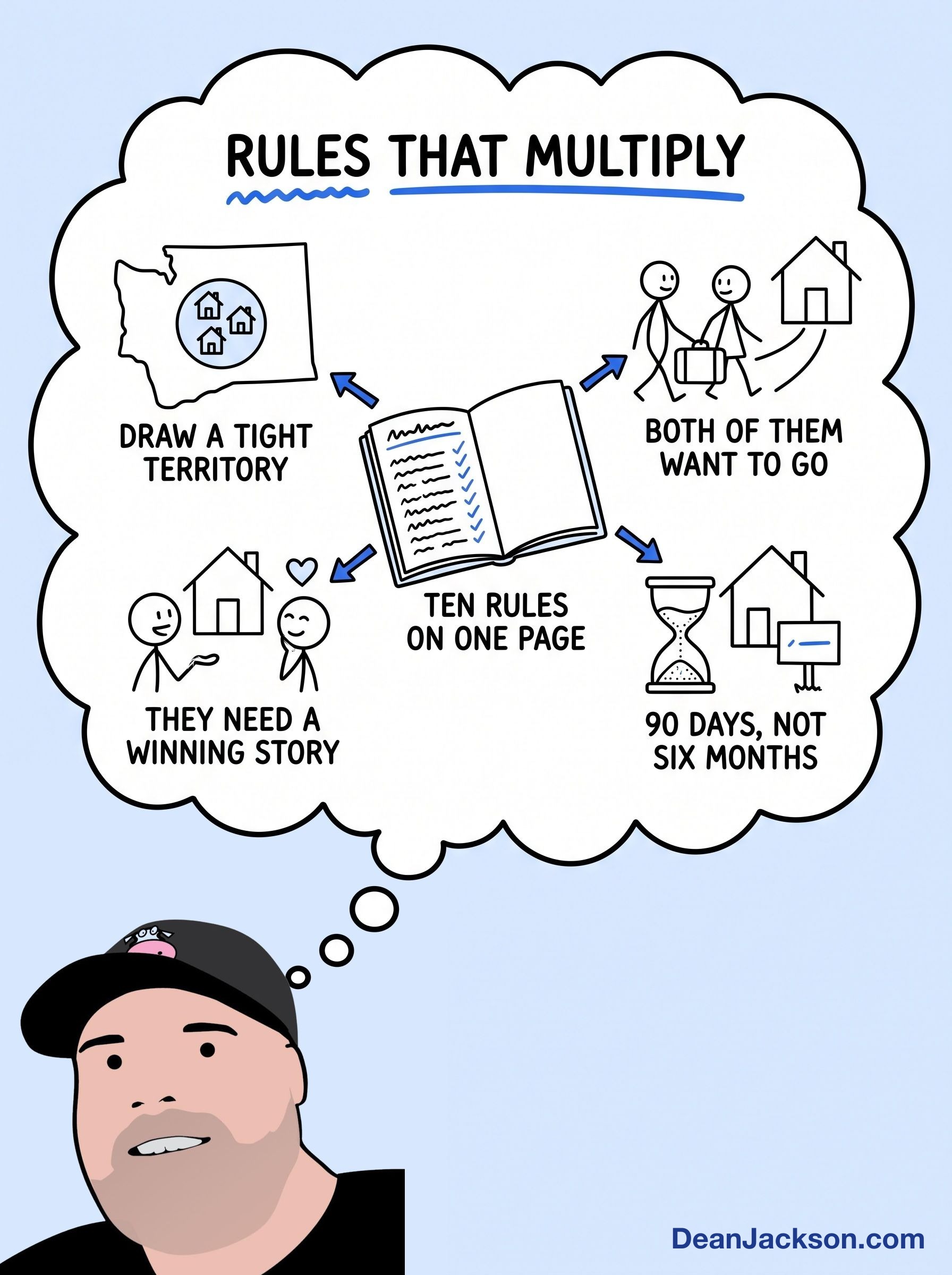
Ten rules from a 1997 journal page for who Dean would take on as a client, and why constraints on who you work with are a multiplier, not a limiter.
Good morning.
Rules sound like a limiter.
Constraints on how you do business, on who you'll take on, on how long you'll work at something... they feel like they can only cost you.
They're the opposite.
They're one of the greatest multipliers you've got, because they quietly remove the opportunities that were never going to work out anyway.
Let me show you what I mean.
There's a page in my 1997 journal titled Rules for Good Listings.
I'd been practicing this in my own business and overlaying it on everything I was learning at the time.
Deming, on the stability of a system and taking the friction out of it.
And my own experience, which was simpler than that. When a listing didn't work out and I went back and looked at why, there was usually a pattern.
Here's the uncomfortable part.
In the back of my mind, I usually knew. Right at the start, I knew that one wasn't set up to work.
Now, before the rules, the thing that makes any of this possible.
When you've got a system that generates all the leads you need, you stop operating out of scarcity.
You've got abundance instead. And abundance means you get to be selective.
You can't set standards for who you work with until you've got more people than you need.
That's really what the lead generation is for.
So here they are. And read them as clients or customers rather than listings, because that's the whole exercise.
Number one. Geographic area limits.
In my final years selling real estate, the tighter I drew my area, the more money I made.
We could theoretically have covered Caledon and Hillsburgh and Erin and every outlying town.
Choosing to focus on Georgetown and Halton Hills was a freeing decision. I didn't have to stay on top of the inventory anywhere else.
Number two. At least neutral in condition, or willing to get there.
Some of the listings I took early on were dumps, or so packed with stuff you couldn't see the house.
When you're starting out you take them anyway, because it's a foot in the door.
Neutral just means clean and clutter free. I'm not talking about renovating. I'm talking about nobody walking in and being repelled by the work ahead of them.
Number three. Motivated to move, and in agreement.
The best situation is somebody with a job transfer who has to be in Calgary by a certain date.
Motivated, and both of them excited about going.
If one of them is driving the move and the other one really doesn't want it, the one who doesn't want it can quietly make sure it doesn't happen.
Number four. Priced within 3% of the selling price. No more.
I wanted to work with people who wanted to sell, and I wanted the house sold quickly.
The homes that sell faster and for more money are the ones priced closest to what they're actually worth.
Number five. Able to afford the move.
People have a dream of the bigger house or the place out in the country, and sometimes the math just isn't there.
If the whole thing depends on their house hitting a number, everything can fall apart very quickly.
Number six. Willing to participate.
Willing to do the things that give the house its best chance. When I showed them how to tap into the 18% of homes that sell by direct or indirect referral, they were on board.
Number seven. Listed for 90 days only.
This was a big one, and the constraint was on me as much as it was on them.
My home selling system was a system that got homes on the market and sold in under 90 days.
The temptation is to take an overpriced listing on a six month or a one year term. We'll test it at your price, and if it doesn't sell we can revisit it.
That's permission to be lazy. For both of you.
And saying you'll only take it for 90 days does something else. It tells them you mean the price you just recommended.
You've seen more homes than they have. You know what the market is doing right now, especially if you're concentrated in one area.
So when they want to test it high, being unwilling to sign for six months is the most reassuring thing you can do.
Number eight. Easy to show. Lockbox, no restrictions.
No we can't show it when we're not home. No we have to be there. No only on these days.
It needs to be available when buyers want to see it.
Number nine. A winning story.
I've told you about Jerry Spence, and the way we'd tell the story of a listing so a buyer had a reason this was the house for them.
The losing stories are the ones you hear all the time. We're not giving it away. We don't have to sell. If they want it they can pay our price. We've put a lot of money into this house.
All resistance. No power.
The winning stories sound like this. We got our dream job in Calgary and we have to be there by the end of next month. We found our dream home in the country and we need to sell this one to get it.
You'll win more if you let them feel like they're winning.
Tim and Darlene's townhouse sold for more than the asking price that way. We told people the situation, the dilemma, and what the house was worth.
Number ten. No roadblocks.
Nothing standing between where you are and getting this thing sold.
Now translate all of that into your business.
Is there a geographic constraint that would help you?
Is there a minimum standard somebody has to meet before you'll work with them?
Do all the partners or decision makers have to be on board?
Is there a budget somebody needs to have?
Is there a time frame you'd hold yourself to, out loud, in front of them?
Here's the exercise.
Take a page in your journal and write the rules that have to be true for your very best clients. The ones you get the very best outcome for.
Then use them two ways. As selection criteria... and as the thing that keeps you grounded when you're tempted.
It sounds paradoxical, winning by having constraints.
But the constraints are exactly what free you up to go as fast as you can.
I got a funny email from Rick the other day. Dean, question. Are you saying you can teach me to make fat stacks by hanging out at a pub drinking coffee like you?
And I laughed to myself, because... yes. That's exactly what I do.
Every idea I've ever had, and every dollar I've made in thirty years, went through my brain and my pen and onto a journal page before it ever went out into the real world.
So I'm running the 50-Minute Profit Finder this Friday at 1pm. Free, live on Zoom, and I'll walk you through the exercise myself.
Bring a pen and something to write on. We'll go looking for the lowest hanging fruit in your business, and probably some fruit you didn't know was there.
And here's your nudge for today.
One page in your journal. Rules for good clients.
Start with the last one that didn't work out... and write down the rule that would have kept you out of it.
Transcript
Auto-generated transcript, provided as supporting material. It may contain errors, and speaker labels are occasionally mis-attributed.
Good morning. Sometimes having rules and constraints on the way that you do business or the people that you do business with seems like it would be a limiter but it can be the greatest multiplier in your business because it removes the outliers of opportunities that are not going to work out. Let me explain what I mean. So, in uh today's journal, this is 1997, I have a page titled Rules for Good Listings.
And I'd been thinking a lot about this because I had both been practicing it in my own business, but I was overlaying it on a lot of the things that I was learning. I was learning from Deming about the stability of a system and removing friction from things. And I learned from my own experience that sometimes when a listing didn't work out or and you can just think about this as a client or a a customer or somebody that you're going to work with. If you look at the things that don't work out, sometimes you see a pattern of specific reasons why.
And even though you took on the business, you may have in the back of your mind known that this wasn't set up for success. One of the greatest benefits of having a system that can generate all the leads that you need is that you are suddenly faced with instead of a scarcity situation, you're faced with an abundance that you are now getting to be more selective in the people that you work with. So, I was looking and man, a lot of these things would be exactly the things that I would look at today and it's the things that we um train our real estate agents to to focus on. So rule number one is geographic area limits that in my area in the final years of me selling real estate.
I found that the tighter that I made my geographic concentration the more money I made because I lived as I said in Halton Hills. We could theoretically go our territory included Kaledan and Hillsburg and Aaron and all these outlying areas. But the more that I made the decision to focus my attention on just the primary area of Georgetown in Halton Hills. That was a freeing decision because now I didn't have to stay on top of all the inventory in the other areas.
I could do the things that I could do because I was only focused on this uh this geographic area. Number two was at least neutral in condition or willing to bring it to neutral. So, there's a lot of this stuff that sometimes the listings that I would take were just dumps or they were so packed with stuff that hoarders or whatever the thing was. And sometimes when you're starting out, you want to do business with people because it's a foot in the door.
It gives you a listing. But when you realize that's going to be a big block, that became a standard. So we look at it and really make that decision that they have to be willing to do whatever it takes to get something into at least neutral position, which means clean and clutter-free. I'm not talking about people, you know, renovating or doing expensive u things, but at least that it shows neutral that nobody's going to look at it and be repelled by the amount of work that they're going to have to do.
Number three, and this was an important one, that they're motivated to move and in agreement, that there's some reason for the move, that they are moving. You know, the greatest thing is somebody who has got a job transfer and they've got to be in Calgary by a certain date. So, they're motivated and they're both the couple excited about making the move. If one couple is one of the couple is driving this and the other really doesn't want it.
I got into certain situations where the you know the the partner that wasn't on board could passive aggressively sort of make things difficult for uh for the move. So be filtering and looking for those things that they're motivated to move and in agreement. So when I look at this and I'm thinking how would you apply this to your business, these rules are something like is there a geographic constraint that would help you? Is there some level of um minimum standard for somebody that you would work with?
Do all the partners or the decision makers in a company have to be on board uh with what you're doing? Number four was priced within 3% of the selling price. No more. I made the decision that I want to work with people who want to sell and I want to get the house sold quickly.
And I realized in doing all the analysis that homes that sell faster for more money are ones that are priced closest to what their actual uh market value or selling price is going to be. And that's a big uh that's a big win if you can make that for yourself that maybe there's a certain budget that somebody has to have to be able to work with you to do something. Number five is able to afford the move. So sometimes people have these dreams that they want to get this uh bigger house or they want to move out to the country, but when you do the math, it's not realistic for them.
That their house is not going to be what it's worth to make the move. And if they're counting on, well, we need to get this much money in order to buy this one, everything can fall apart very quickly. So being able to afford the move was one of the rules for me. six was willing to participate that people are, you know, I talked about our uh listing multipliers in a a earlier video and if I got a sense that people were willing to do the things that would need to be done to give their house the greatest chance to sell, that would be a uh a big thing.
So when I would present the idea of how to tap into that 18% of homes that sold by direct or indirect referral, they were on board and willing to uh to help in that way. Seven was listed for 90 days only. This was a big one is that I was making a decision that my home selling system was going to be a system that gets homes on the market and sold in less than 90 days. Now, sometimes what realtors do, there's a temptation to take a listing that's overpriced and take a longer listing, 6 months or a one year listing and feel like, oh, we'll test it at your price and if it doesn't sell, then we can revisit the price knowing that they have that time to be lazy.
I wanted to have both sellers that were motivated to sell within that 90 days and I wanted to put that constraint on me too that I only took 90-day listings. And the first time that I've presented that to somebody, it's a u you know, it seems like it's a way of it brings some credibility to what you're saying that when you're presenting a price and you know what the price should be because you've seen more than any other uh more homes than they have. you know what the market is doing right now, especially if you're concentrated in a particular area that when they're trying to say, "Well, we can test it at the thing." If you're saying that you're only going to take the listing for 90 days and you don't believe that the house will sell at that price, that sort of commitment to it is a um reassurance I think to the the sellers that oh wow, he's not just if you say to them, I'm not I could tell you that we could test it and we could list it for 6 months, but that's not going to be the best thing.
And I show them all the research that homes that take longer to sell let end up getting less money than the homes that sell for closer to their asking price. Number eight was that it was able to be shown lockbox etc. that is easy to show. I didn't want to get involved in any listings that had a you know restrictions.
Well, we can't show it when we're not home or we have to be here when uh when people are seeing or you know, we're only showing it on this uh things. We need to be able to have it on the market and be available when buyers want to come and look at that house. Number nine for me was that they had a winning story. And you I told you about Jerry Spence and how I built this great way of telling the story of the listing so that we could compel the uh people to give them a reason why this house was going to be the one for them.
And I would compare I would show people that you know there are winning stories and there are losing stories. And the losing stories are we're not giving it away or we don't have to sell or if they want it they can pay our price or we've put a lot of money into this house. All those things are resistant not power stories. The best stories are we need to sell our house.
We got our dream job in Calgary. we need to be there by the uh by the end of next month or we found our dream home in the country and we're willing to uh sell it because we need to sell our house to get this one. All the things that are winning stories that give the buyer a story that's going to make them look like a winner. So, it's almost I would say to people, it's almost like you're going to win more if you let them feel like they're winning.
You're still going to get more than uh market value, but they're going to feel like they're winning. Just like the the townhouse that I helped sell for Tim and Darlene that we ended up selling for more than what the asking price is by telling people the situation, their dilemma, and what the uh what the house was worth. They ended up selling for more. So, if they're not willing to tell a winning story, that's going to be an uphill battle.
And then number 10 is no roadblocks. So if there's roadblocks in the way that they've got uh pets and there's only this or that there's a certain you know they're blocking times when they're not able to u show the house there should be no roadblocks or conditions in whether we can get this house sold. So I would recommend like if you think about it, who are the people, how would you describe the rules that must be present for your very best clients, the ones that you could get the very best outcome for. And it might be a really good exercise for you to do is take a page in your journal and just think about rules that would help you set standards for the kinds of people that you can use as a selection criteria and to keep yourself grounded.
And even though it sounds paradoxical that you can uh win by having constraints, it's going to free you up to go as fast as you can. I got a funny email the other day from Rick. It says, "Dean, question. Are you saying you can teach me to make fat stacks by hanging out at a pub drinking coffee like you?"
And I laughed to myself because I was thinking, you know, yes, I I can do that. That's what I do. Is the funny thing, what I really realized is that every idea that I've had, every dollar that I've made over the last 30 years has gone through my brain, through my pen onto a piece of paper in my journal before it went out into the real world. And if I can turn people on to that activity as a driver for what to do, what to think about, what to ask yourself to draw out, what the next most valuable action is for you, and how to find the most profitable things that you can install in your business.
I'm all for it. m. I'm going to do for the first time a 50inute profitfinder workshop and you're going to join me live on Zoom and we're going to go through a 50inute exercise. Bring your pen.
Bring a notebook or piece of paper. And I'm going to guide you through a thinking process that will help you identify where the lowest hanging fruit is in your business and maybe some fruit that you didn't even know was there. But I'm going to show you where to look for it. So, it's free.
It's for you. m. this Friday. Just watch.
Go to What did we call the website, Josh? >> 50inut profitfinder. m.
Get BreakthroughDNA Free
Discover the 8 Profit Activators that can transform your business. Get the complete framework, free.