How to Get New Customers in Any Market in 45 Days
Watch
Listen
The 1997 Dan Kennedy keynote that laid out the right message, the right market and the right media, plus the three-step campaign Dean built from it.
Good morning.
I was looking back through 1997 this morning, and there it is. The first time I ever met Dan Kennedy.
And if you've ever had the pleasure of meeting Dan Kennedy, you'll know what a lovable, approachable, huggable kind of guy he is.
I'm kidding, of course.
I was 30. He was maybe 41 or 42, and already a grumpy old man. In the best possible way. That's his thing.
It was a weekend retreat Terry Hunterfeld put on for his Gold Rush members, up in Grand Rapids, Michigan. Dan was the keynote.
Same weekend I met Joe Polish for the first time, as it happens.
A lot of history rooted in one room.
This is one of those seed moments.
I'd been studying Dan for years by then. Subscriber to the No BS newsletter, reading everything he put out.
Because in the early to mid 90s, he was what John Carlton would call action central for this new thing called the information publishing business.
There was no internet yet. Barely the start of one.
So the model was this. Pick a market. Write a full page ad. Run it in a magazine those people already read.
Get them to respond for a free report... then mail them a sequence of three things... then sell them a $697 or $897 marketing kit.
That's how Joe Polish started. Ads in a carpet cleaning magazine.
Terry was doing it. A lot of people were doing it.
And it's not far off what the Guide to Halton Hills was for me. Have people respond, then keep on educating them.
Here's what Dan gave us from the stage that weekend. Three things.
They're foundational, and they've held up for thirty years.
Number one. The right message.
That's where it starts, and it's the most important of the three.
He called it the USP. The unique selling proposition. You don't hear the term as much now.
It's the answer to one question. Why should I choose to do business with you over every and any other option that I have?
Get that right, get it so you can clearly say what you're going to do for somebody, and you've got your message.
Number two. The right market.
We don't want to broadcast your message out to everybody.
If you can carefully select the right people to receive it, that's 50% of the job. Right there.
That's exactly why the information publishing model worked so well. The ad ran in the carpet cleaner magazine. The realtor magazine. The homes magazine.
The people you can help were already gathered in one place.
And if you've got what we call visible prospects, you can simply get a list of them.
You can select them geographically. Geodemographically. Psychographically.
Fancy sounding words for something very simple. You can pick people by where they are, or by what kind of people they are.
If somebody rents, they're living in an apartment complex or a rental home in a particular part of town. That's selectable.
The clearer you can get on it, the better.
Number three. The right media.
Once you know what the offer is, and you know who's the best person to make it to, now you can choose the best way to get in front of them.
In 1997 that meant the right magazine, the right newspaper, the right classified section, or direct mail straight to the exact people you wanted.
There was a whole industry around list brokering and list selection. You could find precisely who you were looking for.
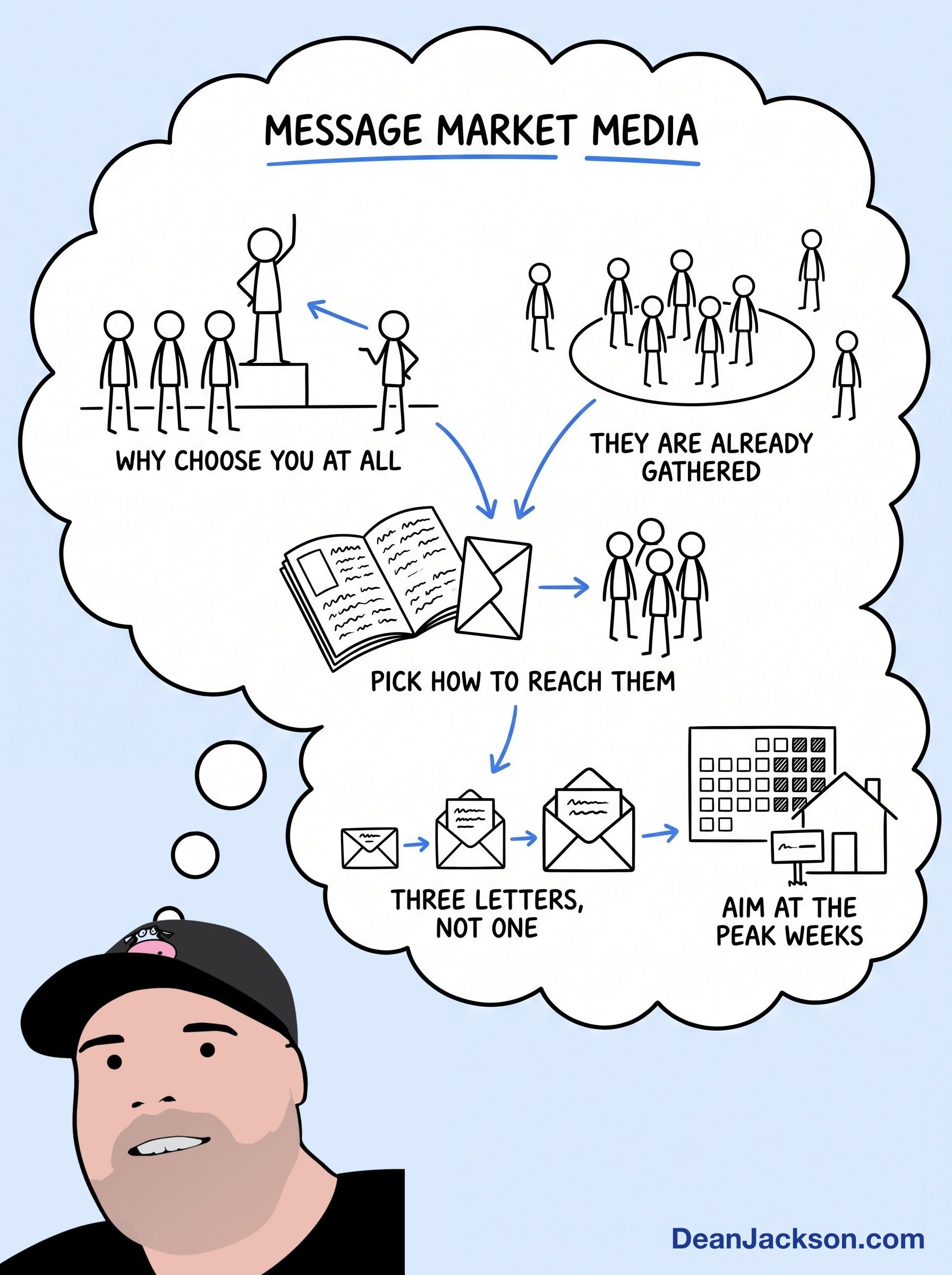
Message. Market. Media.
Then he amplified all of it with something I went away and implemented immediately.
He called it plant the seed farm.
Once you've picked the group of people you're trying to reach, here's how you get dominant market presence in 45 days. A three step letter campaign.
The way he first worked it out was something he called the Giorgio letters.
Picture a restaurant. You pick the people you'd most want to come and eat there.
And you make an offer that's specifically appealing to them. In this case, a romantic dinner for two. Wine, roses, the whole thing.
The letter arrives from Giorgio, the director of romance at Giorgio's Italian restaurant.
He invites you in, and he takes care of everything. You can prepay for all of it.
You arrive and there's the bottle of wine, the roses, the candlelit table, a beautiful meal, dessert. All handled.
And you get to be the hero.
If they don't book, letter two makes the same offer a different way.
And letter three is the one titled can this marriage be saved? Without the romance, none of the rest of it happens.
Three steps instead of one. That intensification was the whole win.
I took that idea and built a postcard campaign out of it.
Getting in front of people who were going to sell their home in a particular market area... right ahead of the time when most of the activity happens.
So instead of mailing every month for 12 months, we mailed for the 8 weeks leading into the peak.
Into the fall, when people list. And into the spring, when people list.
Same people. A fraction of the mailings. All of it landing in the weeks that decide the year.
It's fun to look back and see the seeds of everything sitting right there on the page.
I got a funny email from Rick the other day. Dean, question. Are you saying you can teach me to make fat stacks by hanging out at a pub drinking coffee like you?
And I laughed to myself, because... yes. That's exactly what I do.
Every idea I've ever had, and every dollar I've made in thirty years, went through my brain and my pen and onto a journal page before it ever went out into the real world.
So I'm running the 50-Minute Profit Finder this Friday at 1pm. Free, live on Zoom, and I'll walk you through the exercise myself.
Bring a pen and something to write on. We'll go looking for the lowest hanging fruit in your business, and probably some fruit you didn't know was there.
And here's your nudge for today.
Message, market, media... in that order.
Write down who you'd most want to reach, and where they're already gathered.
Transcript
Auto-generated transcript, provided as supporting material. It may contain errors, and speaker labels are occasionally mis-attributed.
Good morning. Okay, today I was looking through, we're in 1997. This is the first time that I met Dan Kennedy. And if you've ever had the pleasure of meeting Dan Kennedy, you know what a lovable, approachable, huggable kind of guy he is.
I'm totally kidding. I realize now in 1997 I was uh you know 30 and Dan Kennedy was probably 41 or 42 and he was kind of a grumpy old man then even uh as the uh as the thing in the best possible way. That's his thing. And I met him at uh Terry Hunterfeld had a weekend uh uh retreat for his gold rush members and the it's really this is one of those things that's like a seed because without Dan Kennedy like I've been studying Dan Kennedy for years.
I'd been a subscriber to his no BS u the Dan Kennedy letter newsletter and Dan in the early to mid90s was kind of what John Carlton would call action central for this new business called the information publishing business and you know we're at a point where there was no internet and uh it was just starting but the primary thing that people would do. They would pick a market, they would write full page ads that run in industry specific magazines. So, this is what Joe Polish started uh doing. He learned this model from Dan Kennedy of running ads in a uh carpet cleaner magazine, getting people to respond for a free report, and then mailing them a sequenced mailing package of three things, and selling them a $697 or $897 marketing kit, their course.
And that model was being used by a lot of uh a lot of different people including Terry Hunterfeld. So that when I met Dan, he already had kind of a really cool model that he was pioneering and in a lot of ways that using uh information as a way for people to respond was really what the um the guide to Halton Hills was about. It was a similar model. Have people call or have people respond and then continue to um educate them.
But Dan was the keynote speaker at at Terry's event in Grand Rapids, Michigan. And uh that's happens to be the first time I met Joe Polish uh too. So there's uh a lot of like history rooted in these moments that we're discovering here. But here's the three things that Dan Kennedy shared in his uh keynote that are right on track and they're foundational and we've talked about some of them, but Dan's number one thing was that you have to have the right message.
That's the most important. That's what it starts with. And he called this what was uh you know you don't hear this term as much now but it was the big term was a unique selling proposition a USP and that was the answer to the question of why should I choose to do business with you over every and any other option that I have. So, when you get your offer right, when you get what it is that you're going to do for somebody and you can clearly articulate it in the way we've been talking about for the last few uh videos, you've got your message.
When you get that message right, now the next thing that we need to do, number two, is pick the right market. We don't want to just broadcast your message out to everybody. If we can carefully select the right people to get your message, then that's 50% of the job. And that's why this information publishing business worked so well was that you were running ads in an industryspecific magazine, in a carpet cleaner magazine or a realtor magazine or a homes magazine that you have the right market that you are uh that you're attracting there and you know that the people that you can help are going to be gathered there.
or if you have what we call visible prospects, you can get a list of those people. So he went through and talked about some of the ways you can select them geographically, you can select them geodemographically, psychographically, and all those sound like fancy words, but you're basically saying you can select them where they are or certain types of people like we know that if you are a renter, then uh you're living in a particular area in an apartment complex or in rental homes that this is uh that's how you can select that market and the clearer you can get on it the better. And then number three is the right media. And once you know what your offer is and you know who's the best person to make that offer to, then we can choose the best media to get in front of those people.
And that really when you look at, you know, the options that we had in 1997, you could run in the right magazine or you could run in the right newspaper or classified section and you could send direct mail right to the very specific uh people. There was a whole industry around list brokering and list selection where you could get a you could find exactly the people that you wanted. So you could um you know find those people and pick the most efficient way to get in front of them. And then he amplified these ideas with something that I immediately implemented.
And coming up in I think in the next journal, you're going to see how I used this process. But he talked about intensifying your approach to this with what he called a plant the seed farm. So when you pick your group of people that you're trying to get to, he was sharing how to get dominant market presence in 45 days by using a three-step letter campaign. Now how he first invented this, he created this uh this process that he called the Giorgio letters.
That was an example for a restaurant where you would pick the people that you would want to come to your restaurant. You would make a uh offer that was specifically appealing to people. This was a romantic dinner for two with uh wine and roses and the whole thing. and he would send a letter to these specific men offering them from Giorgio, the director of romance at Giorgio's Italian restaurant, and he would invite them to come and he would take care of everything.
They could prepay for it. They would uh arrive and they would have a bottle of wine and they would have roses and a beautiful candle lit area in the uh in the restaurant and he'd prepare a beautiful meal for them and dessert and everything would be taken care of and he would get to be the hero. He would offer that and get people to call and book. And then if they didn't, he would send another letter and offer it again in a different way.
And then in the third letter, he would send a can this marriage be saved? And he would talk about, you know, this without the romance, nothing is going to uh take place. and he talked about how that intensification of making three steps to something was a uh a big win. So, I used this to create a postcard campaign to get in front of people who were going to sell their home in any uh in a particular market area right in front of the times when most of the activity was happening.
So, we did this in the uh leading up into the fall where people list their homes and into the spring when people list their homes. So, instead of mailing every month for 12 months, we mailed for the 8 weeks leading up to the peak time when most of the homes came on the market. So that that's fun to uh look back at and uh it's fun to see how the seeds of of everything uh happened here. I got a funny email the other day from Rick.
It says, "Dean, question. Are you saying you can teach me to make fat stacks by hanging out at a pub drinking coffee like you?" And I laughed to myself because I was thinking, you know, yes, I I can do that. That's what I do.
Is the funny thing what I really realized is that every idea that I've had, every dollar that I've made over the last 30 years has gone through my brain, through my pen onto a piece of paper in my journal before it went out into the real world. And if I can turn people on to that activity as a driver for what to do, what to think about, what to ask yourself to draw out, what the next most valuable action is for you, and how to find the most profitable things that you can install in your business. I'm all for it. m.
I'm going to do for the first time a 50inute profitfinder workshop and you're going to join me live on Zoom and we're going to go through a 50inute exercise. Bring your pen. Bring a notebook or piece of paper. And I'm going to guide you through a thinking process that will help you identify where the lowest hanging fruit is in your business and maybe some fruit that you didn't even know was there.
But I'm going to show you where to look for it. So, it's free. It's for you. m.
this Friday. Just watch. Go to What did we call the website, Josh? >> 50inut profitfinder.
Get BreakthroughDNA Free
Discover the 8 Profit Activators that can transform your business. Get the complete framework, free.