How One Idea Turned a $4M/yr Restaurant Into $11M/yr
Watch
Listen
Gamal Aziz looked at a perfectly good $4 million restaurant in the MGM Grand and asked how high is high. The answer took it to $11 million a year.
Good morning.
Most of us set the same kind of goal. Constant and never ending improvement.
Twenty percent better. Slow and steady wins the race.
There's another way to think about it, and I've been carrying it around since 2006.
I read a piece about a gentleman named Gamal Aziz, in a magazine I don't think even exists anymore.
He'd just come over from the Bellagio to run the MGM Grand.
And the first thing he did was pull apart every line item in the hotel. Restaurants. Gaming. Rooms. Entertainment. Conventions.
Every category of revenue, looked at on its own.
Then he asked one question of each one.
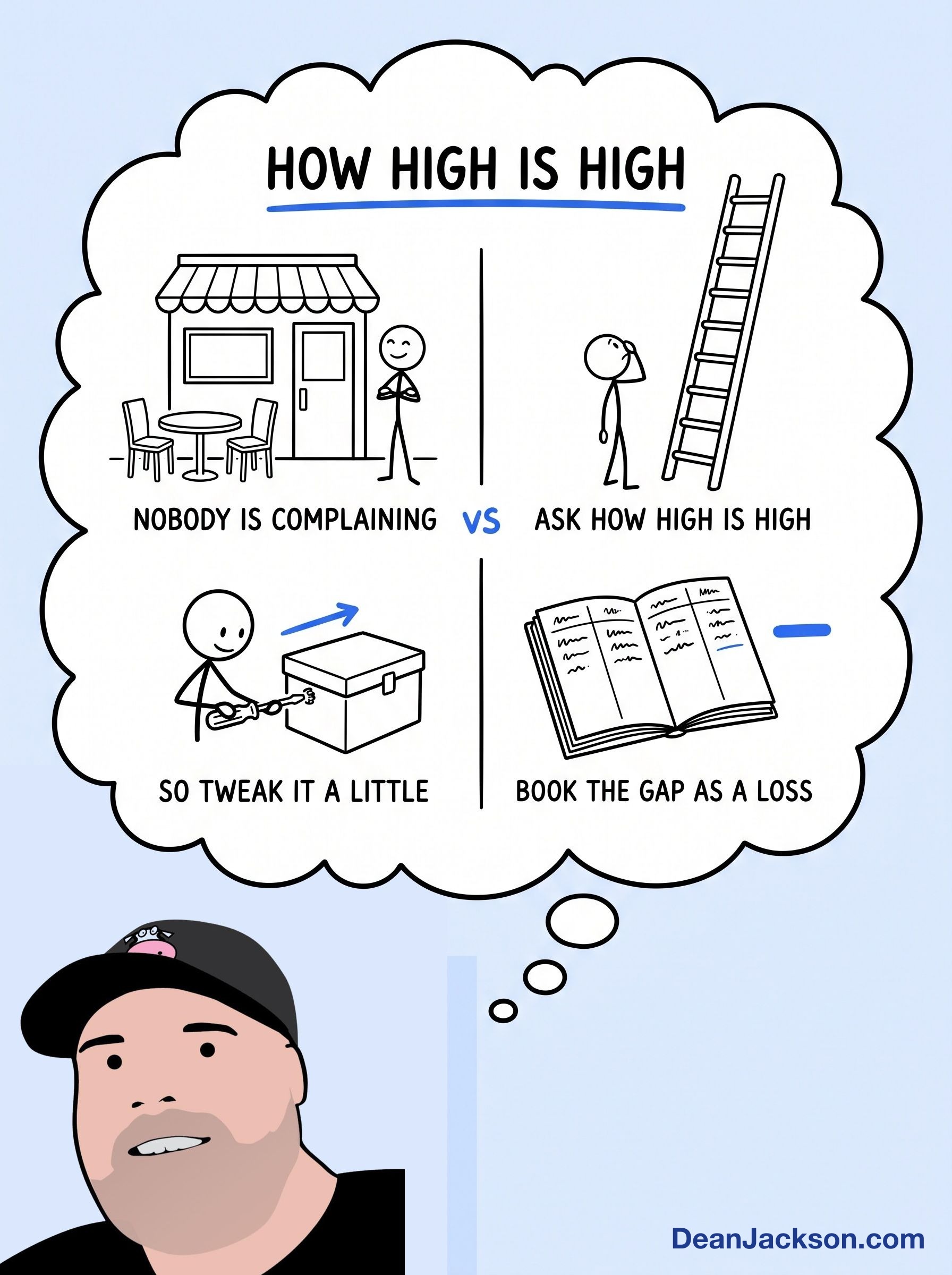
How high is high?
Not how do we improve this. What's actually possible here?
Take the restaurants.
They had a flagship restaurant that was perfectly serviceable. Profitable. Nobody was complaining about it.
Four million dollars a year.
And the reasonable question, the one almost everybody asks, is what could we do to lift this by twenty percent.
Gamal asked the other one. And he already knew the answer.
With a celebrity chef and a real destination restaurant, that same footprint could do eight million.
Here's the part I want you to sit with.
He booked the difference as a loss.
Not as an opportunity. Not as something to get to one day. In his mind, the hotel was losing four million dollars a year by not having that restaurant.
He took it to the board. They agreed. They ripped it out.
They partnered with Michael Mina and opened NobHill in exactly the same footprint.
First year... eleven million.
He'd been aiming at eight.
Now let's do it with yours.
You've got different buy buttons. Different things people pay you money for.
Look at each one on its own, the way he looked at each line item.
And ask how high is high.
Not what's realistic. What's possible, with the same framework you're already running?
And by the way, none of this means scaling past what you actually want. You're in control here.
It's your dream. You get to create exactly the business you want.
But carry this question through every line of what you do, and I think we're going to turn up some pretty big opportunities.
I got a funny email from Rick the other day. Dean, question. Are you saying you can teach me to make fat stacks by hanging out at a pub drinking coffee like you?
And I laughed to myself, because... yes. That's exactly what I do.
Every idea I've ever had, and every dollar I've made in thirty years, went through my brain and my pen and onto a journal page before it ever went out into the real world.
So I'm running the 50-Minute Profit Finder this Friday at 1pm. Free, live on Zoom, and I'll walk you through the exercise myself.
Bring a pen and something to write on. We'll go looking for the lowest hanging fruit in your business, and probably some fruit you didn't know was there.
And here's your nudge for today.
Take your biggest line item. Write down what it's doing now, and what it could be doing.
Then look at the gap between them... and call it what Gamal called it.
Transcript
Auto-generated transcript, provided as supporting material. It may contain errors, and speaker labels are occasionally mis-attributed.
How high is high? We want to think. We're here to talk about your business and we're here to find the extra profits that are hiding in your business right now. And this one idea will set the stage for how to think about your biggest ideas.
See, most people set a goal when they're thinking about their business for, you know, constant and neverending improvement. just improving things 20% at a time. Slow and steady wins the race. But in 2006, I was introduced to an approach that I still think about to this day.
0 magazine, which I don't even think is still around, but it featured a gentleman called Gamal Aziz. And Gamal was the head the GM of the MGM Grand Hotel. He just moved over there from the uh from Bellagio. And his first line of thinking when he went in was he looked at every line item, every profit contributor to the hotel.
You know, I don't know what the total revenue of the hotel was, but every line item, every category of revenue that came in, restaurants, gaming, hotels, entertainment, conventions, all of those things independently contributed to the total revenue of the MGM grant. Same thing for you. You've probably got different buy buttons that people pay you money for whatever your goods or products or services are. And when we look at each one of those, the question that he would ask is how high is high?
What's possible here? So for instance, he would look at restaurants and he knew from sitting in the lobby of the hotel greeting people in the entrance night after night. He would see them getting out of the hotel, getting into limos or taxis. He'd say, "Where are you going tonight?"
and they say we're going to Spago or we're going to Nou or we're going to Circus. Wherever they're going, these are destinations that they're heading to. Now, when he looked at their restaurants, they had nobody was complaining about their restaurants. They had a flagship restaurant that was perfectly serviceable.
They were doing $4 million a year in this uh in this restaurant. And no, it was profitable. Nobody was looking at it as a problem and nobody you know it might be reasonable to say what could we do to improve the profits here by 20%. But what Gamal did was he knew that if we had a celebrity chef and a destination restaurant, we could be doing $8 million a year in this same space.
So he went to the board, he explained his uh idea to them. They agreed. They ripped out the the restaurant. They partnered with Michael Mina.
They opened Knobill in the same footprint. And when they were out the first year, they did $11 million. What a radical idea of not starting to look at just what can we approve, looking at what is possible. But the distinction is that when he saw that they could be doing $8 million a year instead of four, he booked that as a loss.
In his mind, they were losing $4 million by not having a person, not having a celebrity chef, having a a destination restaurant. So, we're going to apply that thinking to your business today. And so I want you to start thinking first as a whole. What's possible for your business?
I mean, look around what what's possible. And by the way, you don't have to think about scaling beyond what you want. You're in control. It's your dream.
You get to create any business that you want. We can focus on creating exactly the business that you want. But how high is high? what's possible with the same framework that you're doing right now.
And I think you'll see if you start taking this and carrying it through, we're going to find some pretty big opportunities for you. So, I got a funny email the other day from Rick. It says, "Dean, question. Are you saying you can teach me to make fat stacks by hanging out at a pub drinking coffee like you?"
And I laughed to myself because I was thinking, you know, yes, I I can do that. That's what I do. Is the funny thing, what I really realized is that every idea that I've had, every dollar that I've made over the last 30 years has gone through my brain, through my pen, onto a piece of paper in my journal before it went out into the real world. And if I can turn people on to that activity as a driver for what to do, what to think about, what to ask yourself to draw out, what the next most valuable action is for you, and how to find the most profitable things that you can install in your business.
I'm all for it. So this Friday at 100 pm I'm going to do for the first time a 50inute profitfinder workshop and you're going to join me live on Zoom and we're going to go through a 50inute exercise. Bring your pen. Bring a notebook or piece of paper.
And I'm going to guide you through a thinking process that will help you identify where the lowest hanging fruit is in your business and maybe some fruit that you didn't even know was there. But I'm going to show you where to look for it. So, it's free. It's for you.
m. this Friday. Just watch. Go to What did we call the website, Josh?
>> 50inut profitfinder. m.
Get BreakthroughDNA Free
Discover the 8 Profit Activators that can transform your business. Get the complete framework, free.