How To Multiply the Value of Every First-Time Customer
Watch
Listen
Profit Activator 5, part two. Your During Unit isn't one transaction. Add a birthday club and a wine pairing, and the same hundred guests are worth more.
Good morning.
Day ten of Profit Activator week, and we're still on number five.
Yesterday was the storyboard. Every benchmark in your During Unit, and two questions at each one. Where's the wow, and where's the friction.
Today we layer something on top of it.
Because the way most people treat a new customer is as a transaction to get out of the way.
And the thing you want in your head, and in theirs, from the very first moment... is that this is a lifetime relationship.
There's more than one opportunity here.
Let me go back to the restaurant.
A hundred people come through tonight. Thirty dollar average ticket. That's a three thousand dollar night.
That's your million dollar restaurant model right there.
Now think like a multiplier.
Start with the asset. If you want those people in your After Unit, you have to know who they are.
I eat out constantly. I travel, I'm in restaurants all the time.
And almost nobody ever asks for my contact information. Nobody gives me any indication they'd like a relationship with me beyond tonight.
So go back to your benchmarks and look for the gap.
There's a lovely one in a restaurant. The order's been taken, the food is being made, and the server comes back to top up the water and tell you it won't be long.
Nothing is happening in that moment. It's just a gap.
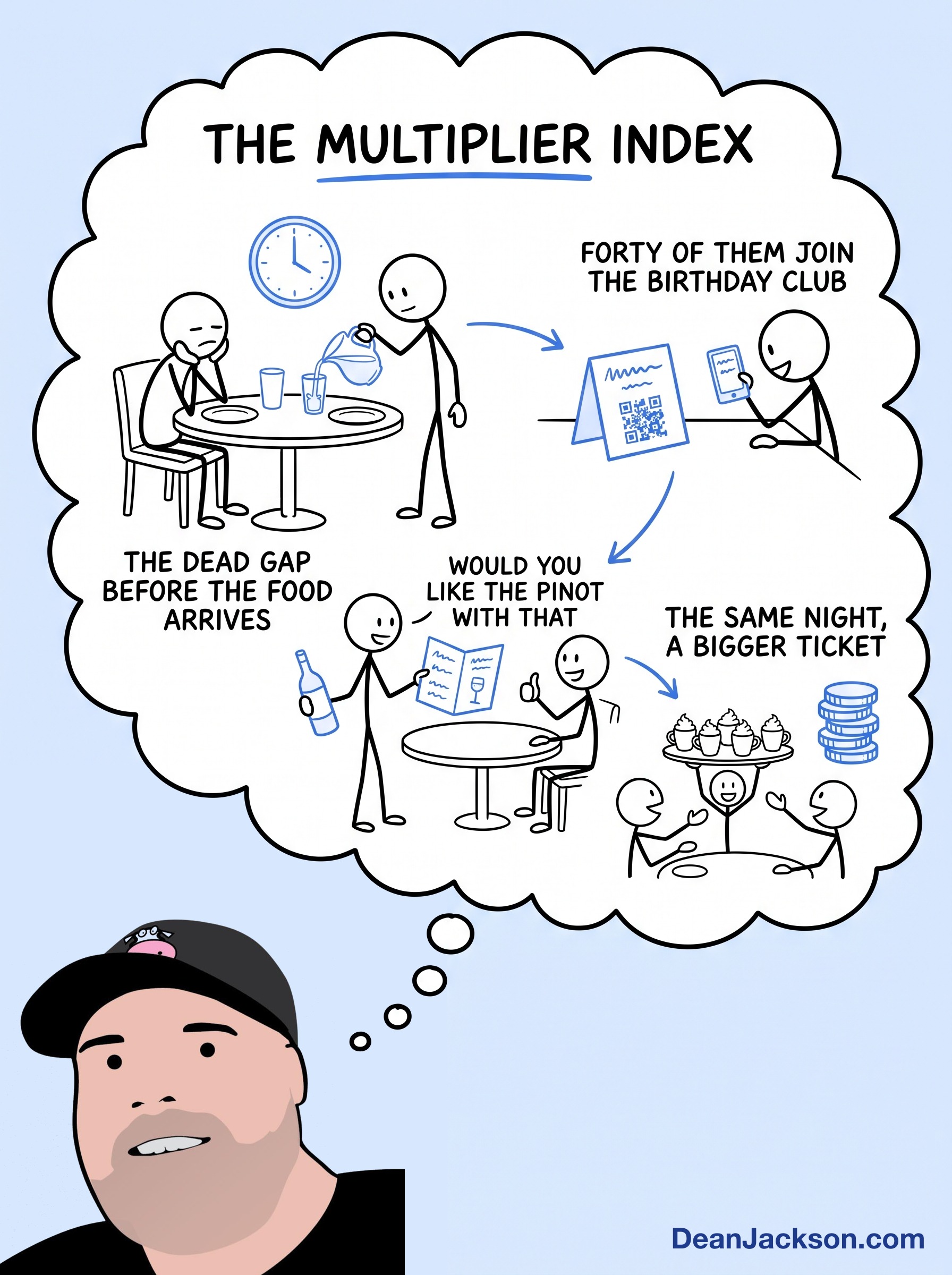
So fill it with the birthday club.
Join tonight, and we'll celebrate your birthday right now with some birthday cake for dessert... and you'll get a twenty dollar gift card on your actual birthday.
A tent card on the table with a QR code on it. That's the whole mechanic.
Now a hundred people come through and forty of them join.
That's your database. People with a name and an email who have already been in your restaurant and already enjoyed it.
Getting those people back is easy compared to finding a stranger.
Then you keep going down the timeline.
Next question. How do we get more people ordering wine, and ordering the better wine?
So you sit down with the chef, or the sommelier if you've got one, and you pair a wine to every entree. Printed right there on the menu beside the dish.
And when somebody orders the fish, the server says would you like the pinot with that?
A lot of people, presented with the idea, will simply say yes.
Now your average ticket goes from thirty dollars to thirty-six.
Same hundred people. Same night. Thirty-six hundred instead of three thousand.
Keep going.
Maybe you get known for one specific thing. The Olive Garden. Outback and the bloomin' onion. The appetizer or the dessert that people have to have.
I was in a restaurant that did this beautifully. Nobody wanted dessert... and then out came a tray of dessert shots. Little cups with a brownie and some whipped cream, little parfaits, two or three dollars each.
Suddenly everybody's saying oh, maybe just a bite. Maybe just one of those.
And the margins on those are wonderful.
None of that changes the food or the service. It's all layered on top of an experience people were already having.
That's the multiplier index. Where are the opportunities for more to happen, simply because somebody is doing business with you.
And the job title I'd like you to try on is guest experience architect.
Front of stage is the play. What people see and feel.
Back of stage is everything that has to happen to make the magic real. The systems, the processes, the assets. The tent card, the printed pairing, the sommelier's list.
You design the front, then you go and build the back.
There's so much richness sitting in your During Unit, and it's very rarely about doing the main thing better.
It's about seeing all the moments around it.
Tomorrow we carry it into the After Unit.
Here's your nudge for today.
Take the storyboard you wrote yesterday and find the gaps. The dead moments where nothing is happening.
Then pick one and add something. A way to get their contact information... or an easy yes worth six dollars.
Join me live on the next free 50-Minute Profit Finder call, Friday, October 30 at 1:00pm ET. Save your spot →
Transcript
Auto-generated transcript, provided as supporting material. It may contain errors, and speaker labels are occasionally mis-attributed.
Good morning. What if every time you get a new customer, they turn into two, three, four, or more transactions or different customers? That's possible. And that's what the the during unit profit activator 5 and the transition into profit activator 6 which is provide after sales service combine to make what we call the during unit.
Now yesterday we talked about the idea of creating and architecting a dream come true experience that people are going to rave about. We want you to kind of start by doing the ultimate scenario which is writing the review first and then setting up the systems to make that review possible. Now when we look at every time a new customer comes on board, part of your thinking needs to be that this is going to be a lifetime relationship that there is more than one transactional opportunity here. And you need to presence that both in your mind and in the minds of your customers that this is different.
This is not just a transactional let's get it out of the way type of thing, but that your intention is to create a lifetime customer out of them. And that's how we transition smoothly into the after unit. So, one of the ways that you can think about strategically multiplying every customer that goes through your during unit experience is to identify where are the opportunities to enhance this. So if we look at the when you're keeping score, when you kind of know what the the numbers are, the metrics are in your business, this becomes easier.
So I I outlined a restaurant experience yesterday when we're talking about the the dream come true from the moment somebody arrives at the restaurant to getting seated to uh getting their menus and getting ordered. The food comes, they enjoy the meal, they have dessert, they pay the check, and off they go. That little hour and a half or 2hour experience is your primary during unit. And we want people to have an amazing experience.
And maybe the sum of all of that turns into, you know, let's call it it's a $30 average ticket per person for that experience. So, you have a h 100red people come through, $30 average ticket, you've got a $3,000 night. That's your milliondoll restaurant model right there. Now, if you're thinking like a multiplier, if you're thinking about building a lifetime relationship with people, you're going to begin the process with that in mind.
So, if you're going to first of all build an asset of known people who like your restaurant and come there into the after unit, it's going to help to have contact information to know who they are. I eat out a lot. I travel a lot. I eat out at restaurants all the time.
And very very rarely do people ever ask for my contact information or offer any sort of indication that they're interested in having a lifetime relationship with me. So if you think about that as a primary asset, let's say that you look through the process and you start asking yourself where would be an opportunity for us to create this lifetime relationship with people. So, they arrive at the restaurant, they get seated, they get their order taken, and then there's a little period of time between when the order is taken and the food is being prepared and the server comes back to maybe refresh the water uh and just let assure you everything's on its way. What if in that moment in that little period vignette, we create the idea of a birthday club where if we were to say to people, you know, they come in, you you sit them down and you say your food will be right out.
In the meantime, um we have our birthday club and if we uh if you join the birthday club, we can celebrate your birthday tonight with some birthday cake for dessert and you get a $20 gift card on your birthday. Here's the cards for it. or point to a, you know, a a tent card on the table with a QR code that people can join the birthday club. And you think about now a h 100red people go through that experience and at the end of the night you've got your $3,000 plus maybe you get 20, 40, 50, 60 people to join the birthday club.
And now you've got the foundation for your database, your your content, uh, for your people that you could invite them back, you could send them a thank you email, you could, uh, text them, you could do whatever. You've got the name and the contact information of a visible prospect now or a visible active customer, somebody who came into your restaurant and enjoyed it. It's much easier to get people to come back that way. So, you do that for a few uh times.
You get everybody in line with that. And now you start layering on your CL your customer experience timeline. You start adding in the things that are the opportunities for you. So let's say that your next opportunity is to say how could we get more people ordering wine with their dinner and maybe ordering premium wines.
So maybe you have the menu and you get with the chef for somalier if you've got a somalier at the restaurant and you make a wine pairing for each of the entre. So now people arrive at the restaurant, they get seated, they take the order, they get presented the birthday club opportunity, but as people are ordering, when they order the fish, the uh server would right on the menu, you could have the recommended wine pairing with it and it could be recommended or prompted by the server that would you like the pino with that or would you like the malbeck with that? And that is a great opportunity that many people when just presented with an idea will take you up on that idea. So now let's say and instead of ordering the uh ordering the house red or a house white that maybe they order one of the premium wines that was recommended that's maybe a little bit more expensive than just the the house wine.
And so now at the end of the night, you've had a 100 people come through. You've got 40 people join the birthday club. And your average ticket went from $30 to $33 or $36. And now you've got $3600 instead of the $3,000 that you have.
And part of your job as this guest experience architect is to continually keep treating that storyboard of the experience for the opportunities that are going to make a big difference. Maybe you get known for a specific appetizer or a specific dessert that people rave about and must have. You look at restaurants, some restaurants are known for their appetizers. You think about the Olive Garden or the uh Outback chain with their bloom and onion that that's something that everybody has to have or some specific dessert that people have to have.
Or maybe it's an opportunity that when people are presented the opportunity for dessert that if they don't take the dessert, this actually happened in a restaurant that I was at. They came out with a tray of dessert shots. Little like little cups with a brownie and some uh whipped cream or some little parfait type things that were like two or $3 like little dessert things. And then all of a sudden everybody's like, "Oh, maybe just a bite.
Maybe just one of these." But you think about what that you know the margin on desserts like that are so high that looking and adding those things to your experience are amazing. You know, when we talk about your measuring this as a multiplier index, that's a great way to think about it is to recognize where are the opportunities for you to have additional things happen because somebody is doing business with you. That's an amazing uh opportunity.
So, you know, think like a guest experience architect. Think strategically about what the opportunities that you could use and then use your below the line architecture to create the systems and the processes and the assets that you would need to support that vision. You might think of it as front of stage and back of stage, right? that here's the play that's going on and here's all the things that have to happen behind the scenes to make that magic real.
So, there's so much richness in your during unit. And that's what I want you to really catch on to here. It's not just about one transaction. It's about setting the stage for a lifetime relationship and maximizing the experience that people are having with you.
Today I got a funny email the other day from Rick. It says, "Dean, question. Are you saying you can teach me to make fat stacks by hanging out at a pub drinking coffee like you?" And I laughed to myself because I was thinking, you know, yes, I I can do that.
That's what I do. is the funny thing. What I really realized is that every idea that I've had, every dollar that I've made over the last 30 years has gone through my brain, through my pen onto a piece of paper in my journal before it went out into the real world. And if I can turn people on to that activity as a driver for what to do, what to think about, what to ask yourself to draw out, what the next most valuable action is for you, and how to find the most profitable things that you can install in your business.
I'm all for it. So this Friday at 100 pm I'm going to do for the first time a 50inute profitfinder workshop and you're going to join me live on Zoom and we're going to go through a 50inute exercise. Bring your pen. Bring a notebook or piece of paper.
And I'm going to guide you through a thinking process that will help you identify where the lowest hanging fruit is in your business and maybe some fruit that you didn't even know was there. But I'm going to show you where to look for it. So, it's free. It's for you.
m. this Friday. Just watch. Go to What did we call the website, Josh?
>> 50inut profitfinder. m.
Get BreakthroughDNA Free
Discover the 8 Profit Activators that can transform your business. Get the complete framework, free.